
Here is an exceptionally easy argument to make:
- Mass migration is ensuring that the historical majority in Britain is becoming a minority.
- This is the result of policies that have been pursued regardless of popular opinion.
- This has had many kinds of destructive consequences.
The first claim is so obviously true that one might as well deny the greenness of the grass. The second is proven by decades of broken promises (see Anthony Bowles’s article “Immigration and Consent” for more). The third requires argumentation, but I think that it is clear if one considers hideous incidences of terrorism, grooming gangs and violent censoriousness, as well as broader trends of economic dependency and electoral sectarianism.
Again, this is not a difficult argument to make. So why is it made so badly?
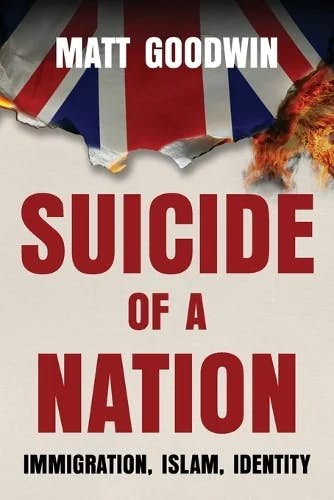
Matt Goodwin’s Suicide of a Nation is a very bad book. It reads like the book of a political operator extending his CV. The left-wing commentator Andy Twelves caused a stir on social media by pointing out various factual mistakes and what appear to be non-existent quotes. Twelves speculates that these “quotes” are the result of AI hallucinations, which is plausible, if not proven, in the light of the fact that two of Mr Goodwin’s sparse footnotes contain source information from ChatGPT.
Inasmuch as Suicide of a Nation makes a form of the argument sketched out the beginning of this article, there is truth to it. But it contains a fundamental problem — it assumes that this argument is so true that there is no requirement to make it well.
“Slop” is an overused term but it feels painfully appropriate for a book that is spoon fed to its audience. Goodwin, who had a long academic career before becoming a successful commentator, is not a man who lacks intelligence. But he writes as if he thinks his audience lacks it. “I did not write this book for the ruling class,” writes Goodwin, “I wrote it for the forgotten majority.” Alas, he seems to think that the average member of the “forgotten majority” has the reading level of a dimwitted 12-year-old. As well as being stylistically simple, the book is full of annoying paternal asides. “In the pages ahead I shall walk you through what is happening to the country …” “In the next chapter we will begin our journey …” Thank you, Mr Goodwin. Can we stop for ice cream?
The book is terribly derivative, with a title that reflects Pat Buchanan’s Suicide of a Superpower and a subtitle — “Immigration, Islam, Identity” — that all but repeats that of Douglas Murray’s The Strange Death of Europe — “Immigration, Identity, Islam”. It is written in the humourless and colourless rhetorical style of AI. I’m not saying it was AI-generated. (Indeed, a brief assessment using AI checkers suggests that it was not.) I’m just saying that it might as well have been.
There is a lot of highly dubious sourcing. Mr Twelves did not exhaust the number of questionable quotes in the book. “A nation that cannot defend its borders,” Goodwin claims the Roman historian Livy wrote, “Will soon cease to be a nation.” I can find no record of this quote. “Language is the tie that connects past with future, and binds together the citizens of the same nation,” Goodwin claims the lexicographer Noah Webster wrote. Again, I can find no record of this quote. To be fair, perhaps Goodwin has one — but he should have included more footnotes. He’s an academic! How did this not occur to him?
The writing is lazy. Goodwin, for example, twice refers to “the Canadian psychologist Gad Saad” within forty pages. (Thank God — I would have thought it was a different Gad Saad.) But the arguments are also lazy. “Would countries such as China, Saudi Arabia or Japan tolerate this?” Goodwin asks, after listing a series of crimes committed by asylum seekers, “No. Only Britain’s elites are this deranged.” Germany’s? Sweden’s?
What makes all this so strange is that it is so unnecessary. This should not have been a book that was difficult to write thoroughly and effectively. Again, I can only assume that Goodwin does not feel as if he has to make the argument well. His apparently abundant sales suggest that in cold economic terms this might be true.
Why? One explanation that occurs to me is that the right is unusually post-literate. Its success, in marketing terms, has been more prominent in the realms of social media and, especially, podcasts. The right has developed a formidable podcasting ecosphere, in which Goodwin is a major player, where the failure to systematically articulate one’s perspective is less obvious. A book, with this in mind, could almost be an afterthought — an excuse for generating more podcasts.
Secondly, the spectre of political correctness provides a built-in excuse for poor argumentation. “The elites will attack me because I wrote this for you,” writes Goodwin, “They will call me every name under the sun because I dare to tell you the truth.” On Twitter, Goodwin is already claiming that the left is “having a meltdown” — “cherry-picking” and “misrepresenting”. “Ignore the losers on the Left,” writes Goodwin, “Read it for yourself.” We should read books for ourselves. But we should also read critiques for alternative assessments. That we should ignore censoriousness does not excuse ignoring criticism.
Finally, and most generously, perhaps people have a sense that urgent truths should be communicated plainly and directly. Of course, there is something to this. Arguments, in many cases, should be clear and accessible. But this should never come at the expense of accuracy (what is Goodwin claiming to provide if not the truth?). Nor should it entail dumbing down complex issues (and what should be done about the state of Britain is complex, as Goodwin surely realises since he has spent much of the past months arguing with members of the nationalist party “Restore”).
Besides, call it idealistic but I just don’t think a book that claims to defend British culture should be so short on eloquence, wit, scholarship, poetry et cetera. British culture is pretty meaningless if it has the literary standards of ChatGPT and the argumentative standards of a telemarketer. Goodwin is talking about major issues here — tremendous demographic and cultural change, democratic dysfunction, and societal pathologies — but to do it so carelessly diminishes their status rather than inspiring or persuading people. The narrative around Suicide of a Nation has nothing to do with immigration, Islam and identity but with its stylistic and argumentative deficiencies — and the sad truth is that the author can hardly complain when there are so many of them. The lesson for his colleagues in Reform is not to let short-term popularity make them complacent when it comes to political and intellectual seriousness.