This article is taken from the December-January 2026 issue of The Critic. To get the full magazine why not subscribe? Get five issues for just £25.
Last week, I was at work and I went to the gents but the urinals overlooked a large amphitheatre. I was suddenly aware of being much less clothed than necessary. Urine was pooling around my feet and also, now, around the treasured possessions and much-loved pets of people who had suddenly sprung up around me.
A crowd gathered. I knew many of them, colleagues and friends disgusted by my deviant behaviour and the indignities I had visited on them. A high reedy voice in the crowd said that a senior university man should know better, and there was a hum of disapproving agreement with that sentiment. I started to stammer out an explanation but what explanation was there? Then I woke up.
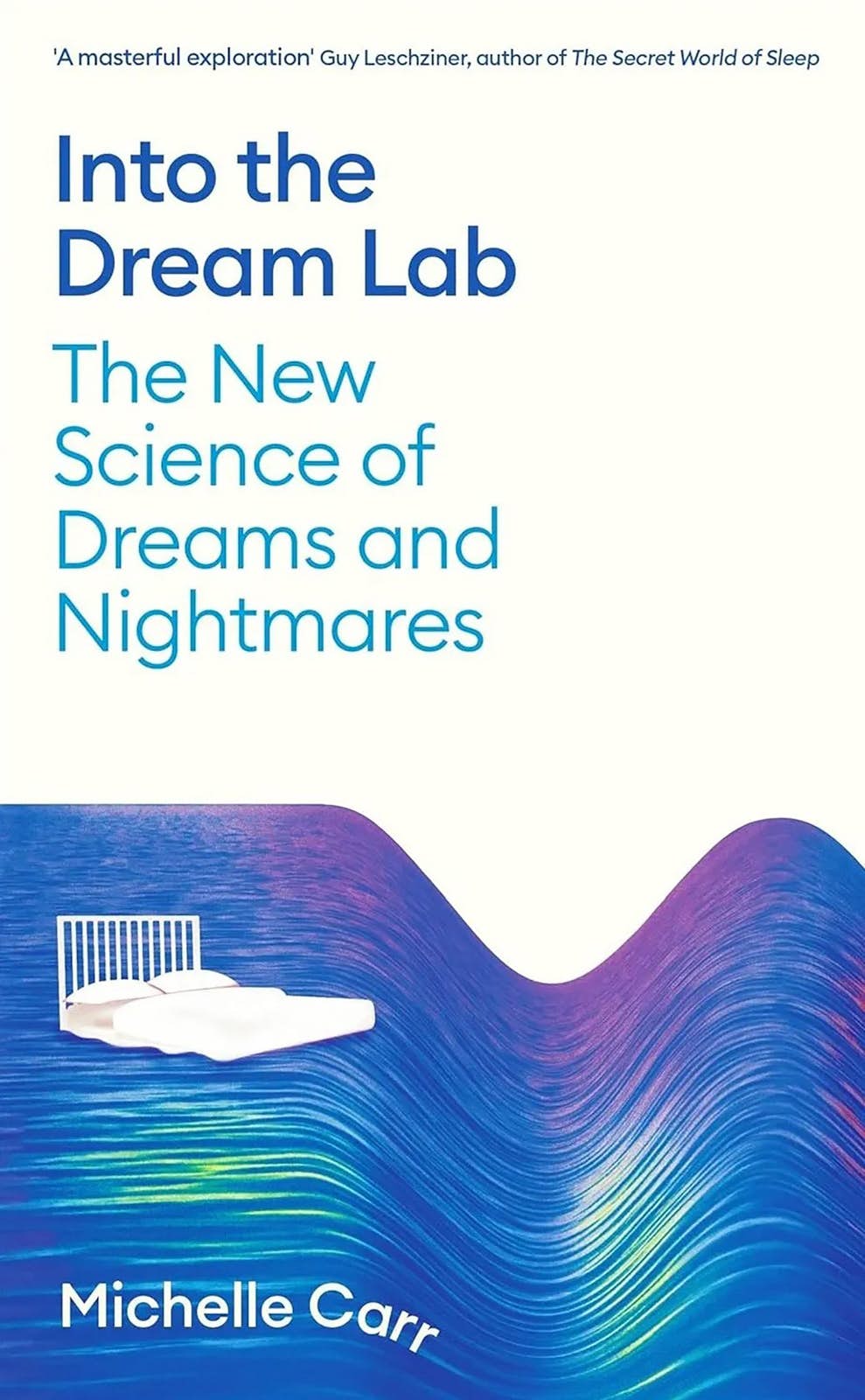
“What an intriguing subconscious landscape I have,” I thought, “a true creative, a genius maybe.” Wrong. New rooms in the house, teeth falling out, being chased — it is bog-standard dream fare, as laid out in the opening pages of Dr Michelle Carr’s new book. Into the Dream Lab explores questions such as why we dream at all and what is going in our brains whilst we do. A key theme is the science of how nightmares arise, why they may become recurrent and what can be done to alleviate the distress this causes.
The opening section deals with questions that probably interest everyone. Surely we all wake up at some point wondering, “Why did my brain decide to blend inconsequential details from my childhood with yesterday’s work meeting? Why did the action all take place at sea? Why did I dream about doing an arduous manual task all night with the result that I now feel exhausted?”
Part One is an informative and sometimes entertaining journey through these questions. We learn how common dream themes cut across the vast difference in the waking lives of humans. “Dreams are consistently social in nature, encouraging dreamers to freshly reengage with people, even strangers, from their waking lives,” Carr tells us, highlighting one theory that they have a physiological function for us to replay and “rehearse” scenes from our waking lives in order to shape and refine our social interactions when awake.
This is also true of practical tasks performed pre- and post-sleep in the laboratory setting. Those who dream of the task, such as a Tetris-like game, seem to be better at it the next day. Thus, Carr says, “dreams are often informative in nature, fashioned around a theme of skill rehearsal or achievement”.
Such research is enabled by the world’s many academic sleep labs where volunteers slumber whilst the researchers monitor their brain activity and physical movements — albeit with the confounding problem that many have dreams about being in a sleep lab. Techniques used to monitor brain and body function during sleep mean the field is evolving rapidly.
They include the “high density EEG”, which uses hundreds of scalp electrodes to capture detailed electrical brain signals. This, aided by metabolic tracers to monitor brain blood flow, gives interesting insights into the activity and connectivity of different brain regions during varied phases of sleep, especially Rapid Eye Movement (REM) sleep when most dreaming occurs.
One of the book’s most fascinating sections explores how, even when we are awake, some parts of our brain can be in a state that resembles sleep much more than wakefulness, mapping out and formalising the vague concept of what daydreaming means. Research such as this can put an empirical framework on the theory of why we dream, and why it might be evolutionarily useful to remember dreams.
The theory is that the apparent weirdness of dreams, in which seemingly unconnected events are pieced together, helps us sift through important memories, connecting things that our waking brains may not automatically put together. This strengthens these memories whilst sieving out less important details.
Disassociation also appears to be important: dreaming about painful or traumatic events may be coupled with more pleasant, entirely neutral or seemingly unconnected events in order to dilute them and make them easier to live with.
Some physiological basis for this may lie in the fact that many parts of the brain that generate strong emotional, even primal responses, such as the amygdala, are suppressed by our higher-processing cortical centres. The result is that painful memories are replayed in the context of a much lower emotional backdrop, with slowed breathing and a suppressed heart rate. In this framing, dreams allow us to resolve negative emotions and move on. Maybe healthy dreaming is doing what expensive therapy tries to achieve for us when awake.
This process seems to break down in the setting of recurrent nightmares, where “repetitive and highly emotional content recurs and lacks the novelty and creativity of normal dreams”. Here the amygdala’s high-intensity emotional churn is not suppressed; the experience is not diluted with unrelated content or dissipated amidst comatose calm.
Part Two deals with how nightmares can be treated with a variety of innovative psychological techniques for taking the heat out of these spiralling nocturnal hellscapes such as in post-traumatic stress disorder. This was news to me. Like many doctors, I am apt to respond to talk of nightmares with, “Returning to the matter of your kidneys … ”
However, much of this section reads like a grant application, so I found myself drifting into committee mode: “Well, that’s a small study, that’s a case report, maybe the nightmares are getting better because someone is paying attention.” Sometimes, the point is stretched rather thin: it may or may not be true that nightmares can precede a flare of lupus, but it’s a big call to commit someone to heavy-duty side-effect-laden treatment on this basis.
Things liven up again on the matter of lucid dreaming and the many tips about how to intentionally control a dream. This is fun stuff, though I suspect your engagement with it depends on whether you want to be the Tarantino of your nights or whether you are happy to let the chips fall unconsciously where they may.
If you fancy the former, this book is for you. I did reflect that two of my close friends experience chasing dreams where they are the chaser. Dr Carr doesn’t touch on this but … it can’t be good, can it?
The NHS-worn old cynic tends to think, “Well, dreams are just that aren’t they?” After all, dreaming doesn’t have those highlight-reel knockout moments of, say, a popular science book on cancer or infection: “It was then that Septimus Thackeray recognised that his tincture could only mean penicillibrillium — the antibiotic that could kill everything.” But dreams are a beguiling subject, and this book throws up much to contemplate, awake and asleep.