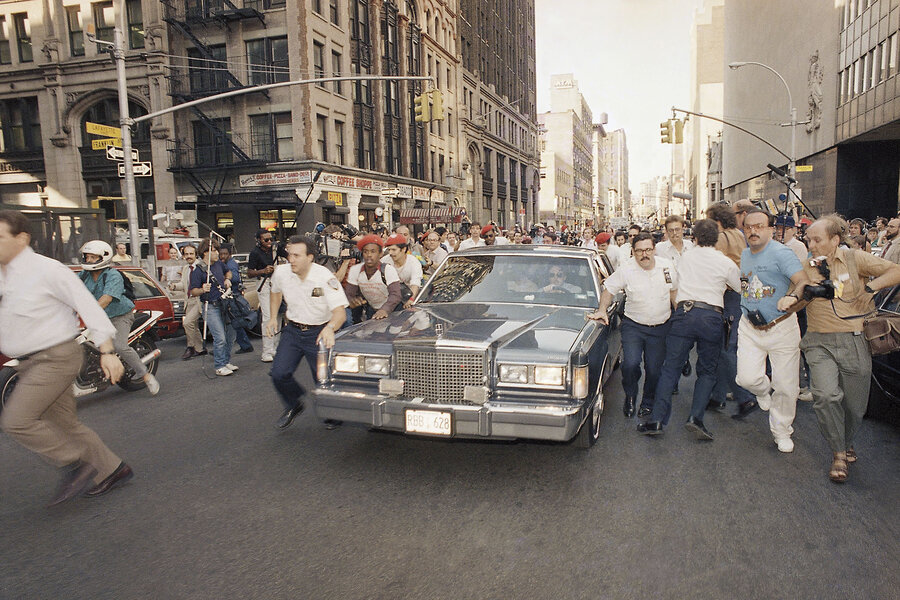
On Dec. 22, 1984, a white man shot four Black teenagers in a New York City subway car, later claiming he believed they were about to rob him. The man, Bernhard Goetz, was dubbed the “subway vigilante,” and at a time of soaring crime rates, he received remarkable public support. Meanwhile, the teens – Barry Allen, Darrell Cabey, Troy Canty, and James Ramseur – were regarded not as victims but as thugs and predators.
Two excellent new books offer powerful yet distinct takes on the subway shootings. In “Fear and Fury: The Reagan Eighties, the Bernie Goetz Shootings, and the Rebirth of White Rage,” Pulitzer Prize-winning historian Heather Ann Thompson explores the episode’s roots in the period’s stark racial and economic divisions and argues that the incident has had a pernicious effect on our contemporary political culture. In “Five Bullets: The Story of Bernie Goetz, New York’s Explosive ’80s, and the Subway Vigilante Trial That Divided the Nation,” Elliot Williams, a CNN legal analyst and former federal prosecutor, is primarily concerned with the case’s legal dimensions.
Both books are deeply researched, providing detailed accounts of the circumstances leading up to the violence, the shootings themselves, and their aftermath. They paint similar pictures of Goetz, a loner who, in Williams’ words, was long “frustrated by what he regarded as the city’s failures to fight crime and mess.” Both authors report that at a 1980 meeting of his building’s tenants’ association, Goetz shocked his neighbors by using racial epithets to blame Blacks and Hispanics for New York’s problems. After being mugged in 1981, he applied for, and was denied, a gun permit; he began illegally carrying a concealed weapon.

Why We Wrote This
The Bernhard Goetz trial in New York grabbed national headlines at a time when crime was a major concern. Two books capture the social and legal fissures that the case laid bare.
Thompson offers a sympathetic portrayal of the 18- and 19-year-old victims, describing their difficult lives in the face of gutted social services and the scourge of crack cocaine in their public housing development in the South Bronx. (For his part, Williams is critical of those who, over the years, have “strained to defend” Allen, Cabey, Canty, and Ramseur, each of whom had run-ins with the law before the shootings.) The four were on their way to steal quarters from a Manhattan video arcade by jimmying open the coin boxes with screwdrivers. They knew they would be less likely to arouse suspicion if they had some cash to spend on the arcade’s games.
After Goetz boarded the train, Canty asked him for $5. As Williams writes, “Whether the words said to Goetz were a question, a demand, a violent threat, an order, or just a casual statement, we will never know.” Goetz immediately drew his gun and fired on the teenagers, leaving all of them injured and rendering Cabey permanently disabled.
Thompson calls the crime “Christmas come early” for New York City’s rival tabloids. She and Williams both cover the intense competition between the New York Daily News and the New York Post; the latter had been purchased by Rupert Murdoch in 1976. The papers fed their readers a steady stream of salacious – and often inaccurate – details in the case. They played an outsize role in shaping public opinion, even during the nine days before Goetz turned himself in, when many of the facts were unknown. (Within days, the Daily News had referred to the unidentified gunman as “an instant hero.”) Some media outlets falsely reported that the tools that two of the teenagers had been carrying in their pockets to rob the arcade were sharpened screwdrivers that they brandished at Goetz.

Goetz eventually stood trial on charges including attempted murder and reckless endangerment. The prosecution had strong evidence, including witnesses who reported that the teenagers on the subway were rowdy but not menacing. The jury also watched Goetz’s chilling videotaped confession.
Still, in the end, the overwhelmingly white jury was convinced by the defense’s portrayal of Goetz as, in Thompson’s words, “a ‘fed up’ Everyman.” As Williams writes, “The jury saw themselves in Goetz.” He was convicted only of a weapons charge and served eight months in prison. In 1996, a civil jury found Goetz liable for Cabey’s injuries. He was ordered to pay Cabey $43 million, but he declared bankruptcy.
Williams has a firm command of the case’s legal issues. He also observes that the law doesn’t exist in a vacuum, noting that politics and public opinion often affect the workings of the justice system. “It is possible that Goetz’s acquittal on violent crime charges was legally defensible but not just; supported by law but not morality,” he concludes.

Unlike Thompson, who based her account on archival materials, Williams interviewed most of the surviving major players – although not the two living victims of the four who were shot – including the attorneys, the judge, and, notably, Goetz himself. Goetz has remained unrepentant over the years.
As a historian, Thompson is interested in the long shadow of these events of four decades ago. She draws a line from Murdoch’s New York Post to Fox News, the crown of his media empire, arguing that Fox has provided a largely white conservative viewership “a constant feedback loop of resentment.”
Most significantly, Thompson posits that the shootings “unleashed and normalized a new era of racialized rage.” She sees the influence of the Goetz case in the spread of what are often called “stand your ground” state laws and in the actions of George Zimmerman, Kyle Rittenhouse, and Daniel Penny – all, in her words, “ordinary men” who “[meted] out extralegal punishment” and were subsequently acquitted of most or all of the charges against them.
Finally, she sees echoes of the subway vigilante saga in the political success of Donald Trump, who was himself a prominent figure in 1980s New York. In fact, Thompson put aside another book she was working on in order to write about Goetz precisely because she saw the racial anxieties revealed by the case as key to understanding Trump’s return to power. Mentioning the Jan. 6, 2021, storming of the U.S. Capitol and President Trump’s subsequent pardons of the rioters, Thompson suggests that taken to their extremes, fear and fury can threaten democracy itself.