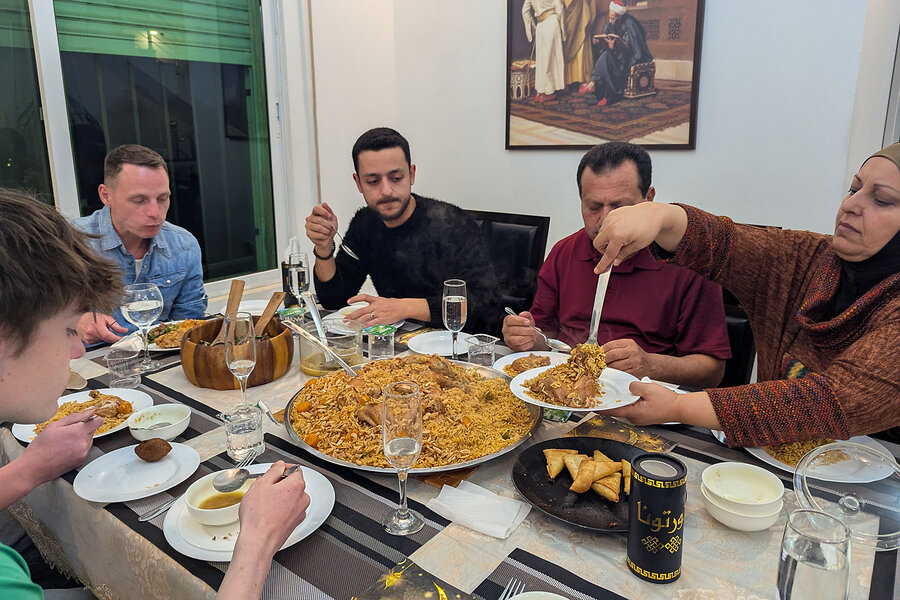
Around a full table neatly laid out with fine china and napkins depicting a golden crescent moon and lanterns – symbols of the Islamic holy month of Ramadan – the war raging across the Middle East feels distant.
Tourist Jens Kalenka and university classmates Rory Flynn and Freddie Mulder settle onto the sofas in Hamza Alkhlaifat’s living room in northern Amman the night before – finally – they were to board flights back home to Germany and the United Kingdom, respectively.
As they wait for the sunset adhan, or call to prayer, to announce the end of the daylong fast, Jordanian fighter jets swoosh low overhead, followed by the faint boom of interceptors knocking down an Iranian projectile, gently rattling the windows.
Why We Wrote This
In Jordan, a country well-known for its hospitality, locals are inviting stranded foreigners to break-the-fast evening Ramadan meals amid the stress of war.
“Was that a hit?” asks Mr. Mulder, mildly intrigued – now used to the noise after days of conflict.
“You are safe in your second home. Ramadan Kareem,” Mr. Alkhlaifat says, smiling and using this common expression of the holiday, which translates to “generous Ramadan.”

Courtesy of Hamza Alkhlaifat
As thousands of foreigners have been stranded in Jordan because of canceled flights in the wake of the U.S.-Israeli war against Iran, Jordanians throughout the kingdom are approaching non-Jordanians with invitations to iftars, the evening meal Muslims eat to break their daily fast during the holy month of Ramadan.
The eruption of war coincided with Ramadan – when Muslims around the world fast from sunrise to sunset – bringing to the fore a medley of Arab and Islamic values: hospitality, charity, helping strangers, offering safe havens, and solidarity with the less fortunate. These principles have been expressed in Gulf states by governments paying for the hotel stays and meals of stranded travelers.
Jordanians have proudly and warmly embraced waves of refugees pushed into this kingdom by neighboring wars over the years, and they are once again opening up their homes and hearts to people upended by conflict.
A host in Amman
One of the more viral examples of Jordanian hospitality is that of Mr. Alkhlaifat, a university student, influencer, and cultural ambassador who has been holding iftars with foreign visitors in Jordan for the past five years and promoting cultural exchanges through Instagram and his Amman “Beit al-Karam” (House of Generosity) homestays.
This year, he has spent Ramadan patrolling Amman’s streets for foreign visitors and posting public invitations on social media telling all stranded travelers that they have a place to stay and a meal at his home.
At his iftar table Friday was Mr. Kalenka, a local government worker from Dresden touring Jordan, whose stay in the kingdom was extended by three days before securing a flight out.
Mr. Kalenka was walking with Mr. Alkhlaifat, whom he had contacted on Instagram to show him the hidden gems of the capital, when the first air sirens blared in Jordan Feb. 28 announcing Iranian retaliations against Jordan – a U.S. ally – for the joint American-Israeli offensive on Iran.

“I asked, ‘Should I be worried? Should we seek shelter?’” Mr. Kalenka recalls.
Mr. Alkhlaifat turned to him and said, “Don’t worry, you’re safe,” and, in the same breath, “Come and have iftar with my family.”
In offering seats at the iftar table, Jordanians are also providing community and comfort during this time of regional war.
“Foreign visitors are stranded on their own during a regional crisis in a place where they don’t really know someone or speak the language, and I can understand how scary that can be,” says Mr. Alkhlaifat.
“I want to show people that they are not alone.”
Sharing a meal
Under the specter of war, Mr. Kalenka continued his visit across the kingdom, on to the World Heritage Sites of the hand-carved Nabatean city of Petra and the deserts of Wadi Rum.
“Everywhere I went in Jordan people were inviting me to iftar … you wouldn’t experience this kind of generosity in Germany,” Mr. Kalenka says. “I had heard Ramadan was a special experience, but I had no idea how special it would be.”
At Friday’s iftar, cooked up by Mr. Alkhlaifat’s mother, Um Hamza, a spread of spiced chicken kabseh rice, cheese-stuffed sambusek pastries, and salad was lavishly spread across their dining room table.
As the sun sets, Mr. Alkhlaifat and his parents eagerly serve their guests.
“Even if we didn’t have guests and we were on our own, we would call neighbors and friends over to break fast with us,” Um Hamza says as she ladles lentil soup for her guests. “This is the spirit of Ramadan. People gathering, enjoying each other’s company.”
Mr. Flynn and Mr. Mulder, two non-Muslim students at the University of Bristol who took budget flights to Jordan on a lark, were approached in the streets of Amman by Mr. Alkhlaifat, who insisted they join him for iftar in his home – an exchange that went viral.
For Mr. Alkhlaifat, the conflict was a calling – to show the “real side” of Jordan.

Courtesy of Hamza Alkhlaifat
“Even before this war, people thought Jordan was in a war,” Mr. Alkhlaifat says, noting how crises in neighboring Syria and nearby Gaza gave some foreigners the misconception that the steady and stable kingdom of Jordan was in the heart of a war zone.
“I have been working to show that Jordan is a peaceful country,” he says. “We want to show that Ramadan is about gathering around the table, about people. Just like Jordan itself.”
Mohammed Hussein, a financier in Amman, has also been hosting iftars in his home for his foreign colleagues and friends, offering his guest room to those who need a place to stay each night since the war started.
“Ramadan is not just about a meal and prayer, it is about community,” he says. “And community doesn’t stop at your family or the people that pray at your mosque. All the people of this world; we are one human community and we must show up for one another.”
A sweet ending to an uncertain time
Some 12 hours before their flights were to depart, Mr. Alkhlaifat’s guests enjoyed one last treat: qatayef, the Ramadan-staple sweet served in the Levant and Egypt.
Um Hamza carries up platters of the spongy pancakes folded over in the shape of a crescent moon, lightly fried and dipped in a simple syrup. They are crispy sweet on the outside, revealing savory-sweet fillings of sugar, rosewater, and melted sheep’s cheese or crushed nuts on the inside.
After protesting that they were too full, each guest takes one qatayef, then two, then three.
The guests shared similar feelings: fullness, safety, and a deep desire to one day return to Jordan.
“This is one thing I will take with me,” Mr. Mulder says. “Ramadan is not just fasting and eating. It is people who make the holiday.”