Nigel Farage has a big problem, and his name is Donald Trump.
The leader of Reform UK genuinely likes and admires the American President. He counts himself as a friend, and mourned a brief falling out with him a few years ago. He stood by Trump when he was being hauled through the courts by Democratic Party prosecutors.
No doubt he enjoys being close to the most powerful man in the world. But if it were merely a marriage of convenience it could be easily broken. Farage’s ties with Trump go deep.
The unpredictable President is waging a futile war that threatens to plunge the world into recession. His popularity is sagging in the US. It’s worse here. In a recent poll, 73 per cent of Britons had an unfavourable view of Trump. These people include many prospective Reform voters.
I suppose it’s just about possible that Trump will pull off a miracle, and bring a swift end to the war against Iran on terms that are favourable to the West. But it seems much more likely that we are all going to suffer for a long time for his rash and ill-considered action.
Every time we go to the petrol station or look at our latest gas bill, many of us will blame Trump. If there should be shortages in supermarkets, blame could turn to hatred. That wouldn’t be good for Farage, who is identified in the public mind as Trump’s leading British cheerleader.
And it’s not just about the rising cost of living. Some people may enjoy Trump’s sallies against Sir Keir Starmer, which are increasing in number. But almost no one appreciates his crass rudeness about the British armed forces – certainly not patriotic ex-Labour voters thinking of voting Reform.
Most outrageous was his assertion two months ago that some Nato troops ‘stayed a little back, a little off the front lines’ in Afghanistan. Since Britain was America’s foremost partner in that conflict (and lost 457 military personnel) this was interpreted as an unjustified dig at America’s closest ally.
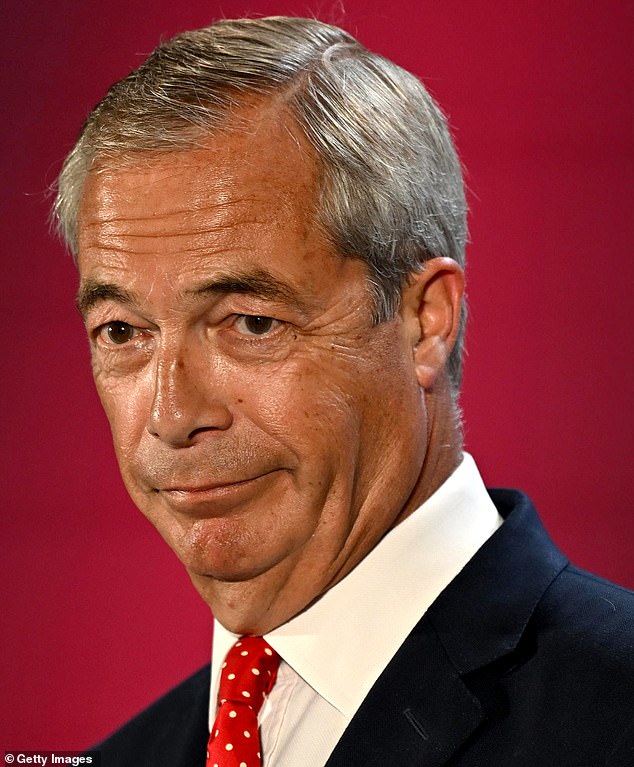
Nigel Farage needs to move out of Trump’s orbit, and demonstrate both to critics and doubters that he is not at all the same kind of politician, writes Stephen Glover
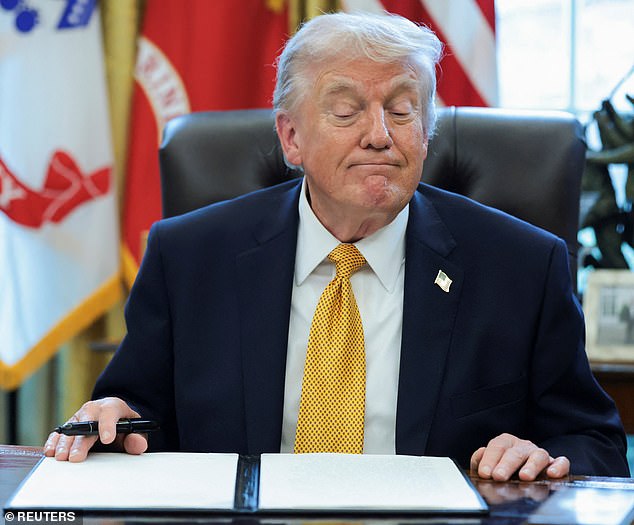
Donald Trump is ‘the biggest barrier to people voting Reform,’ according to research by Luke Tryl, executive director of think-tank More in Common
Trump’s latest slur came last week, when he described Britain’s two aircraft carriers as ‘toys’. They may not be as formidable as America’s carriers, and it is unfortunate that both of them have spent so much of their lives being repaired. But they are very far from being toys.
Does Nigel Farage realise the danger he is in? I am sure he does, since he is a highly intelligent man, and some people inside Reform (where there is widespread scepticism about Trump’s war) will be warning him. He has tempered his initial support, probably because he realises the war may end badly.
At the beginning he was enthusiastic, saying that although he was ‘incredibly nervous about intervening in foreign wars’ he believed that this was ‘the right one.’ In an interview with the New Statesman he unwisely suggested that Iran ‘potentially poses a bigger danger than Putin poses to us’.
But as things began to go wrong, and Trump contradicted himself almost hourly, Farage grew more cautious, saying ‘let’s not get ourselves involved in another foreign war’.
Since then he has said remarkably little about events in the Middle East, which is odd when most politicians are talking about little else, and many voters are alarmed. Three weeks ago he made a brief visit to Florida as a member of the Mar-a-Lago club, which is owned by Donald Trump.
He didn’t see the President, who was staying about an hour’s drive away at his hotel in Doral. This was not necessarily a snub. There have been other occasions in the recent past when Farage has visited Mar-a-Lago without seeing Trump. That said, it wasn’t exactly a show of affection on Trump’s part.
And that is far from being a bad thing. From Farage’s point of view, any distance he can put between himself and the President is very likely to be to his political advantage.
Reform has recently slipped in the polls. The party now averages about 26 per cent, down from highs of around 31 per cent last October. There are probably several factors, but Nigel Farage would be foolish to dismiss the idea that his association with the increasingly disliked President is one of them.
Indeed, according to Luke Tryl, executive director of the More in Common think-tank and polling organisation, all of his research shows that ‘the biggest barrier to people voting Reform is Trump’.
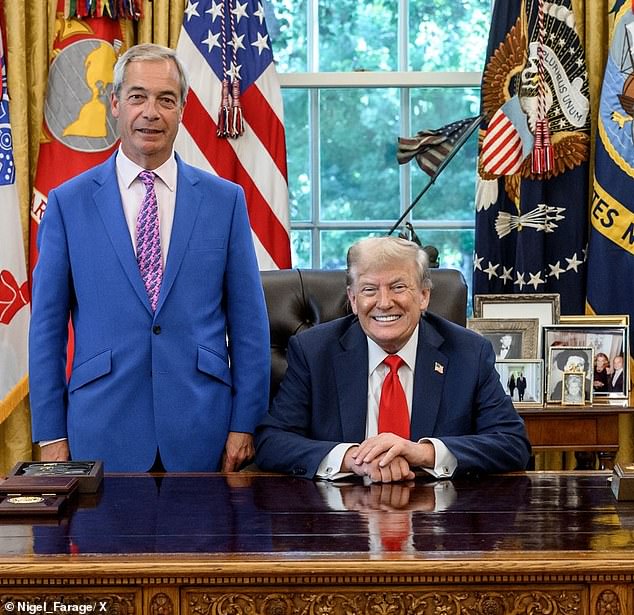
Reform leader Farage and the US President in the Oval Office at the White House last year
Can Nigel Farage bring himself to criticise Trump sincerely, not just about the war but all manner of excesses and absurdities in other areas that repel many voters who might vote Reform?
Or is he so bound to the horror in the White House, so fundamentally aligned to Trumpian values, that he will be unable to break free and convince voters that he isn’t a British re-tread of Trump?
Farage recently said: ‘He [Trump] is a friend of mine. I agree with many things he does. I don’t agree with other things he does.’ The trouble is that voters hear much more about the points of agreement than the points of disagreement.
Nor is the issue exclusively the degree to which the two men see, or don’t see, eye to eye. There is something too submissive about Farage’s attitude towards Trump – witness his frequent visits to his court, and his evident joy when photographed next to him.
I agree that Starmer’s obsequious conduct towards the overbearing President is even more distasteful since he is the Prime Minister of the United Kingdom. In the end, of course, his cringe-making sycophancy has got him nowhere. It only served to open him to Trump’s derision and contempt.
Farage is motivated at least partly by genuine affection and respect. But he could be the next prime minister of this country. It is time he stopped playing the courtier, and applied himself to becoming the international statesman he may shortly be.
He should clasp the old dictum to his heart that ‘there are no true friendships at the top of politics’. This is not easy for him since he is a gregarious and warm-hearted man.
A man, too, who like my esteemed colleague Boris Johnson seemingly wants to be loved. This is no great flaw in normal life, sometimes even an attractive quality. But in politics it can be fatal.
Could Farage break with Trump? I don’t propose that he stage a minor falling out for reasons of political expediency. I am asking whether he can convince voters that he is fundamentally different from the man he has admired. That he’s not dishonest, unreliable, inconstant and sometimes cruel.
I don’t believe the leader of Reform is any of these things. And I also think it’s perfectly all right for Farage to share some of Donald Trump’s views, a number of which are held by perfectly sensible people on the Right.
All I am saying is that Nigel Farage needs to move out of Trump’s orbit, and demonstrate both to critics and doubters that he is not at all the same kind of politician.