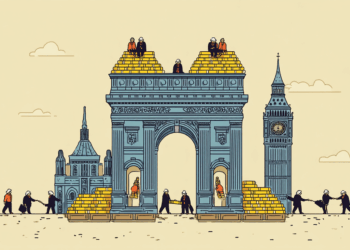
All over Europe populist parties of the Right and Left are on the rise as voters increasingly turn away from the political class that has held sway since the Second World War.
What are the traits of these discredited politicians? They tend to be detached from the concerns of ordinary people. They are sure they know best, though they often don’t. They can be entitled and arrogant. And they frequently use politics as a means of enriching themselves.
Britain has a politician who epitomises these characteristics. I am thinking of George Osborne, Conservative Chancellor of the Exchequer from 2010 until 2016.
Looking at George, it’s easy to understand why many people detest the Tories. This smug and supercilious character gives capitalism a bad name. The mere thought of him makes even me want to take to the streets.
George’s latest money-making venture is to jump aboard artificial intelligence giant OpenAI, developer of ChatGPT. He will be employed in forging relationships with governments around the world. This is his sixth current job. He must hope that it will make him zillions.
What does Osborne know about artificial intelligence? Almost certainly nothing. But that hasn’t held him back in the past. He wasn’t obviously qualified to become Chancellor at the age of 38. He had never held a proper job, having been a special adviser and then an MP.
Nor was he remotely qualified to be editor of the London Evening Standard in 2017. He’d never been a journalist. In fact, he was turned down by two publications on leaving Oxford University. But his friend, Russian-born newspaper proprietor Evgeny Lebedev, owned the Standard.
George sat in the editor’s chair for three years, where it wasn’t clear that he added much to his slender knowledge of journalism, before jumping ship. The title was plainly doomed. It expired as an evening paper last year.
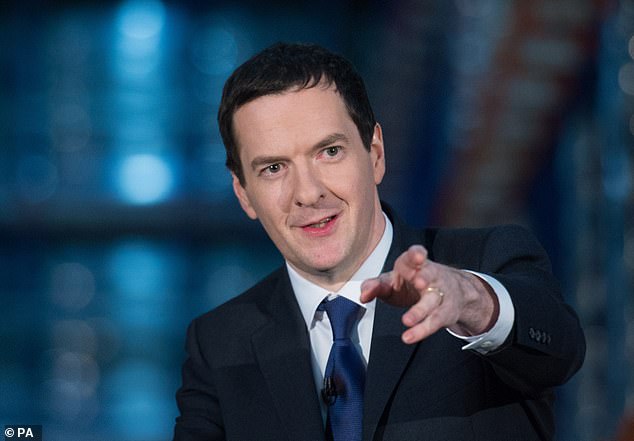
What does Osborne – who has jumped aboard OpenAI – know about artificial intelligence? Almost certainly nothing, writes Stephen Glover
How long Osborne will stay loyal to OpenAI depends on the company’s fortunes in what some think is a bubble about to burst. But we can be confident that he will nimbly jump on to some lucrative passing bandwagon should the need arise.
Amusingly – and perhaps worrying to the shareholders of OpenAI – its own ChatGPT doesn’t have a high opinion of George’s credentials. When I asked it whether he knew anything about AI, the reply was that he ‘has no training or professional history in computer science, data science, machine learning or AI research’.
When I inquired whether it would be odd to appoint Osborne to a senior position in an AI company, ChatGPT replied: ‘It would be an odd appointment, unless the role were very clearly non-technical and political/strategic.’
In this matter, at least, ChatGPT is on the button. George is brilliant at opening doors. He’s practically a fixture at the World Economic Forum in Davos or in the counsels of the secretive Bilderberg Group. Hello Hans. Good to see you Francois. Hope you’re keeping well Luigi. We must have lunch.
And great to meet you, JD Vance. When the US Vice-President was holidaying in the summer in a manor house in the Cotswolds – ironically, a few lawns away from the country home of Osborne’s old mate, David Cameron – who should turn up to make the introductions to upcoming Tories but George?
The former Chancellor and Vance are, politically-speaking, oceans apart. George is far closer to former Labour Cabinet minister Ed Balls, with whom he hosts the Political Currency podcast. The sages seldom disagree. They are the embodiment of our political class.
Wherever power is, smoothie fixer George Osborne may be found sniffing around. Hence the love-in with Vance. He’s the Tories’ version of his friend Peter Mandelson, which explains why he has been spoken of as the next British ambassador to Washington. Alas, it doesn’t pay enough.
After leaving the Evening Standard, George worked for the small and highly profitable investment bank Robey Warshaw, where he trousered tens of millions of pounds before it was bought by an American rival. A new wife, a country home in Somerset and a £10 million house in Notting Hill were acquired.
More doors were opened. George even tried to find a buyer in the United Arab Emirates for the Telegraph before the deal was vetoed by the then Tory Government. David Cameron’s sister-in-law Emily Sheffield (his successor at the Evening Standard) accused him of lacking principles. Bingo!
On the subject of ethics, OpenAI and ChatGPT have been accused of plundering the work of artists and other creative producers including newspapers without troubling to pay them. Osborne seems to have forgotten such journalistic values as he once possessed.
As chairman of the British Museum (for which job he again had no obvious qualifications) he has been attempting to loan the Elgin Marbles to Greece, though no one asked him to do this. A nervous Labour Government has so far withheld its support.
George’s other jobs as a lecturer in management at Stanford University in the US, an adviser to the cryptocurrency exchange Coinbase, and chairman of Italian investment firm Lingotto have so far proved less controversial.
OpenAI and ChatGPT have been accused of plundering the work of artists and other creatives without paying them
These are the rich fruits of Osborne’s political career, during which he filled his iPhone with innumerable contacts to be exploited later. Tony Blair, whose riches (for now) surpass those of Osborne, had shown the way.
Perhaps if he had been a more effective politician one would be more forgiving. As Chancellor, he prolonged austerity longer than was necessary, recklessly applying his scythe to the criminal justice system for relatively small savings. Irrevocable damage was caused.
In 2010 he approved an 8 per cent cut in defence spending, from which our Armed Forces have never recovered. And yet he supported his friend Cameron in doubling down on Blair’s futile war in Afghanistan, which cost so much in blood and treasure.
Also with Cameron, he sucked up to President Xi Jinping when it was already clear that China didn’t wish us well. Chinese investment in sensitive infrastructure such as Hinkley Point C nuclear power station was irresponsibly encouraged.
Can anyone recall one enduring achievement of George’s? I can only think of disappointments and failures. He lacked the courage to pursue one of his few good (and widely popular) ideas – the abolition of inheritance tax.
While promoting and justifying austerity, Osborne often repeated the mantra ‘We’re all in this together’. It seemed as absurd then as an 18th-century aristocrat assuring his browbeaten peasants that they were all in the same boat.
Now, as he fills his boots with gold while the country groans under Labour rule, does he feel a smidgen of guilt? Does he ever lie awake at night and wonder whether he deserves these jobs and huge wealth, which are not the product of daring or originality but instead the harvest of a mediocre political career?
Osborne isn’t, of course, wholly responsible for the widespread disenchantment with Establishment politicians. He could line up with David Cameron and Tony Blair and Nick Clegg, who sold his soul to Silicon Valley for £40 million.
But he is for me a symbol of what has gone wrong with this country’s political class – the entitlement, the loss of rectitude, the decline of duty, the rise of greed. George Osborne will at least be remembered for that.