Keir Starmer warned the effects of the Middle East crisis could still be felt by Christmas today despite Donald Trump‘s dramatic ceasefire announcement.
The PM welcomed the apparent negotiations as he called for rapid measures to reopen the crucial Strait of Hormuz.
But speaking to the cross-party Commons Liaison Committee, he warned against taking ‘false comfort’ that the Middle East crisis will end soon.
He said the Government had to plan on the the turmoil dragging on for ‘some time’, suggesting a bailout for energy bills would need to last into the winter when usage gets ‘very heavy’.
That would mean support going beyond the next cap period of July to September, and into October to December.
Rachel Reeves could announce some elements of a package as soon as tomorrow.
‘The immediate priority has to be a swift resolution of the conflict and delivering a negotiated agreement, which puts tough conditions on Iran, particularly in relation to nuclear weapons,’ Sir Keir said.
In some of his strongest comments on the US-Israeli strikes, the premier said: ‘This is not our war and we are not getting dragged into this war.’
Mr Trump has declared he is pausing the military action for five days after ‘very good conversations’ with Tehran – although the regime has denied having any talks. Iranian TV has been boasting that America has backed down.
The apparent breakthrough sparked a massive relief rally on markets, which had endured a torrid morning beforehand. However, oil and gas prices remain higher than before the US and Israel launched strikes.
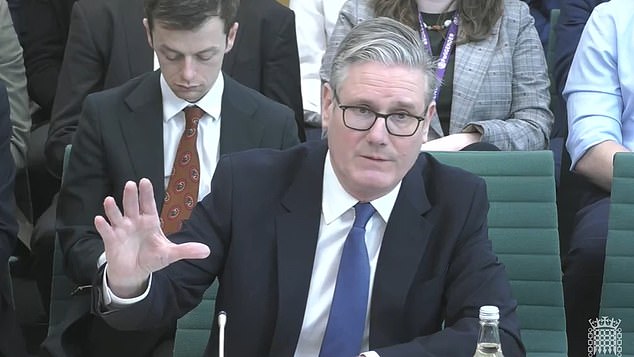
Keir Starmer welcomed Donald Trump’s dramatic Iran ceasefire announcement – as he called for rapid measures to ease the global energy crisis
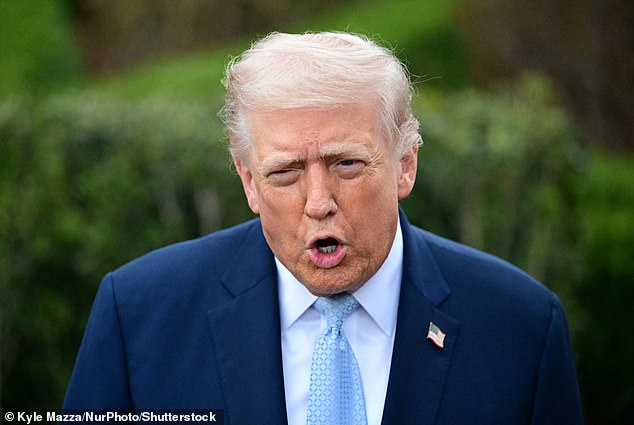
Mr Trump claimed he was pausing the military action for five days after ‘very good conversations’ with Tehran
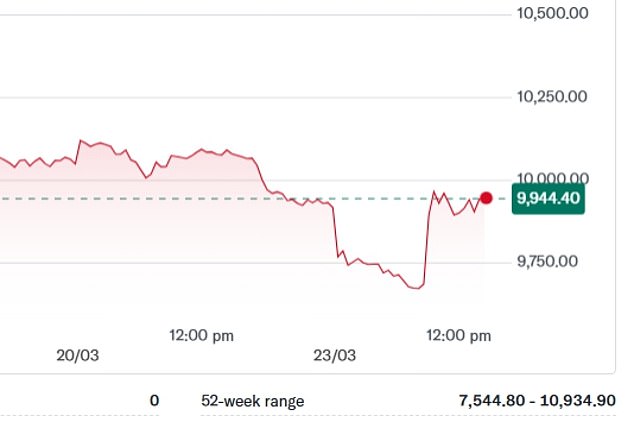
The FTSE 100 had been extending its losses during the morning, but staged a relief rally on the announcement from Mr Trump
The PM will gather senior ministers and the Bank of England governor in Whitehall amid fears of panic at pumps, an inflation timebomb for energy and food bills, and interest rate rises.
Doubts have been mounting over whether the Chancellor will be able to offer significant help for families, with borrowing costs and the stalling economy putting huge strain on the public finances.
Yesterday the chief executive of Centrica, which owns British Gas, said global oil supplies are already down 20 per cent because of the conflict and warned price rises were ‘inescapable’.
Acknowledging the Government’s fiscal constraints, Sir Keir said: ‘I’m acutely aware of how much it cost last time round, and I’m acutely aware of the state of the public finances, but we will look this afternoon at what the appropriate approach is.
‘There are difficulties in that we don’t yet know the extent of the challenge we’re facing, because we don’t know when this conflict is going to an end.
‘We’re looking at in the first instance what happens when the current price cap ends, which is the end of June. I think the one we’re equally focused on is the one after that… ‘
Sir Keir told MPs he was considering giving the Competition and Markets Authority ‘further teeth’ amid concerns about short-term profiteering amid surging oil and fuel prices.
‘I’ve already asked the CMA to look at this, I think we might look at what further teeth we can give the CMA to deal with this,’ he said.
‘I think there isn’t enough regulation in this area. I want to see more on price gouging or profiteering.
‘We absolutely need to bear down on it, and so we’re actively considering whether the CMA should have additional powers to deal specifically with that, but at the moment, we’re making sure they’re focused on anti-profiteering steps that they can take.’
Sir Keir discussed the Iran war and how to reopen the crucial Strait of Hormuz with Mr Trump in a 20-minute call last night.
Pressed by MPs on how long the disruption would last, Sir Keir said: ‘It’s hard to answer that question, if I’m honest about it.
‘I think all our focus and energy has to be in the swift de-escalation, but we’ve got to plan on the basis that it could go on for some time, and that’s the way in which we’ll plan this afternoon.
‘Since the conflict started, I’ve been really clear with the team that we mustn’t fall into the sort of false comfort of thinking that there will necessarily be a quick and early end to this.
‘We have to plan on the basis there may not be.’
He added: ‘On energy supplies, I can reassure the committee that we haven’t any meaningful concern about energy supplies. Obviously the price fluctuates daily.’
Sir Keir hinted that Rachel Reeves will outline some energy support tomorrow, after a Cobra meeting on the potential fallout this afternoon.
He admitted that the Government did not have huge sums of money to throw at the problem.
‘I’m acutely aware of how much it cost last time round, and I’m acutely aware of the state of the public finances, but we will look this afternoon at what the appropriate approach is,’ Sir Keir said.
‘There are difficulties in that we don’t yet know the extent of the challenge we’re facing, because we don’t know when this conflict is going to an end.
‘We’re looking at in the first instance what happens when the current price cap ends, which is the end of June. I think the one we’re equally focused on is the one after that… ‘
Posting in all capitals on his Truth Social site, Mr Trump said the US and Iran ‘have had, over the last two days, very good and productive conversations regarding a complete and total resolution of our hostilities in the Middle East’.
He added further talks will take place to work towards a ‘total and complete resolution’ of the conflict which broke out on February 28 when Operation Epic Fury was launched.
The President had issued a 48-hour ultimatum on Saturday night for Iran to fully reopen the Strait of Hormuz or face ‘obliteration’.
The financial markets immediately reacted to Trump’s post with the price of oil and gas dropping as stocks rebounded across Europe.
Iranian state television reported Trump ‘backed down’ from attacking the nation’s power plants following a ‘firm warning’ concerning Tehran’s plans to retaliate.
No10 had tried to play down tensions between Sir Keir and Mr Trump over the mounting crisis in the Middle East, insisting their call was ‘constructive’.
But shortly before the conversation, the president spread a toe-curling clip from the British version of ‘Saturday Night Live‘ on his Truth Social platform.
The scene from the show – which aired for the first time on Sky this weekend – depicts the PM in No 10 too terrified to pick up the phone to talk to Mr Trump about Iran.
‘What if Donald shouts at me?’ the comedian playing Sir Keir says to his deputy, David Lammy. When ‘Mr Trump’ answers he immediately hangs up in a panic.
The real Mr Trump has repeatedly vented fury at Sir Keir’s reluctance to take a bigger military role, branding him ‘disappointing’ and ‘no Churchill’.
He has also called Nato countries – including the UK – ‘cowards’ for not sending warships to the Strait of Hormuz.
Polls have suggested the British public is extremely wary about taking part in the US-Israeli attacks on Iran, which have caused carnage in oil and gas supplies and raised fears of a global recession.
Having hit $114 a barrel earlier this morning, the oil benchmark Brent crude fell back to $98 before rising again to around 106 dollars just after midday.
Sir Keir is due to chair a meeting of the Government’s emergency Cobra committee this evening, with discussion focusing on the economic impact of the war.
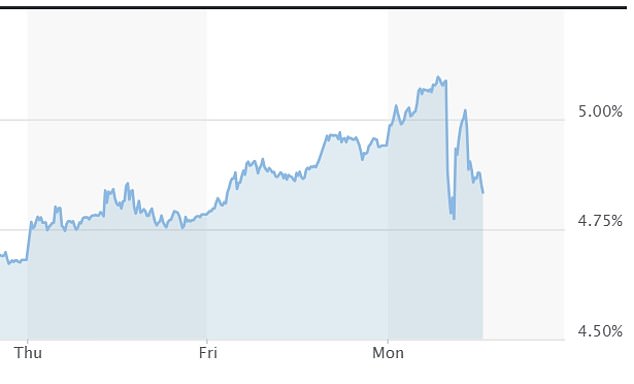
The interest rates on 10-year gilts – one of the main ways the government raises money – were climbing alarmingly this morning, before easing back
He told reporters the meeting would examine ‘every lever that’s available to Government’ to respond to soaring energy prices and the knock-on effect on the cost of living.
As well as senior ministers including Chancellor Rachel Reeves, Foreign Secretary Yvette Cooper and Energy Secretary Ed Miliband, the meeting will be joined by Bank of England governor Andrew Bailey.
Sir Keir said: ‘I want to make sure that when it comes to the cost of living, we’re doing everything we possibly can at a very difficult period like this.’