The world of parliamentary politics is dry and dull, the preserve of policy wonks and that peculiar breed of bookworm who enjoys ploughing through political biographies. But every so often a story emerges from the mirk of Westminster with the voyeuristic allure of melodrama. A sap and a broad, entangled in past deceits, paranoid they’ll be discovered, desperately trying to hold on to their powerful social positions yet tottering on the edge of a mutually assured destruction. So it is with the saga of our patsy Prime Minister and his entanglement with a deadly dame next door.
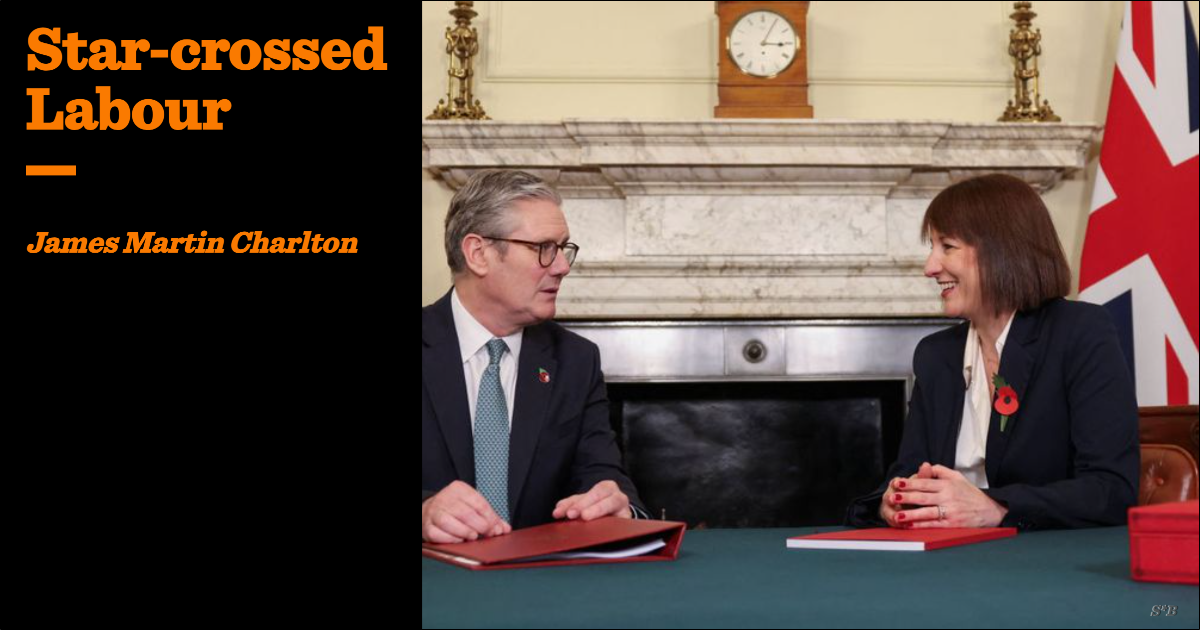
The Chancellor has had an unusual budget. There were the leaks; the planting of stories about a gaping black hole; the unceremonious dumping of the budget into the public domain fifteen minutes before take-off; and a poison-pen letter. The OBR had squealed — there was no black hole, no deficit, the rationale for their heist of £30 billion was a put-up job. What else could this fated pair do but carry on the deceit, double down on the falsehoods. “I swing, sweet peach, and you swing too. All we gotta do is keep to our story.”
With Keir Starmer and Rachel Reeves, we leave the realm of mere reportage and enter the mysteries of literary typology. This is the art of recognising recurring human patterns across different works, ages and forms. It treats literature as a field of enduring types, revealing how certain pairings or predicaments return with uncanny consistency. Starmer and Reeves belong to one of the oldest types of all — the fatefully entangled couple. In scripture we meet Samson and Delilah, the powerful man undone by misplaced trust in a woman whose loyalties lie elsewhere; or David and Bathsheba, the king and the woman bound by an illicit liaison, a death arranged to conceal the transgression…
I certainly don’t mean to imply a romance between our PM and his Chancellor; if nothing else, I wouldn’t wish to put those images into my readers’ minds. But sex aside, there is something in their situation that recalls the lovers in Double Indemnity, who murder her husband for the insurance and find a dogged claims investigator on their tail. This take casts the FCA in the old Edward G Robinson role, scrutinising whether Mel Stride’s talk of irregularities has legs. Perhaps they won’t investigate, but that’s no refuge. In The Postman Always Rings Twice, the public know the diner-proprietor couple have got away with murder, leaving them trapped together running their kitchen in mutual fear and loathing; our scheming pair are running a country. They must surely feel that the game is up, that the past is close behind, and that one day the truth is going to come Out Of it.
The eccentric architectural interconnectedness of the two Downing Street residences — linked by internal passageways into a single, maze-like complex behind those paired iconic doors — is eerily reminiscent of the castles and mansions of the Jacobean stage. James I himself had a secret doorway through which he visited his favourite, George Villiers, for illicit purposes. And that era’s drama is full of couples of our type. In The Changeling, an aristocratic woman persuades her father’s manservant to kill for her; she finds herself inexorably bound to him, and he demands everything in return, reminding her that she is now “the deed’s creature.” Reeves will be for all time the author of that black hole. She and Starmer will give us endless rationales full of noble intentions: lifting children out of poverty, boundless breakfast clubs, and the rest. But we will simply echo the words of the sister in Women Beware Women, when her brother tries to justify her lover’s killing: “The reason! That’s a jest hell falls a’laughing at.” Reeves and Starmer would do well to remember that such couples end in a hell of their own making. In ’Tis Pity She’s a Whore, the incestuous brother kills the sister with whom he has broken social norms, holding up her heart on the point of a dagger as he confesses. I don’t suppose that Starmer’s resignation speech will be nearly as thrilling.
A proto-thriller is how some critics describe the story of that most famous of Jacobean doomed couples. In Shakespeare’s great tragedy, Macbeth — a minor royal official — encounters three “weird sisters” who suggest that he is fated to hold a more prestigious role, and become king thereafter. When he returns home and tells the wife, she urges him to give fate a helping hand, and together they plot the murder of the incumbent king. Starmer was merely the lowly Shadow Secretary of State for Exiting the European Union under Jeremy Corbyn. After rising to the party leadership, one of his first acts was to remove the Whip from his predecessor, later expelling him altogether. Reeves became his Shadow Chancellor in a 2021 reshuffle. Their fates have been entwined ever since. With their election they became the two most powerful people in the UK. “To be thus is nothing, but to be safely thus…”
At some point in the last six months they must surely have agreed — tacitly or explicitly — that the only way to remain in power was to appease their backbenchers and spend more on welfare. Let us not pretend this was a decision born of conviction. Both had stated boldly that the two-child benefit cap would not be lifted and that taxes would not rise for working people. Yet ambition must be fed, and the polls were turning against Starmer as surely as the weird sisters’ prophecies turned against Macbeth. Was it Reeves who suggested the invention of the deficit, with Starmer the persuadable goose reluctantly agreeing? We may never know. But the black hole tale was spun; their mutual crime became known; and now forces are massed against them — the right-wing press projecting the image of an English army advancing on the Scottish usurper. Does our Prime Minister sleep? Does Reeves try to wash the stain of the lie from her hands in somnambulant wanderings?
All of these doomed couples … discover that breaking codes of behaviour does not lead to an easier life
Wrongs, once committed, do not sit easy. They breed guilt, rancour, paranoia. In his (significantly) Watergate-era song Idiot Wind, Bob Dylan’s narrator sits on a pile of ill-gotten wealth and reflects on the deeds that secured it: the killing of a wealthy man, the stealing away of his wife, her death and his inheritance. Now the stories are leaking to the press. He is holed up with a woman in what was once a promising relationship; all that remains is suspicion, recrimination, mutual distrust. Her triteness disgusts him. What does Starmer feel when he watches Reeves grin her way through another interview, laughing off the accusations that she lied with startling banality? “Idiot wind, blowing every time you move your teeth.” The song’s world is full of evil omens; Starmer is haunted instead by calamitous polls. Dylan imagines a universe of inversion and stasis; Starmer’s premiership spirals downward. Where the singer feels he has been “double-crossed,” Wes Streeting skulks in the cabinet, is that a leadership challenge on his mind?
All of these doomed couples — of noir, of Jacobean tragedy, of song — discover that breaking codes of behaviour does not lead to an easier life. Only at the end of Dylan’s song does the narrator break from recrimination, stop insisting that his partner is the idiot, and acknowledge mutual culpability. Doomed couples cannot find peace — and cannot be forgiven by the public — until they admit they have been a pair of idiots. The only alternative is further calamity. We learn a great deal by considering the type of couple they are. Will Starmer and Reeves see the shape of it before their ending writes itself?