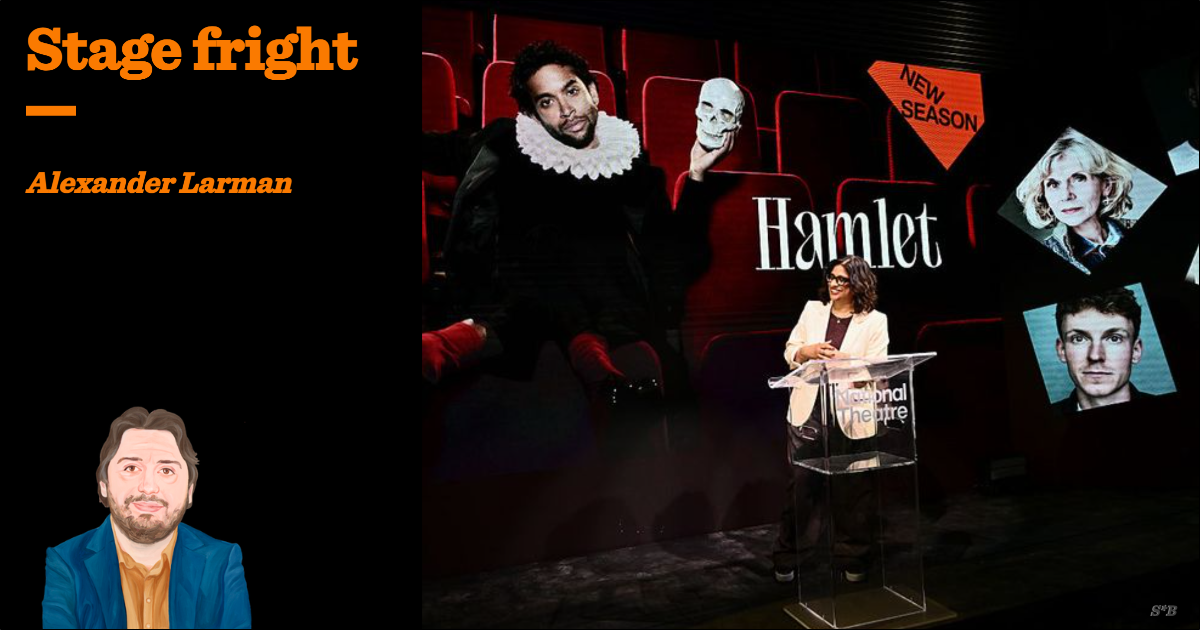

When Indhu Rubasingham became the new artistic director of the National Theatre, there were many who were scathing about her first programming choices, accusing her variously of the usual criticisms levelled at state-subsidised theatre — general wokery, excessive adherence to diversity and a navel-gazing concentration on plays that were of no interest to anyone outside the M25, or, alternatively, a conservatism and lack of risk-taking that couldn’t have been levelled at Rufus Norris’s largely clown-car regime.
I was more optimistic than many, saluting her decision to return to the canon after Norris’s tiresome abandonment of it. I wrote here: “there is a welcome return to classicism here, albeit with a decidedly 2025 twist, that makes me feel, for the first time in years, genuinely, albeit cautiously, optimistic about venturing to the South Bank once again.”
Well, I have ventured to the South Bank once again, and the results have been decidedly mixed. I was unimpressed by the Robert Hastie Hamlet, which I described in this magazine as “mildly diverting rather than tear-jerkingly poignant” — but my reaction was warmth itself compared to how Rubasingham’s own first production, The Bacchae, was greeted by the press. The Times’s theatre critic Clive Davis began his review by writing: “Let’s be positive and say that things can only get better after this.” It was met with near-disbelief by those who believe that Euripides is not necessarily improved by being adapted by a previously untested playwright, liberally sprinkled with profanities and having some cross-dressing thrown into the mix. The star-studded Playboy of the Western World, which played to far from sold-out houses, proved that all the famous faces in the world can’t make JM Synge a wildly appealing proposition for audiences.
Several of the plays that were announced by Rubasingham last year are about to open, including the eagerly awaited Man and Boy — an unjustly neglected Terence Rattigan classic — and the Lesley Manville-Aidan Turner Les Liaisons Dangereuses, and both of those should give her the commercial successes that any National Theatre director needs early in their career to prove that their tenure is going to be a worthwhile one. Yet there has now been a further announcement of her second season, and it is impossible to feel particularly excited by what’s been promised.
Gimmickry seems to be what is at the heart of many of the new shows
The planned Paul Mescal-led Death of a Salesman will not be appearing until next year, because of Mescal’s commitments to playing Paul McCartney in Sam Mendes’s quartet of Beatles biopics, and in its stead are a series of productions that combine big stars with strangely modish approaches. Seeing Cate Blanchett on the London stage should be an unmissable highlight of any theatrical year, but just as her last appearance at the National opposite Stephen Dillane in the BDSM-themed drama When We Have Sufficiently Tortured Each Other was one of the many flops of the Norris regime, I feel a sense of weariness at her appearance opposite her Tár co-star Nina Hoss in a mash-up of Sophocles’ Electra and Ingmar Bergman’s film Persona, called, fittingly enough, Electra/Persona. Those of us who would have been content with seeing Blanchett in Electra itself, played straight without gimmicks, will be disappointed.
But gimmickry seems to be what is at the heart of many of the new shows. There is a new production of Moliere’s The Misanthrope, and the lead role has been gender-swapped, to allow for the casting of Grey’s Anatomy and Killing Eve star Sandra Oh. The actress Francesca Mills, whose appearance in Hamlet as Ophelia won praise from critics, is cast in the lead role of a revival of Jim Cartwright’s The Rise and Fall of Little Voice: that Mills is affected by dwarfism means that the show’s story of a chronically shy young woman who only comes to life when privately singing along to the music of Judy Garland and Billie Holiday will have its protagonist’s “otherness” underlined in thick ink. And the presence of Letitia Wright on stage in Clint Dyer’s new newsroom show The Story will suggest that Rubasingham is hoping that familiar faces from film — in Wright’s case, Black Panther — will bring in audiences, rather than established classical actors. The likes of Simon Russell Beale and Alex Jennings, once stalwarts of the National, are conspicuous by their absence.
The new boss is, it might appear, the same as the old boss
Still, Nicholas Hytner’s triumphant decade-long regime — the most successful, both artistically and commercially, in the theatre’s history — is having a strange kind of backhanded homage being paid to it in Rubasingham’s decision to resurrect Tom Morris and Marianne Elliott’s production of War Horse, first staged at the National twenty years ago. There is nothing wrong with bringing back much-loved productions of classics — opera does it all the time — but given that Rubasingham has boasted about how “it’s a privilege to stage work that theatrically explodes, surprises and challenges us to see the world anew”, hoping that a literal warhorse like this will bring in the punters seems an oddly cowardly decision.
It now seems fairly clear what the National’s new direction of travel is, cleaving far closer to Norris than to Hytner, or, if you will, relevance rather than excellence. I still have hopes that the shows will be worth seeing, and will review as many as I can see with an open mind. But my initial optimism that Rubasingham was going to do something wholly different to the previous decade is fading fast. The new boss is, it might appear, the same as the old boss. Like Pete Townshend, I will get on my knees and pray that we won’t be fooled again.