One of the ironies of digital money is that the riskiest versions get the most attention with their spectacular surges and plunges. But some economists say the less heralded, stabler versions pose the greater long-term risk to the financial system.
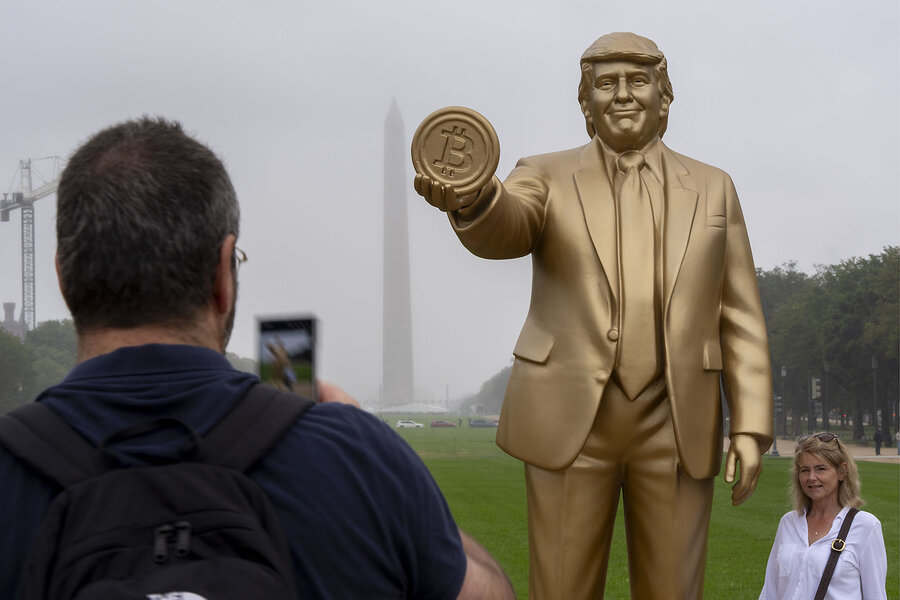
Consider the latest gyrations of the best-known risky version of digital money: bitcoins. In early October, the cryptocurrency peaked above $126,000 per unit, plunged by a third through late November, and has since recovered to around $92,000. On Wednesday, as the Federal Reserve lowered interest rates in a bid to buoy the economy, bitcoins climbed a bit in the immediate aftermath. The downturn has raised fears about the viability of Strategy, headed by bitcoin optimist Michael Saylor, and also cut in half the value of American Bitcoin Corp., backed by the family of President Donald Trump.
In that time, the leading lower-risk version of cryptocurrencies, known as Tether, lost less than 1% and has fully recovered. Yet financial experts see this form of digital money, known as stablecoins, as posing the greatest risk to the economy and consumers. That’s because stablecoins are a new and untested entity and lightly regulated while steadily integrating themselves into the traditional financial system.
Why We Wrote This
The volatility of some cryptocurrencies can shake up financial markets. There’s a stabler version of crypto, but as people continue to buy in, even that carries some risk to the greater economy.
Bitcoins and stablecoins differ because of the way they’re backed. Bitcoins are a volatile and speculative investment because they are backed solely by investors’ faith in a string of computer code – and by the assumption that other investors will share that faith. Stablecoins, by contrast, are designed to keep their value and are fully backed by assets considered quite safe. Tether and the second-largest stablecoin, Circle USD, are pegged to the U.S. dollar and are big buyers of U.S. Treasury bills, short-term debt, and other safe instruments often used by traditional money market funds.
The risk posed by stablecoins is that if for whatever reason their value falters, investors may cash out, causing a larger collapse in which the companies sell off their holdings, including their Treasury bills. If the stablecoin sector keeps growing larger, a downturn in that sector could trigger a sharp fall in the value of U.S. debt.
How big is the stablecoin risk?
Stablecoin issuers were already the seventh-largest buyers of Treasury debt over the previous year ending in June, according to one analysis. As their holdings grow, the risks rise, analysts agree. What they don’t agree on is how pressing that risk is.
A run on a stablecoin is remote, about as likely as a run on money market funds, says Campbell Harvey, a finance professor at Duke University in Durham, North Carolina. “The bottom line here is that the systemic risk is greatly exaggerated.”
Others are more worried. “We now have private companies issuing what are essentially private dollars, which is a system we abandoned shortly after the Civil War because of a series of financial panics that it caused,” says Corey Frayer, a director at the Consumer Federation of America and former cryptocurrency policy expert at the U.S. Securities and Exchange Commission. “We have already paved the way for some pretty serious financial stability threats, and it’s hard to know when those will manifest” themselves.

A more immediate concern is the risk to consumers, he adds. As banks and other financial companies offer new payment systems that allow stablecoins to be used, people may start using the cryptocurrencies without realizing that they don’t come with the financial backing that the traditional financial system offers, such as deposit insurance and protection against fraud.
Concerned that government rules might slow the innovation and adoption of crypto, the Trump administration and Congress have adopted a light-touch approach to regulating the sector. For example, the Senate Banking Committee is rushing to mark up a crypto market structure bill before the Senate leaves on holiday recess. Republican senators have offered concessions to Democrats, who want stricter regulation of digital currency. The concessions reportedly would include ethics language, risk-management standards for intermediary companies handling crypto, and consumer protection standards, among other things.
A debate about crypto regulation
But on Monday, the American Federation of Teachers – often seen as influential because of its large membership – condemned the bill in a letter to Republican committee leaders. In the letter, CNBC reported, teachers union President Randi Weingarten wrote that the bill “strips the few safeguards that exist for crypto and erodes many protections for traditional securities. If passed, it will undercut the safety of many assets and cause problems across retirement investments.”
Others say the crypto world should be required to operate under the same rules that the traditional financial system operates under, rather than a cheaper, more lightly regulated approach.
In some ways, stablecoins are stabler than banks, because they’re backed by safer assets. For example, the mortgages that banks offer help Americans buy homes, which is a boost to growth. But those loans are riskier than, say, the Treasury bills that Tether and Circle rely upon. And stablecoins are more transparent than banks in publishing regularly the size of their reserves. Thus, they may need less, or at least different, regulation than the traditional financial system.
But the industry’s arguments that it doesn’t need things like deposit insurance are “just too optimistic by half,” says Hilary Allen, a professor at American University. “These things look like money market mutual funds, and we’ve had runs on money market mutual funds.”
Few people actually use crypto to make payments or send money. In 2023 and 2024, it was less than 2% of Americans, according to a study from the Federal Reserve Bank of Kansas City this fall. In fact, it’s fallen from nearly 3% in 2021 and 2022, even though roughly a fifth of Americans own crypto. If Americans don’t take up stablecoins with the same verve that they’ve invested in bitcoins and other risky cryptocurrencies, then stablecoins’ march into traditional financial markets may take longer than many anticipate.