It sounds more like something out of a futuristic sci-fi movie.
But aviation history was made in Scotland yesterday when the UK’s first all-electric aircraft took to the skies.
Taking 20 minutes to travel from Glasgow to Dundee – cutting a journey that would normally take up to two hours by car – the eco flight was hailed a ‘landmark day for European aviation’.
The UK’s leading regional airline Loganair piloted the all-electric plane, which can reach speeds of up to 176mph, within its operational network – the first commercial airline to do so.
The trial flight, authorised by the UK Civil Aviation Authority, is part of a two-week programme where the aircraft will be used across the airline’s network to demonstrate its capability to deliver ‘freight, mail and essential goods, such as medical supplies’.
In the coming days the battery-powered ALIA CTOL, which has a range of around 387 miles and a payload capacity of 560kg, will also land at Aberdeen, Wick, Inverness, and Kirkwall on Orkney, taking part in various trips to test how it could be utilised.
The trial is a partnership with US aerospace firm BETA Technologies, with the Scots airline hailing the first flight ‘a significant step towards decarbonising short-haul aviation’ and ‘positioning Scotland at the forefront of next-generation aircraft technology’.
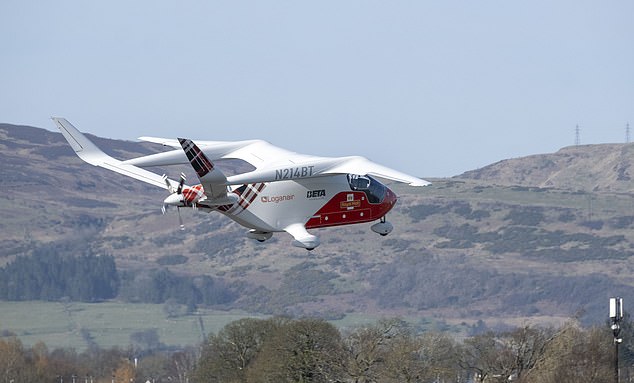
Loganair made aviation history by completing the first ever electric flight in Scotland
Loganair chief executive Luke Farajallah said: ‘We are not talking about concepts, prototypes, or distant ambition, this is a real, tangible programme of flying across our network which
will provide invaluable data on how an electric aircraft could perform in a real commercial environment.
‘Electric aircraft have the potential to transform short haul flying, protecting vital air links while significantly reducing carbon emissions.’
The aircraft is designed for regional cargo and passenger operations and can operate from existing runways, recharging in around one hour using BETA’s fast-charging system.
First Minister John Swinney said: ‘This next-generation technology ensures that Scotland is well placed to play a leading role in reducing the carbon emissions associated with aviation, while supporting regional connectivity for communities in the Highlands and Islands.’
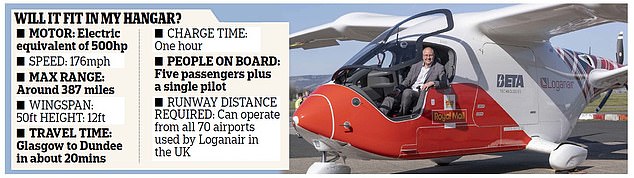
Cleaner, quieter – but would the electric aircraft fit in YOUR hangar?
The airline said that ‘given the various islands, it is the perfect geography for this new technology to be implemented’.
Sophie O’Sullivan, director of future safety and innovation at the UK Civil Aviation Authority, said: ‘Electric aircraft offer the possibility of cleaner, quieter flights, with improved connectivity and greater reliability.
‘As electric aerospace technology advances, trials like this contribute to our work to establish the regulatory framework for advanced air mobility, helping us enable this new technology to develop safely.’ Keir Mather, aviation, maritime and decarbonisation minister, said the Government was backing UK business with £43million ‘to power up green aviation’.
He added: ‘Zero emission aircraft, hydrogen fuels and advanced air mobility will unlock economic growth, reduce climate impacts from flying, and help deliver our airport expansion plans to boost connectivity and growth whilst creating highly skilled jobs across the UK.’