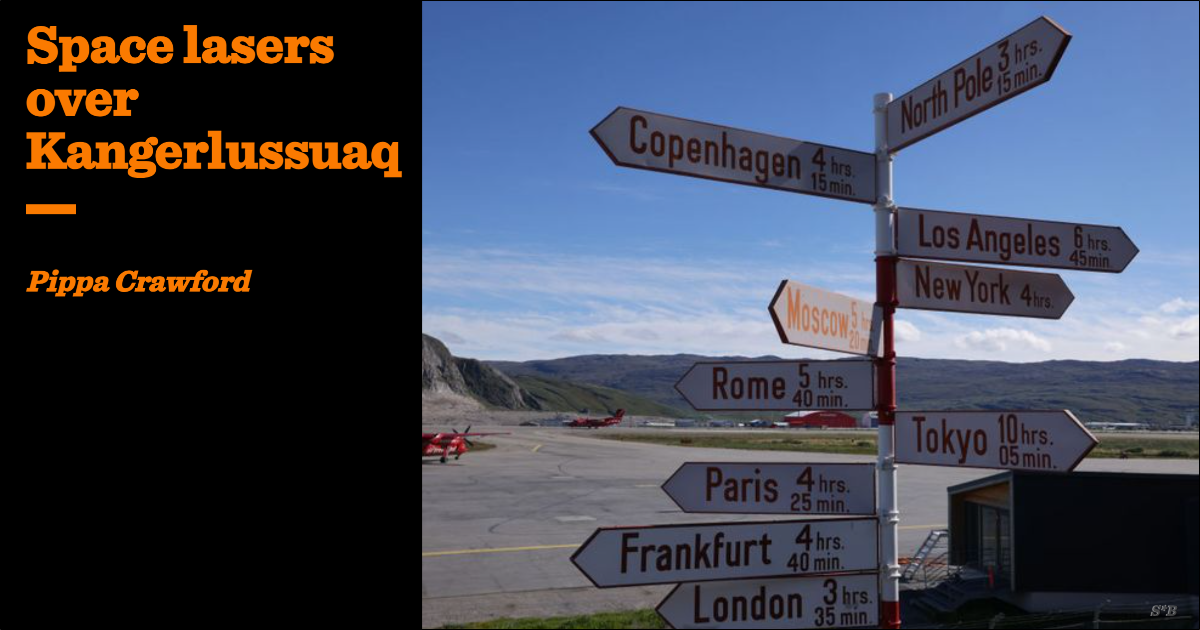
A remote polar station equipped with space lasers might sound like the scene of James Bond’s latest showdown, but it’s business as usual for Kangerlussuaq on the west coast of Greenland. The new optical ground station was announced as part of a deal between the European Space Agency and the Lithuanian space and defence tech company, Astrolight. It should be ready by the end of 2026.
Lasers download data from low-orbit satellites at high speed, promising to free up the overloaded systems we use for everything from air-traffic control to mobile signal. Unlike traditional satellites, which rely on radio frequency, lasers can resist signal-jamming. Put simply, a radio signal spreads in many directions after transmission (leaving it vulnerable to interception) whereas the newest lasers take a direct and invisible path between an object and its target. This year saw multiple signal-jamming attacks linked to Russia, leaving Europe scrambling to develop a solution.
Laurynas Mačiulis, CEO of Astrolight, said that Russian aggression has highlighted the importance of “resilient” communication. “Countries that were sleeping, countries that considered themselves safe are now investing in military technology. And communication is of great importance to the digital battlefield,” he told The Critic.
A spokesperson for the European Space Agency valued the ESA’s contribution to the Greenland project at 1 million Euros, with additional investment by Astrolight said to be “significant.”
Whilst the new station will feature some of the world’s most advanced systems, Greenland already hosts satellite bases for the US and China. Why is the satellite industry thriving in the Arctic? And why is Greenland in particularly high demand?
Clear Arctic skies offer one advantage — optical systems work better under low cloud cover. And as satellites cross the poles with every orbit as they travel through space it is practical to build ground stations in the far north or south. Yet the remote landscape also appeals to countries seeking to develop military communications — especially so-called “dual use” systems.
Military activity in space is strictly regulated by international treaties, but dual use systems — which operate on a scientific or commercial basis, but have potential military uses — provide nations with plausible deniability for their activities. Building such stations also makes it possible to repurpose existing infrastructure in wartime. Arctic scholars Boschetti and Falco write that the commercial US OneWeb base in Nuuk, Greenland already has the capacity to be incorporated into the Department of Defense. Likewise, the Chinese ground station in Kangerlussuaq is officially part of a project to study climate change, but has an identical satellite layout to the Chinese station in Svalbard, Norway, which conducts military research.
Astrolight told The Critic that the Greenland project “will only be used for civilian purposes.” The Baltic start-up is also marketing its optical systems to navies, recently training with the Lithuanian navy, and participating in a NATO exercise.
Despite the apparent split between Astrolight’s civil and military projects, it is striking to see Europe investing in tech with a defence application in the strategically important Arctic region. As for the ESA, Europe’s space program has been doing more work alongside companies that make weapons as well as researching space, signing a contract with Thales and Leonardo in February of this year.
On December 1st, ESA officials greenlighted defence investment in Europe — a significant shift in the organisation’s 50 year mission
What’s in it for Greenland?
Headlines about Greenland tend to focus on the larger powers seeking to profit at its expense. Rising sea temperatures are opening up new shipping routes in the Arctic, promising access to rare minerals long buried under the frozen earth, and driving economic competition between Russia, China, and the US. But Greenland is an autonomous territory, home to 55,000 people, and seeking to control its own future. Whilst still reliant on Denmark for financial subsidies and approval for some policy decisions, the government has pushed back — hard — against any suggestion that Greenland is for sale.
A recent visit by US Vice President JD Vance ended in embarrassment after officials were unable to find a single person in Greenland who wanted to welcome Vance’s wife. Greenland’s courts also defend the territory from attempts to force through unwanted foreign investment; Australian mining company ETM has been arbitrating against the government since 2022, after Greenland voted to ban uranium mining.
Public defiance and legal firepower have helped Greenland resist bullying until now, but going forward, local leaders have some careful decisions to make about which industries to invite onto their land. To reach the long-term goal of becoming independent from Denmark, supported by 84 percent of Greenlanders, the country must build up its GDP — and escape becoming a client state of another power. The satellite industry could have a critical role to play.
“Greenland presents one of the world’s most complex connectivity challenges,” said the CEO of state telecoms company Tusatt, following a recent deal with France’s Eutelsat. “This agreement reflects our commitment to resilient, future-proof connectivity that serves all society.”
Investing in Greenland’s communications makes economic sense, as faster networks will reach isolated communities and boost other sectors — particularly fishing. Fish are Greenland’s main export, and improving ship-to-ship communication helps fleets to navigate the unpredictable Arctic seas. But there is also an intriguing element of game-play here. By hosting satellite stations run by multiple foreign powers; and supervising their construction, Greenland positions itself as a strategic intelligence hub — and as a potential buffer zone in future conflict.
Greenland has found an industry it can influence, and could even dominate
Denmark was a founding NATO member, meaning that Greenland is part of NATO too. The presence of the US and European satellite stations reflects this alignment. Yet the potentially dual-use Chinese stations were built and continue to run in Greenland, despite NATO’s position that China is a “systematic challenge” and “does not share our values.” There is also growing evidence that China’s space sector engages in intelligence sharing with NATO enemy Russia, supported by the recent sightings of Chinese spy satellites over wartime Ukraine.
Surely these are conflicts of interests? Certainly, Greenland could be accused of hedging its bets. And yet, the Arctic territory has a long tradition of the natural extremes of its landscape and climate being used to gather information — and to decide who may use it. With optic technology set to develop rapidly, Greenland has found an industry it can influence, and could even dominate. It looks unlikely that its latest satellite base will be its last.