This week the King and Queen will carry out one of the most ancient religious traditions of the British monarchy – attending the Maundy Thursday church service and distributing Maundy money.
It has been part of royal routine for 800 years, since King John in 1210 washed the feet of several of his subjects, just as Jesus did of his disciples before the Last Supper.
Handing out silver – and highly collectible – coins was substituted for feet-washing long ago, but the King, like his mother, Elizabeth II, has embraced the ceremony, combining as it does a sign of Christian faith with meeting the people.
Then, a few days later, as he has done all his life, the King will attend church on Easter Sunday.
There was never any doubt about Elizabeth II’s faith. It was simple, strong and evident in all she did, especially her Christmas Day messages.
The King’s faith is more complicated, enlivened not just by his membership and indeed leadership of the Church of England but also by his interest in other Christian denominations and other faiths.
But what of his son and heir, William, who will one day, succeeding his father, be given the title of Defender of the Faith and role of Supreme Governor of the Church of England?
For years there have been murmurings about whether he is a Christian or not, growing louder since he became first in line to the throne.
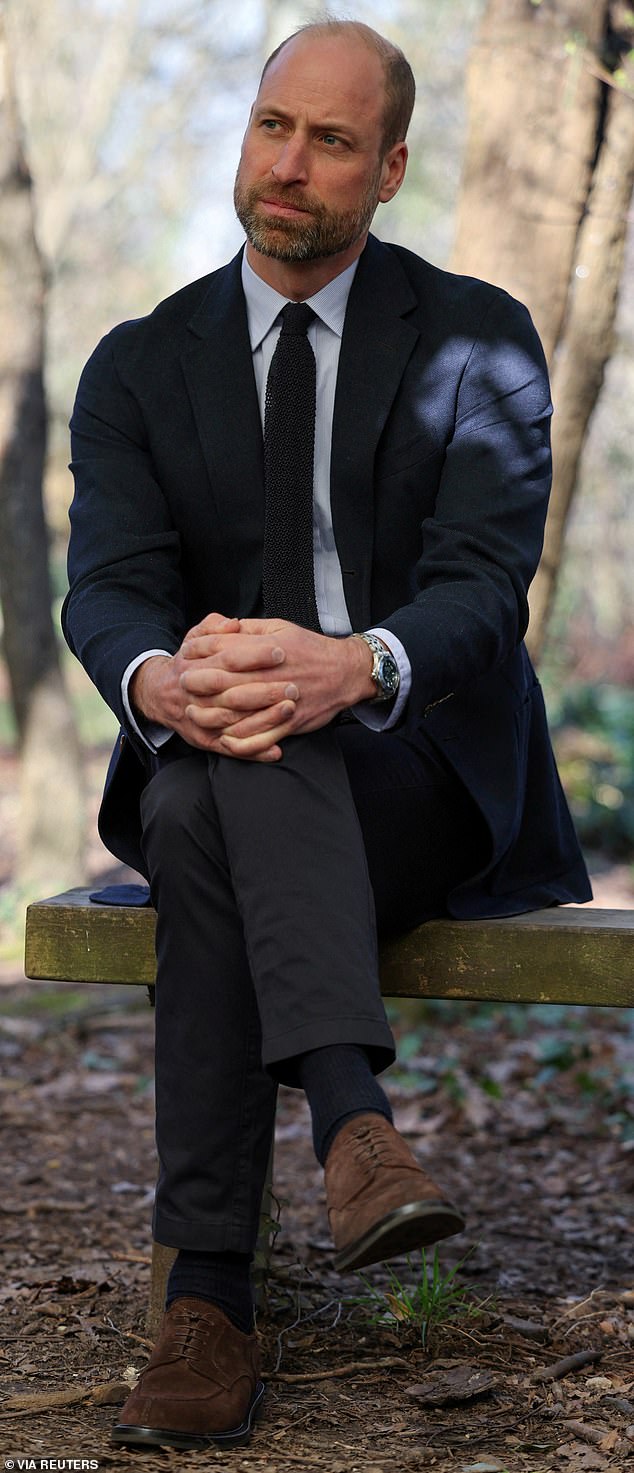
The Prince of Wales has revealed his commitment to the Church of England and his ‘quiet faith’. His devotion to the Christian faith has long been questioned as he is not a regular churchgoer nor as devout as his father, King Charles or the late Queen Elizabeth
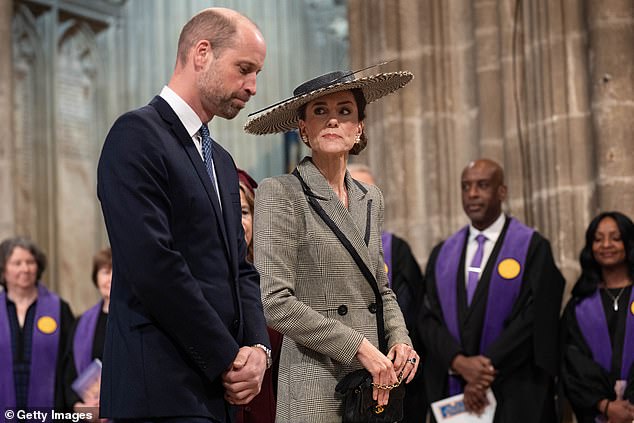
Prince William and Catherine attending the Enthronement Ceremony installing Dame Sarah Mullally as the Archbishop of Canterbury at Canterbury Cathedral on March 25, 2026
Given the questions about him, he decided in the run-up to the enthronement of Sarah Mullally as Archbishop of Canterbury last Wednesday – where William represented his father – that the time had come to let it be known that he is indeed a Christian.
The enthronement, a source said, was an opportunity to say that the future King and Supreme Governor does indeed believe, though an admission was made that ‘the Prince of Wales’s commitment to the Church of England is sometimes quieter than people expect, and for that reason it is not always fully understood’.
Some will argue that faith is a private matter. Except in William’s case it is not. He cannot fall back on the Alastair Campbell response when asked about Prime Minister Tony Blair’s faith that ‘we don’t do God’, because the British monarchy does do God.
The role of the monarch is entwined with the Established Church, which is why William’s seemingly half-hearted expression of faith is disappointing, to say the least.
When looking at his life, there are few clues as to the strength of William’s faith.
Like so many royal babies before him, William was christened in the music room at Buckingham Palace, with the then Archbishop of Canterbury, Robert Runcie, officiating.
Aged 14, he was prepared for confirmation by his father’s friend, Bishop (now Lord) Richard Chartres.
But just a few months later, his mother Diana died tragically in a car crash. Might that have tested his faith in a God who could allow such a dreadful thing to happen?
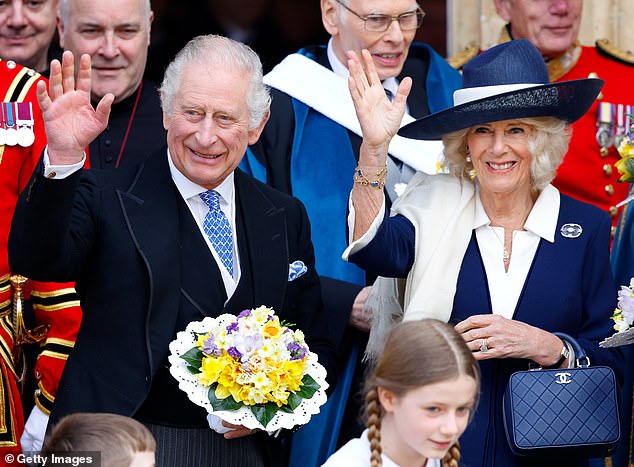
King Charles’s faith is more complicated, enlivened not just by his membership and indeed leadership of the Church of England but also by his interest in other Christian denominations and other faiths. Pictured: King Charles III and Queen Camilla attended the Royal Maundy Service at the cathedral York Minster on April 6 2023
Perhaps being taken to Crathie Church near Balmoral on the morning after his mother’s death was a trial rather than a consolation.
There was little else to go on until his marriage in 2011 to Kate Middleton at Westminster Abbey. Rowan Williams officiated as Archbishop of Canterbury.
Kate, who had been confirmed in the run-up to their wedding, and William together wrote a prayer for the service, which referred to the busyness of each day, and to ‘keep our eyes fixed on what is real and important in life’.
Whether what was important included God was not clear.
Since then the couple have had their three children christened and with the rest of the Windsors attend church at Sandringham on Christmas Day.
But there is little other evidence of the couple being practising Anglicans. They seem, like so many of their generation, to be more into being green than God-fearing.
Kate, in particular, loves to talk about Mother Nature. ‘Winter,’ she enthuses in one of her films about the four seasons, ‘has a way of bringing us stillness… to be at one with nature, a quiet teacher and a soft voice that guides…’
But the guide that traditionally inspires the heir to the throne and his wife is God. Indeed, the hymn Thy Hand, O God, Has Guided was sung at Archbishop Mullally’s installation at Canterbury Cathedral. The final line of every verse: ‘One Church, one faith, one Lord.’
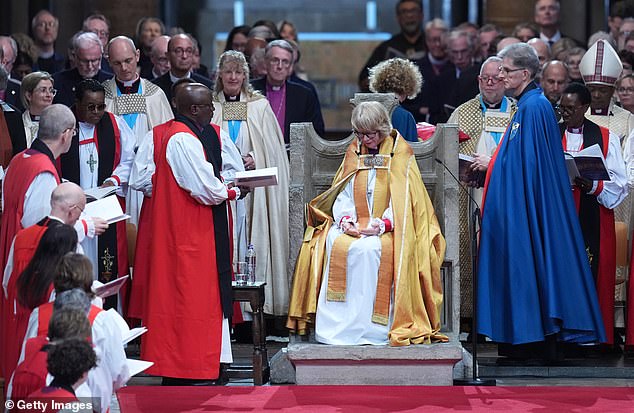
The Most Reverend Dr Albert Chama, Archbishop of Central Africa, led a prayer for the Archbishop of Canterbury Dame Sarah Mullaly during the Enthronement Ceremony on March 25 2026. The Royal family was in attendance
Of course, Britain is no longer a country of one church and one faith. William, like his father, is well aware of how diverse society is today.
The 2021 Census showed that non-believers make up around 38 per cent of the population and that could well increase by the time William is king.
When that time comes, William’s coronation may have to reflect that – and so be less religious a ceremony than his father’s crowning was.
But if religion’s connection with the monarchy disappears entirely, it will be a problem for our constitution, given the Established Church has the monarch at its helm as Supreme Governor.
But it’s more than that. A monarch who believes is a signpost, pointing to something bigger than themselves. That is why, at the coronation of Charles III, when William’s father entered Westminster Abbey, he said of Christ: ‘In his name and after his example I come not to be served but to serve.’
It was a moment of humility: he might be the King, but he looked to a higher power. Without that purpose and meaning, the royals are just another form of celebrity.
The Church of England is not known to be sharp-elbowed in a modern secular world, but it should not be treated as a passive denomination, whose followers should meekly accept a celebrity as its head.
An equivocating, cosplaying Pope or Chief Rabbi would not be countenanced by their congregations, and so the Anglican Church merits the same respect and dignity of being led by a true believer.
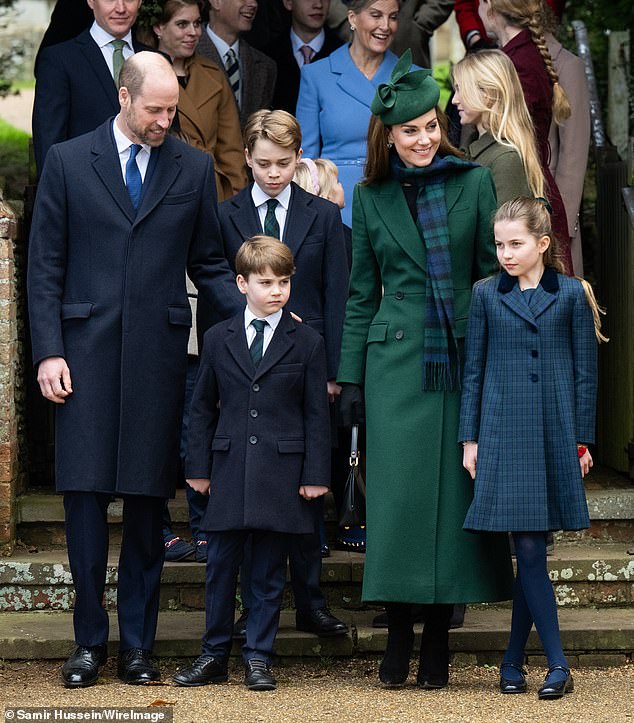
Prince William enjoys attending services at significant times of the year, such as Christmas and Easter. Pictured: Prince William, Prince of Wales, Prince Louis of Wales, Catherine, Princess of Wales and Princess Charlotte of Wales attend the Christmas Morning Service at Sandringham Church on December 25, 2024 in Sandringham, Norfolk
If Willliam cannot bring himself to embrace this purpose then the strong link between monarchy, the people and the Church will dissolve. And passing on this religious role seems impossible.
If William won’t – indeed cannot – be defender of the faith like his father, grandmother and our monarchs reaching back to Henry VIII, who will? Hardly Meghan and Harry, nor any of the doomed Yorks. Anne and Edward, though fine supporters of his father, will surely be too old to step up.
The one hope we have is William’s evident admiration for people whose vibrant faith has inspired them in what they do. These are the people who run charities he loves, like The Passage, the homelessness project in London, founded by the late Cardinal Basil Hume and an order of nuns. This faith in action seems to capture William’s imagination.
It’s also the faith of Archbishop Sarah Mullally that inspired her years as a nurse, and in her William could find a kindred spirit.
If Mullally could explain to the prince how her Anglican faith helps her make sense of the world, and holds her fast to her commitments, then William may yet come to fully embrace it too – and become the staunch defender of the faith the nation deserves.
Catherine Pepinster is the author of Defenders Of The Faith: The British Monarchy, Religion And The Coronation.