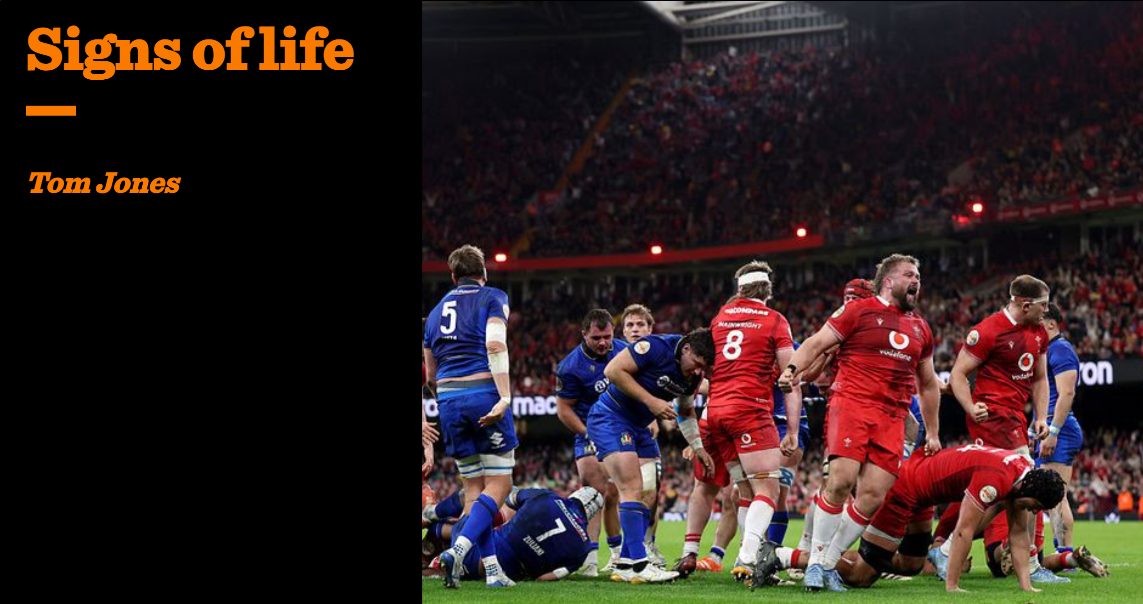
By sheer coincidence, the daffodils I planted in my garden chose the week before last to bloom. Regardless of the painful obviousness of this omen, I was happy to take any sign of good luck ahead of Wales’ game against Italy. After so many years that have offered so little to celebrate, you take your signs of life where you can get them.
“So many years” means precisely three. It has been three long years without a win in the Six Nations — fifteen games in all. Not quite the full drought of that 18-match winless run across all Tests, finally broken against Japan last August, but enough for the bloodless spirits still watching to weep.
But throughout this tournament, there have been undeniable green shoots. The first game was a shelling, 41 points adrift at Twickenham. My self pity and hatred walked hand-in-hand. Somehow it got worse, blown away by France in a record loss the following week. I begin to weary of this motif.
But from a mountain of despair, a stone of hope: Wales went further underwater than the Bismark, but England scored 20 less than the thumping 68-14 loss in Cardiff last year. In 2025, France scored 43 unanswered points: Wales may have let 54 in this time, but at least they put 12 on the board.
The 23-26 loss against Scotland may have been the hardest to take. An uncertain, unsteady, frail and in the end insufficient lead, lost in a moment where the whole team was collectively in absentia and Scotland were, momentarily, world class. It was like being released from prison to be lead to the scaffold: but there was, at least, a lead.
A loss against Ireland was expected, and duly received: but they had come expecting to canter, and instead had to grind. In each of the games, there had been a marked improvement in Wales’ performance: we were still not favourites to beat Italy in the final round, but dare we to dream? Alas, Italy beat England. A momentous, inopportune win.
But the team that turned up to the Principality could do no wrong. A defensive back three that looked sounder than it has in half a decade, a front row that has gone from strong to rock solid, the tireless battering ram Aaron Wainwright, the ever-effusive Tomos Williams all combined to produce a win that the Wales teams of old may have considered routine, but we now consider an important marker. That Dan Edwards’ drop goal will be considered one for the ages showed not only how important this win was, but how much confidence this team suddenly had in itself. A performance, finally, to justify faith.
It has been a long road back for Welsh rugby, and this is not the end of their troubles. The WRU is a mess, there are too many regions and the process already underway to cut one is divisive – and may yet prove insufficient. Players are leaving (blamelessly) for the better security and pay offered by playing abroad. Previous coaching choices to rely on stalwarts instead of blooding youngsters, combined with changes to the player development structure — made to alleviate the financial strains of the unsustainable regions — has resulted in a delayed development curve across a generation of players, and chronic lack of depth.
Restoring Wales to it’s natural, prominent place in world rugby is God’s work: not just for the good of this fan, but for the nation.
The reason I support them, despite only being a quarter Welsh (my grandfather was a coal miner), was that the first game I watched involved featured an implausible number of people also called “Jones”. That was enough for me. My loyalty is founded on a largely ludicrous premise of questionable connection: if I made the same claim about Ireland, I’d be called a plastic paddy. But who pretends to be Welsh? There are not plastic taffs, because Wales does not have much in the way of cultural cache. It is not cool to be Welsh, as it is — currently — to be Irish.
Whereas Irish identity has been aggrandised by the diasporic enthusiasm of America and Scotland’s romantic image was burnished in the Victorian imagination, Wales has had no external patronage. Its cultural weight, such as it is, has therefore been carried disproportionately by rugby. The game matters more there because it has had to: it is a vessel for identity in the absence of anything more substantial.
That is why Wales’ decline has been so hard to bear. Wales are not accustomed to being perennial whipping boys like Italy, nor do they possess the population or structural depth to guarantee competitiveness, as England or France can. Learning to live with defeat is bad enough: the worry it may be permanent adds an existential angst. The performance against Italy was important not so much for the result that it looked like a moment of awakening. Wales looked like themselves again. Not yet restored, but recognisable.
That is for the good of the game, as much as anything. The number of rugby-playing nations is not deep enough to survive losing Wales. A Six Nations with both Wales and Italy as only semi-competitive teams would be rendered ridiculous. Cricket scores may bring short-term schadenfreude to former rivals, but they come at the long-term cost of the impoverishment of the game. Wales is more than a participant in rugby: it is a piece of its soul.