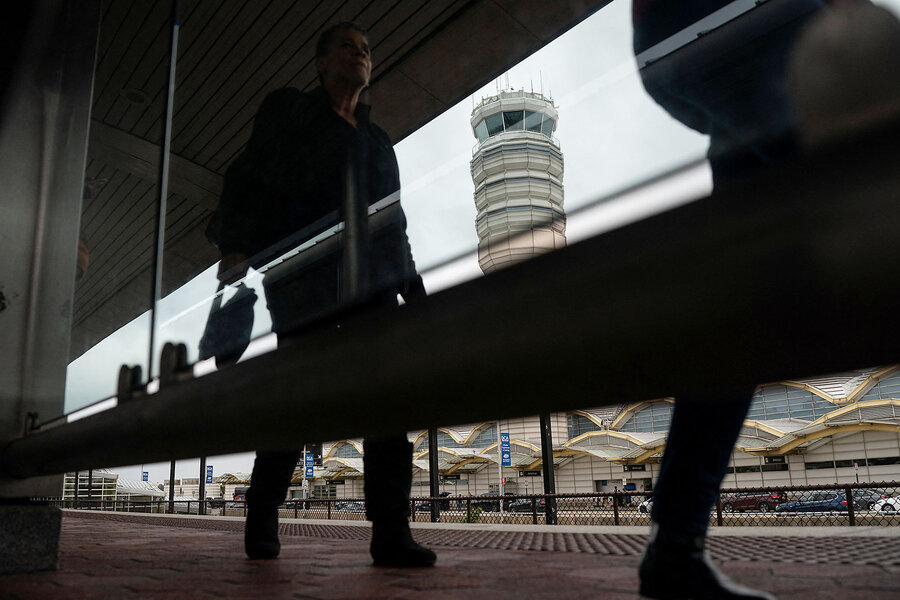
The Federal Aviation Administration faces a shortage of 3,000 air traffic controllers, according to the Department of Transportation. Experts say many of them work six-day weeks, and that a skeletal staff means that even small interruptions can cause flight delays and cancellations.
That’s what happened Monday, when California’s Hollywood Burbank Airport closed its tower for several hours because it had no air traffic controllers, although the airport remained open. While Monday also saw staffing shortages at other airports, and a cascade of flight cancellations, disruptions have been far fewer in subsequent days.
“It only takes one or two sick calls to create something like that at a facility that is so understaffed,” says Mick Devine, executive vice president of the National Air Traffic Controllers Association. “The problems that we’ve been … warning everybody about for years, people are now getting eyes on what it really means.”
Why We Wrote This
Delays resurfaced at multiple airports this week because of air traffic controller shortages. The current shutdown might have a greater effect on the FAA’s attempt to hire enough workers to fully staff the nation’s airports.
Starting on Friday, air traffic controllers will be working without pay. The attention on airline travel brought by the shutdown is highlighting the vulnerabilities created by having bare-bones staff. And, as the FAA tries to fill the gap, it faces a potential obstacle: The government shutdown could set back hiring and training efforts.
Is the shutdown affecting flights?
During a shutdown, all operational air traffic controllers are deemed essential workers and are required to come to work. Some support staff, like finance officers and IT specialists, are furloughed.
U.S. Transportation Secretary Sean Duffy said at a press conference Monday that there had been a slight uptick in the number of controllers calling in sick since the shutdown started. He said Americans may see more delays during the shutdown, adding that air traffic controllers may see extra strain.

“Now what [controllers] think about as they’re controlling our airspace is … Do I have to take a second job and drive Uber when I’m already exhausted from doing a job that’s already stressful to think about how I can make extra money because the government may not provide me a paycheck?” Secretary Duffy said.
The National Air Traffic Controllers Association, a union representing many air traffic controllers, has a new pop-up on its website urging members not to engage in any coordinated efforts that would disrupt air travel.
On Monday, with Burbank’s tower closed for hours and other airports experiencing staffing shortages, more than 6,000 flights were delayed.
Mr. Devine doesn’t believe the delays are caused by “sick-outs.” He says tower shutdowns like the one at Burbank Airport have occurred over 100 times this year at various locations – the result of a strained system that’s already operating at limited capacity.
“It wasn’t affected by the shutdown, it wasn’t caused by the shutdown, it was just highlighted by the shutdown,” he says.
Air traffic controllers will receive a partial paycheck on Oct. 14, but will not receive money on subsequent paydays if the shutdown continues. A new draft White House memo says federal workers are not guaranteed back pay for their forced time off (or unpaid work) during a shutdown, despite a 2019 law designed to ensure that back pay is provided. Historically, federal workers have always received compensation when a government shutdown ends.
What are the longstanding issues with shortages?
A CBS News analysis of FAA data in January found that more than 90% of air traffic control towers were understaffed relative to a target set by the agency, and more than 40% weren’t meeting a minimal agency standard.
The federal government has been trying to close that gap for several years. In 2024, under the Biden administration, the FAA turned out 1,811 new recruits, the most in almost a decade. On Sept. 23, Mr. Duffy announced the Department of Transportation surpassed that number with 2,026 new controllers, exceeding its hiring goals for fiscal year 2025.

The FAA has said it expects to hire 8,900 air traffic controllers by late 2028. But it also plans to lose 6,872 workers because of retirements and other reasons, leaving it short of the 3,000 air traffic controllers needed to fully staff airports across the country.
Michael McCormick, an associate professor at Embry-Riddle Aeronautical University and a certified control tower operator, says the pandemic and other government shutdowns are driving staffing shortages.
The pandemic disrupted the training and hiring process, and, he says, led to a wave of early retirements given an uncertain work environment.
Government shutdowns have a similar effect. Typically, the FAA has frozen the hiring and training of air traffic controllers during shutdowns. All controllers are funneled through an academy in Oklahoma City. The academy can only graduate a certain number of people each year, and it’s often several more years before trainees can become certified – so if a shutdown causes them to miss a slot of recruits, the effects can be felt years into the future.
“The 2018-2019 shut down is one of the major reasons why we’re in the scenario that we’re in today,” says Mr. Devine, referencing the interruptions in training.
During the current shutdown, the training center is operating on emergency funding that will last 30 days.
But if that funding runs out, warns Mr. Devine, “you’re looking at probably even worse staffing in 3 or 4 years than we have today.”
How did travel delays affect the most recent shutdown?
On Jan. 25, 2019, a few air traffic controllers calling out sick caused delays at airports in New York, New Jersey, and Philadelphia. That same day, President Trump ended a 35-day shutdown, the longest in U.S. history. Both Democrats and Republicans had raised concerns the shutdown was putting too much strain on airports.
Now, each side is tying the recent delays to the shutdown, and blaming each other.
“Thanks, @realDonaldTrump! Burbank Airport has ZERO air traffic controllers from 4:15pm to 10pm today because of YOUR government shutdown,” wrote California Governor Gavin Newsom on X Monday.
“The reason we are shut down is because YOUR party can’t get its priorities straight,” responded Mr. Duffy.
Dr. McCormick hopes the shutdown can help highlight the real people in the airline industry who are affected.
“[Our air traffic controllers] work hard, they’re dedicated, they are professional, but at the end of the day they’re human,” he says. “And when policymakers then have the opportunity to see them as what they are – people – and the impact it’s doing to them, that I think is a motivation to come together and reopen government.”