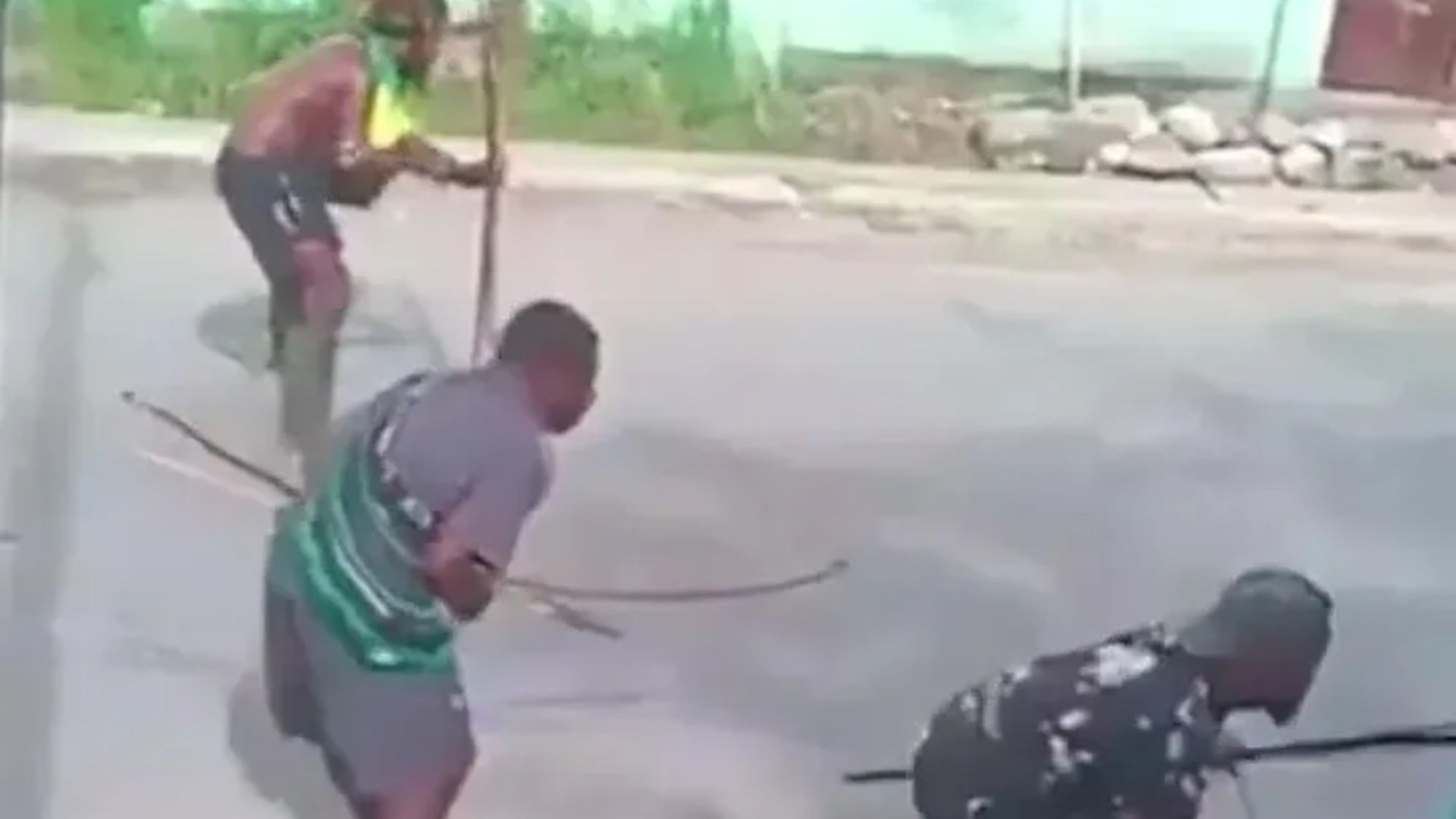
THIS is the moment two rival tribes in Papua New Guinea clashed on a public street, unleashing a barrage of arrows as fighters ducked, dodged and leap through the chaos of a traditional brawl.
Dramatic footage shows dozens of men pouring onto a narrow roadway, hunched low as they advanced towards one another armed with bows, arrows and machetes.
Some can be seen sprinting forward before abruptly dropping to the ground to avoid incoming fire.
Others vault cleanly over arrows that strike the tarmac beneath their feet.
The clip captures the raw intensity of the confrontation, with fighters moving in co-ordinated bursts, drawing arrows from their backs and firing at close range.
Several men leap sideways at the last second as arrows whizz past their heads makeshift cover before re-joining the fray.

Despite the ferocity of the clash, firearms are notably absent.
Guns are forbidden on the streets, forcing rival clans to rely on traditional weapons that have been used in tribal warfare for centuries.
It remains unclear whether any members of either tribe were injured during the confrontation.
Clans and tribes across Papua New Guinea have long fought over grievances such as land ownership, compensation disputes and perceived insults.
In more recent years, elections have increasingly acted as flashpoints for violence, with tribes aligning themselves along local candidate and party lines.
Traditionally, conflicts are governed by strict customary rules. The man who first raises a grievance – known as “the owner of the fight” – is responsible for starting and ending the confrontation, with his clan expected to support him.
Elders historically played a stabilising role, encouraging mediation and ensuring neutrality, including rules forbidding attacks on non-combatants or neutral buildings.
However, community leaders say those customs are increasingly ignored.
Younger fighters are often accused of launching attacks against the wishes of elders, eroding long-standing mechanisms designed to limit bloodshed.
While bows and arrows remain symbolic weapons of tribal conflict, the wider picture is far more deadly.
In the highlands, the influx of mercenaries and automatic firearms has transformed small battles into mass killings.
Last year, police discovered 64 bloodied bodies along a remote stretch of road in stretch of road in Papua New Guinea’s remote highlands in what authorities described as a gruesome escalation of tribal violence.
The victims were believed to be fighters ambushed by a rival group in the early hours of the morning.
Graphic police images showed stripped and mutilated bodies piled onto a flatbed truck or lying naked by the roadside, some with limbs hacked off and bottles or cans placed on their chests.
Police Commissioner David Manning condemned the attack as a “disgraceful act of barbarity” and announced targeted security operations to restore order, warning officers had permission to use deadly force if civilians or security personnel were threatened.
Assistant Commissioner Samson Kua later confirmed gunfights were continuing in nearby valleys and that bodies were still being recovered from surrounding bushland.
Investigators said the attackers had access to an extensive arsenal, including AK-47s, M16s, AR15s and pump-action shotguns.
In the highlands of Papua New Guinea, tribal warfare has become so embedded in daily life that many now view it as inevitable.