This article is taken from the April 2026 issue of The Critic. To get the full magazine why not subscribe? Get five issues for just £5.
Like everything else in The Critic, this column generates staggering quantities of reader reaction, but we’ve never seen anything like the postbag that greeted my recent excursus to Nunland, a serene, even rather beautiful (I thought) appreciation of various sainted singing sisters through the ages.
One suspects a campaign orchestrated by disgruntled ex-convent girls with immemorial grudges against gimlet-eyed sadists twitching their rulers and driven to misanthropy by that sadly undersung garment, the hair-knicker. Less Sister Simper, was the feeling, more Attila the Nun.
And so, very much like the undead sisters of Giacomo Meyerbeer’s Robert le diable, risen from their tombs for one last sexy boogie, opera’s Swingle Sisters sashay back for an encore.
Because of course the truth is that the holy — or at least non-Satanic — nuns in Dead Man Walking and Dialogues of the Carmelites are heavily outnumbered by an altogether racier phalanx corresponding more closely to those we know and love from Nunspolitation-era docudramas like School of the Holy Beast (1974) and Ken Russell’s parodic The Devils (1971), whose main purpose was evidently to confirm the widely-held suspicion that it’s the shortest of hops from convent to cathouse — indeed, they may very well be co-located.
The chap who first sowed this attractive nuncore flowerbed in our cultural landscape was surely Matthew Lewis, in his disgraceful 1796 novel The Monk, the greatest of the early Gothic horrors, which simply swarms with cowled Whitby extras stalking about the place with malign intent.
Its most out-of-control episode is the “Bloody Nun” bit. The hero (possibly drunk) devises a wheeze to spring his beloved from captivity in a haunted castle, by having her dress up as the resident ghost — that bloodstained Nun — but in a hilarious mix-up, he finds himself eloping not with the girl, but with the actual ghost, with all manner of cool sacrilo-necrophile ramifications.
The Nun herself pops up in various operas, from Charles Gounod’s La nonne sanglante to Gaetano Donizetti’s Maria de Rudenz. And once launched, naturally nothing could stop the frenzy of operatic nundom, a high bar being set by that early showing in Meyerbeer’s 1831 supernatural chiller.
The Paris opera guys really nailed the whole sexy-sister thing — now going strong for 200 years — with the chorus girls laying out their wares in a spicy routine as lust-crazed zombie nuns in diaphanous habits and very little besides, risen from their graves to seduce the title character with those cloister-rehearsed moves.
A statue of the Virgin Mary that springs to life to drag her back to the nunnery
Beat that, suckers! Indeed, as Europe subsided into sugary Victorian piety, it began to look as though the sisters’ salad days were over — culminating in André Messager’s 1914 piece Béatrice, where our erring novice is rescued for the team by a statue of the Virgin Mary that springs to life to drag her back to the nunnery.
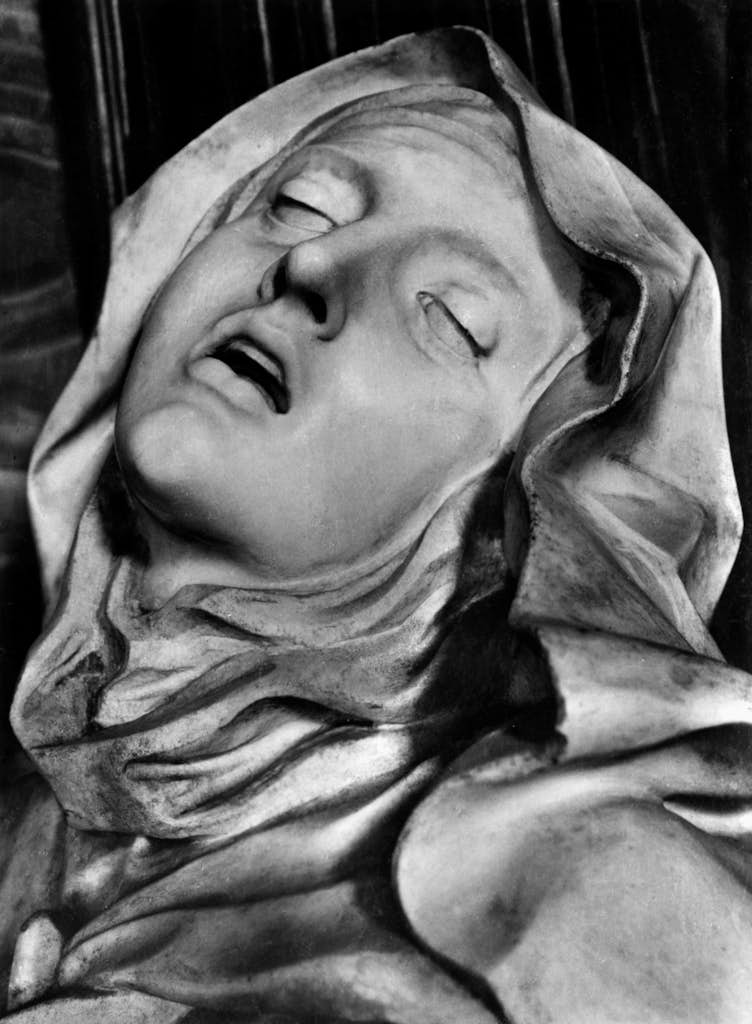
But it seems the suspicion, familiar from the tales of Boccaccio and Chaucer — that the nun’s habit generally conceals a severe case of chaud au cul (I mean, just take a look at Gian Lorenzo Bernini’s Saint Teresa) — was altogether too strong to die out. In addition, with the demands of time and accelerated plot development endemic to opera, its heroines frequently find themselves required to conduct portfolio careers.
There is the slave/undercover agent (Aida), witch/hag/queen (Alcina), cigarette girl/smuggler (Carmen), fox/fur muff (Vixen Sharp-Ears), Wandering Jewess/drudge/hooker (Kundry), opera singer/hooker (Giaconda), earth spirit/hooker (Lulu) and — yes, bien vu, pattern-spotters! — the high-five jackpot of them all, nun/hooker … the Royal Flush dealt to lucky old Thaïs in Jules Massenet’s 1894 opera about the busy 4th century Alexandrian courtesan-stroke-saint.
As you might expect, though the creepy Americans veered towards emetic sanctimonies like The Nun’s Story and The Sound of Music, a strong alternative strand revived in 20th century Europe.
I’m longing for some death-devoted company to dig up Paul Hindemith’s 1921 trilogy of short expressionist one-acters, cartoonishly in tune with current sensibilities: a comic farce about rape, Das Nusch-Nuschi; an enthusiastic examination of erotic strangulation, Murderer, Hope of Women and Sancta Susanna, wherein our holy hottie becomes inflamed by the nice spring weather and tries to get it on with Jesus on the big crucifix. (This works out only fairly well, with her colleagues deciding to wall her up.)
Happily, this last opera forms the basis of Sancta, now at the Flemish Opera in Antwerp — you may have read about it a while back when it launched in Stuttgart and the audience was merrily throwing up, passing out, having strokes and so on.
It all sounds most engaging, described as “the trigger warning that belongs to the Catholic Mass”, with the show’s creator, Austrian director Florentina Holzinger, noting that since opera audiences are pretty ancient, actually dying at the opera would probably be rather nice for them.
This vastly expanded (with music by everyone from Bach to transhuman music experiment and Berghain darling, Born in Flamez) “celebration of the body” is best known for its naked roller-skating nuns who, we are promised, get up to all kinds of other exciting stuff with each other too.
Well, obviously I’m going, in the fearless tradition of The Critic, hoping for the puerile provocation that would seem to be indicated, though you never know. Watch this space, and pray for me.
Sancta is at Opera Ballet Vlaanderen from 4 April