In the middle of the war, as missiles from Iran and Lebanon were raining down on Israel and fighter jets were striking Tehran, Lt. Gen. Eyal Zamir, the Israel Defense Forces’ chief of staff, visited the West Bank to issue a warning over a surge of settler violence against Palestinians.
Speaking to Israeli military officers, General Zamir’s wording was both strong and guarded at the same time. He did not refer explicitly to “settlers” as the perpetrators or to “Palestinians” as the victims. But he did say the offenders are a “threatening minority from within” who endanger Israel’s security as well as its values.
“In recent months, there has been an increase in nationalist crime incidents, some of which are directed against our troops and toward civilian populations,” he said last week in a statement.
Why We Wrote This
Under cover of the Iran war, settler extremists have increased violent attacks against Palestinians in the West Bank. A range of Israeli leaders, from rabbis and former diplomats to Benjamin Netanyahu’s hand-picked military chief of staff, are raising their voices in condemnation.
“It is unacceptable that during a multifront war the IDF is also forced to confront a threatening minority from within. These are rioters who do not represent the greater population,” he said. “In reality, they endanger residents, security, stability, and our values as a people and as a state.”
According to Israeli rights group Yesh Din, 257 incidents of settler violence or harassment against Palestinians were reported across the West Bank in the first 25 days after the Israel’s Feb. 28 attack on Iran. The incidents, spanning 116 Palestinian communities, included shootings, physical assaults, property damage, and threats.
Six Palestinians were shot and killed by settlers during that period, Yesh Din says, adding that to the best of its knowledge, none of the suspected shooters have been arrested.
Coalition tensions
General Zamir assumed command of Israel’s military a year ago after being hand-picked as a loyalist by Prime Minister Benjamin Netanyahu. Yet his remarks suggest an increase of tensions with the more extreme members of Mr. Netanyahu’s coalition, with whom the military chief has already clashed over Gaza policies.

Indeed, the general called on Israeli authorities to take action against the settler violence and “stop it before it is too late,” effectively pointing a finger at the Israeli police, the Shin Bet security service, and the coalition itself. Two key far-right ministers are themselves settlers: Itamar Ben-Gvir, a longtime provocateur turned minister of national security, in charge of Israel’s national police; and Finance Minister Bezalel Smotrich, who is also tasked with overseeing settlements and the West Bank.
The surge in Jewish-extremist violence is testing the country’s rule of law, straining its security forces, and exposing divisions within Israel over how – or whether – to confront it. And the warning from General Zamir underscores growing concern in the military that such attacks could ignite further instability, even as election-year politics limit the government’s response.
General Zamir made his “very important” statement because there was “no way to ignore” events in the West Bank, says Yohanan Tzoreff, a senior researcher at the Institute for National Security Studies in Tel Aviv.
General Zamir’s words were guarded, Mr. Tzoreff adds, because in the middle of a multifront war – with Iran, in Lebanon, and still in Gaza – he is seeking to avoid open confrontation with influential ministers in the coalition for whom expanding Jewish settlement in the West Bank is a primary goal.
“Can you expect him to speak more clearly? … I’m sure he wants to … but he cannot,” says Mr. Tzoreff.
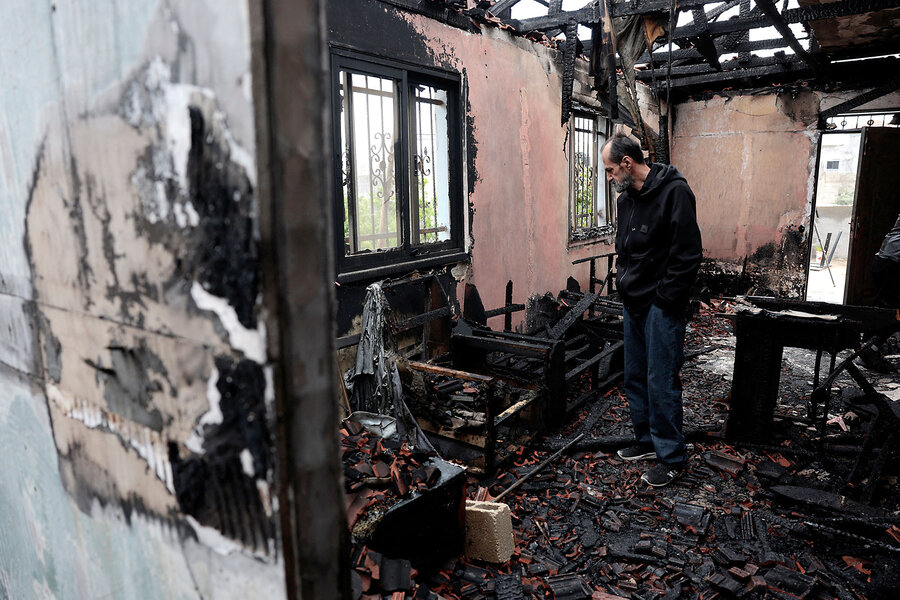
The violence continued last weekend. Rioters entered Palestinian villages overnight on Saturday, throwing stones and setting fire to homes and vehicles, after a settler was fatally struck by a Palestinian vehicle in Beit Imrin, an area where Israelis are prohibited from entering. Investigators are trying to determine whether it was an attack, as quickly claimed by some right-wing politicians, or an accident.

At the settler’s funeral, Mr. Smotrich said he was working toward the “collapse” of the governing Palestinian Authority and to assert control over the West Bank.
According to Yonatan Kanonich, the head of research at Yesh Din, the Netanyahu government wants to annex as much of the West Bank with as few Palestinians as possible, and the aim of the settler violence is to achieve this by forcing Palestinians from their homes.
“Israel is enjoying the fruits of this settler violence,” he says.
Increase in fatalities
Over the past three years, the number of people taking part in the riots – often “hundreds of people together” – as well as the number of weapons used, has surged, Mr. Kanonich says. That’s because “Israel handed out a lot of arms, mainly to settlers, following Oct. 7,” he says, referring to the deadly 2023 Hamas attack that triggered the Gaza war.
Since the start of the war with Iran, as global attention was diverted, there has also been a “dramatic rise in the number of dead,” he says. “Six Palestinians were killed by settlers in the first two weeks of the war; that is a crazy number.”
General Zamir’s decision to visit the West Bank during a war with Iran and Hezbollah was itself a “bold statement,” said a military official, speaking on condition of anonymity. The solution to the violence, the official added, will require coordinated action between the army, police, political leadership, and local community figures who need to speak out strongly.
The recent violence has been so extreme that it has drawn condemnation from opposition members of the Knesset and other politicians, as well as from rabbis, former security heads, educators, and in a signed statement by more than 100 former ambassadors and senior Foreign Ministry officials.
In a post on social platform X, Rabbi Yehuda Gilad, who heads a Modern Orthodox yeshiva, described a firsthand account from a young Palestinian in the Bedouin village of Khirbet Humsa, where a “pogrom” had taken place. The West Bank village is a 30-minute drive from his Yeshivat Ma’ale Gilboa in northern Israel. “Alas, what has become of us?” he posted.
The violence in the West Bank is “a desecration of God’s name and a distortion of the Torah,” he told the Monitor in a phone interview.

Most settlement rabbis oppose such violence, as do most settlers, Rabbi Gilad says. “But there is a group of some extreme rabbis that don’t. And these violent people don’t even ask the rabbis, they do what they want.
“In each society, there are those committing illegal acts, and the police must clamp down on them,” he adds, but Mr. Ben-Gvir, the minister of police, “doesn’t really care.”
Averting eyes
The public, meanwhile, still reeling from Oct. 7 and now dealing with missiles launched by Iran and Hezbollah, prefers to look elsewhere rather than confront what is happening in the West Bank, where Israel restricts the freedom of millions of Palestinians, says Yesh Din’s Mr. Kanonich.
“If you told any decent Israeli about a policy of a far-off country doing such a thing to so many people, they would be in shock. But when it is our backyard, we prefer to ignore it,” he says.
Is change on the way?
Under pressure from the United States, Mr. Netanyahu convened a security meeting last week to address nationalist crimes in the West Bank and called for action, Kan News reported on Sunday. The national police said it had arrested seven suspects linked to the violence in Khirbet Humsa.

Maj. Gen. Avi Bluth, the head of the IDF’s Central Command, which is in charge of the West Bank, also issued a stark warning last week about attacks against Palestinian civilians, cautioning they could ignite a new front in the West Bank. He urged public leaders, rabbis, educators, and parents to act and speak out in a “clear voice.”
“This situation cannot continue,” he wrote in an open letter.
General Bluth is “very serious about preventing this expansion of Jewish terrorism,” says Israel Ziv, a retired general. But without clear condemnation from the government, it will be “very hard” for the army to do the job, he adds.
And words alone will not make a difference, only facts on the ground will, analysts and activists say.
That is unlikely in an election year, says Michael Milshtein, head of the Palestinian Studies Forum at Tel Aviv University.
“Right now, unfortunately, I see no change,” he says. Several months before elections, Mr. Netanyahu won’t want to be seen as “someone who actually promotes activities against the settlers.”
“The only thing that can really be a game changer is American pressure on Israel,” Dr. Milshtein says.