Pape Sady’s teenage sons left in the dark.
One morning in 2020, he woke up and Abdoulaye and Souleymane weren’t there. He waited two days, then three. He asked around. But deep down, he already knew.
Pape had warned them about the risks of the perilous days at sea. After all, he’d made the trip to the Canary Islands himself, over a decade ago.
Why We Wrote This
In Senegal, poverty makes young people embark on a dangerous voyage to reach Europe. Parents and local leaders are seeking solutions to encourage them to stay.
“For over a week, I couldn’t eat or sleep,” he recalls from the courtyard of his sister’s home in the seaside town of Joal, once a popular departure point for migration to Europe. “I knew the route, and that it shouldn’t have taken so long.”
Nearly 64,000 people arrived illegally in Spain in 2024, with a record 46,843 landing in the Canary Islands – the country’s closest point to Africa – from the West African coast, according to the Spanish Interior Ministry. Aid groups say an additional 10,457 people died or disappeared trying to reach Spain that year, most of them attempting the Atlantic route from West Africa, whose strong currents have made it the most dangerous sea crossing in the world for migrants.
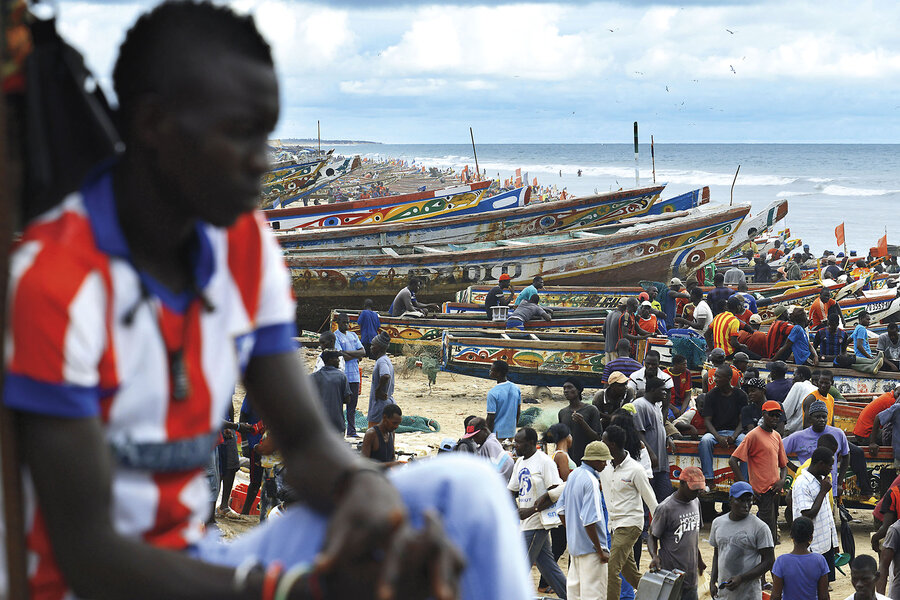
Many were departing coastal towns and villages like Joal, where families who once relied on the sea for jobs now struggle to put food on the table, as industrial fishing increasingly puts traditional fishermen out of work and strips the ocean of precious resources.

But as Pape knew only too well, if the risks of leaving are clear, so are the rewards. Nestled among Joal’s simple concrete homes and dirt lanes are stately, freshly painted two-story houses, built with money sent home from migrants. This tempts those who can’t make ends meet with the promise of a life in Europe. Last year, remittances accounted for 11.6% of Senegal’s gross domestic product, according to the World Bank.
“Many here say it’s better to die at sea than next to the sea because you didn’t have enough to eat,” says Moustapha Diouf, a local antimigration activist who is trying to convince young people like Abdoulaye and Souleymane Sady to remain in Senegal.
Two decades ago, when Mr. Diouf himself boarded a boat bound for Europe, he had felt that same tug. Now, as Senegal’s coastal villages empty out of their young people, he is trying to make the opposite pitch: Stay, and try to build something better here instead.
The stakes of this fight are calculated in the lives of those like Abdoulaye and Souleymane, the stability of fishing communities like Joal, and even the future of this country. At a time when Senegal looks to build its industries and assert independence from the West, the country needs its young people.
But leaders, activists, and parents face an uphill battle to keep them at home. International migration is growing, and historical evidence suggests that as poorer countries approach middle-income status, people tend to leave more often, not less. Senegal now faces a quandary affecting countries across the region: When the promise of Europe burns so bright, what would it take to keep young people at home?
“I told Abdoulaye and Souleymane, ‘Watch out, it’s not better over there,’” says Pape. “But they were stubborn and determined. They went anyway. Luckily, they survived.”

A harrowing voyage to the Canary Islands
Abdoulaye Sady didn’t want to disappoint his father, but he knew he couldn’t stay. He worked as a hairdresser in Joal and fished with his dad and brother on the weekends. Still, he found himself calling his mother in mainland Spain each month, asking her to wire him cash.
In Europe, he thought, he could earn more and help his family out.
When Abdoulaye boarded the wooden fishing boat along with 180 others that day in 2020, he knew the risks. But he had grown up on the water. The waves didn’t scare him.
Nothing prepared him, however, for the harrowing voyage to the Canary Islands. The trip was supposed to take five days, but halfway there, the boat got lost. After a week at sea, it ran out of gas. The passengers could see the Canary Island of El Hierro, which their phones’ GPS told them was only 11 miles away. But they were trapped, the last of their food and water gone.
For four days, the boat drifted agonizingly toward the shore. In desperation, some people drank seawater and became violently ill, or dehydrated. When his fellow passengers began to die, Abdoulaye watched as they were thrown overboard.
“I couldn’t look at the sea for a long time after that,” he says from a hillside café in La Orotava, on the Canary Island of Tenerife. “Every time I would go to the beach here, I always thought of that trip, of the people who died.”
Like many young men who leave Senegal, Abdoulaye grew up in a fishing family; each evening, Pape came home with fresh fish for dinner. But by the time Abdoulaye began joining him on fishing trips as a teenager, they often returned empty-handed.

A state of collapse, then glimmers of a recovery
The family’s problem is one that faces fishing communities along the length of Senegal’s coast, where the majority of fish populations are in a “state of collapse,” according to a report by the Environmental Justice Foundation. Small-scale fishers like the Sadys have seen their catch decrease by over half in recent years, and say their living conditions are also plummeting.
One of the main culprits is the industrial fishing boats roaming the Senegalese coast, dragging tens of thousands of tons of fish into their nets each year. While most of these ships are registered as Senegalese, many are in fact controlled by foreign investors from Europe and China, and often flout restrictions on where they catch and how much.
That has squeezed the local fishing industry, and also altered the way Senegalese eat. Traditionally, fish has been a centerpiece of local diets, and the star attraction of beloved dishes like thieboudienne, a plate of stewed white fish served over a bed of rice and vegetables.
But as Senegalese fish exports quadrupled between 2008 and 2018, the amount of fish available to households here fell by half, according to a 2022 study in the journal Marine Policy. Losing fish means “losing tradition,” U.S.-based Senegalese chef Pierre Thiam told The Associated Press.
In November 2024, the European Union announced that it would not be renewing an agreement with Senegal that allowed European boats to fish surplus stocks in Senegalese waters in exchange for yearly payments of around $1.8 million.
Although European boats are responsible for only a small proportion of the total catch in Senegalese waters, many Senegalese see the end of the EU agreement as a positive sign for the local fishing industry, in particular traditional fishers.

“Compared to two years ago, we’re already seeing a difference,” says Abdourahmane Diouf, a member of Joal’s CLPA, the local artisanal fisheries council. “Revenues are going up. Marine life, especially octopus and sardines, is starting to come back.”
But for small-scale fishermen, so far little has changed.
Inside the Joal port on a recent morning, men in rubber boots scurry around, sorting fish and packing them into refrigerated trucks destined for the international market.
But local authorities estimate that nearly 90% of fishermen in the area work in the artisanal sector, and out on the beach, dozens of their wooden fishing boats sway idly near the shore. Meanwhile, fishermen crouch under the awning of a building with nowhere to go. Three women attempting to sell octopus say they do so in vain – most middlemen will end up buying from the big industrial boats.
Pape still tries to go out to sea each day with his 16-year-old son, Ibrahima, who dropped out of school to help his dad fish. Together, they catch miniature sharks to sell to hotels and clients in Ghana. Whatever the pair doesn’t sell, they exchange for fish to feed their family of 10.
In addition to Abdoulaye and Souleymane, Pape’s eldest son and his first wife live in Bilbao, Spain, where she earns a living braiding tourists’ hair. In good times, Abdoulaye sends a few hundred euros to his father – enough to pay for the family’s food for a month. But inflation and poor job prospects mean it’s getting harder and harder for any of them to send money home.

Meanwhile, Pape’s two other wives work odd jobs, collecting plastic garbage from the beach and selling it to recycling centers or selling small amounts of fish at the port.
“We have enough money to eat, but not much else,” he says, crossing his arms on a low bench in the courtyard, while a sheep bleats in the next room. “I can never relax. There are so many mouths to feed.”
But although Pape struggles to provide for his family, his friends and neighbors call him “the little rich guy” because he has sons in Europe. His second wife has started pleading with him to allow Ibrahima to migrate to Europe, so she can have a child who’s “made it,” too.
“If Ibrahima comes to me one day and says he wants to leave on a boat, I’ll refuse,” says Pape, shaking his head. If his brothers can sponsor him for a visa, “maybe,” he says. “But on a boat, no way.”
Europe less welcoming of immigrants
The promise of legal status is one of the key factors driving so many Senegalese migrants toward Spain in particular. The country has long had more open policies toward new arrivals than many of its European neighbors. In May, its government simplified the procedure for obtaining residency and work permits.
It has also expanded its circular migration program, which provides short-term visas for West Africans to come to Spain for seasonal work, mostly in agriculture, before returning home.
But the number of people who qualify for the circular migration program, which involves a lengthy interview process, remains small. And “because it doesn’t provide a longer-term perspective, people don’t get enough skills to invest back in Senegal,” says Ravenna Sohst, a policy analyst at the Migration Policy Institute Europe.

Annika Hammerschlag/AP/File
For migrants who are able to remain in Spain, meanwhile, there are other challenges. Far-right and anti-immigrant parties have gained ground across Europe – including some regions of Spain. Despite the country’s open policies, polls show a growing majority of Spaniards support the deportation of both unauthorized migrants and those with legal status who commit crimes.
Abdoulaye says he has, at times, experienced “horrible” racism and battled assumptions that migrants like him are only in Spain to benefit from the country’s social security net, instead of working to integrate into Spanish life. He just wants to be treated as a “normal person,” he says, but instead, “everyone thinks all Black people just got off the boat.”
Many unauthorized migrants also remain stuck working low-paying, under-the-table jobs that don’t make them enough money to send home, much less pay their own bills.
“Families think that you arrive in Europe and it’s an El Dorado. But it’s exactly the opposite,” says Alioune Fall, president of Sama Chance. The Dakar-based nonprofit provides newly returned migrants with temporary housing and psychological support to help them reintegrate into Senegalese life.
“Some people have had very intense experiences; many have been exploited,” says Mr. Fall. “They’re ashamed to return to their families and say, ‘It didn’t work out.’”
Convincing young people to stay in Senegal
Moustapha Diouf, the migration activist, is determined to stop young people from leaving Senegal in the first place. In 2006, he was one of the more than 30,000 people who left West Africa for the Canary Islands, part of a historic migration wave that lasted until 2008. The majority came from Senegal, where global price shocks collided with an erratic rainy season that led to low crop outputs for farmers.
But soon after his arrival, Mr. Diouf was imprisoned and deported back to Senegal. Upon his return, he set up the nonprofit AJRAP – Association of Young Repatriates – and has since become an outspoken voice against migration. From his home in Thiaroye-sur-Mer, an impoverished fishing village outside Dakar, Mr. Diouf makes the rounds in schools and community centers across Senegal to spread the word about the dangers of migrating by sea.
“People here are very poor,” he says. “But we shouldn’t have to do this.”
Mr. Diouf’s campaign is part of a wider effort to reduce both the push and pull of migration. In October of last year, the EU announced that it was giving Senegal €30 million ($34 million) to help prevent illegal migration to its shores.

The money will go toward stopping departures and human trafficking, supporting sea rescues, and educating people about the dangers of migrating by sea. At the same time, Senegal’s marine corps has begun tracking its waters for illegal fishing – which equally helps detect boats headed for Spain.
The EU has also spent more than €160 million ($185 million) in Senegal since 2015 on efforts to address the root causes of migration – like poverty, poor governance, and insecurity. But the impact has been inconclusive.
Now, activists like Mr. Diouf are pushing Senegal’s national government to do more to convince young people to stay. He says not enough of the money promised for education and job training is actually reaching Senegalese communities.
Meanwhile, in towns like Joal and Thiaroye-sur-Mer, the lure of Europe and what it can offer continues to separate the haves and the have-nots.
In these towns, most residents live in weathered homes made of sand and clay that flood every time it rains, where flies buzz over fresh meat in open-air courtyards because refrigerators are too expensive. Wooden pirogue boats idle in the bay, while young people do odd jobs – rolling car tires across town or selling bags of tap water – to help their parents make ends meet.
But on nearly every corner, fancy houses tower above their neighbors. Inside are televisions and washing machines, purchased with money sent from abroad. Those with family in Europe sport Nike-brand tracksuits and shoes. They needn’t worry how the electricity and water bills will get paid at the end of the month.
More patrols in Senegalese waters have largely stopped young people from boarding empty fishing boats in coastal towns like Joal and Thiaroye-sur-Mer, say local authorities. But the restrictions have only pushed them into the hands of smugglers on the coast of Gambia, Guinea-Bissau, and Mauritania.
“Obviously, these kids don’t want to risk their lives,” says Mr. Diouf, crouching next to a pirogue canoe at Thiaroye-sur-Mer’s beach. “They’re just motivated to have a better life.”
The Canary Islands still beckon
Back in Tenerife, Abdoulaye has a temporary residency permit and is trying to move forward. He’s training to be a chef and works as a translator from Spanish to Wolof, to help Senegalese arrivals with the challenges of adjusting to their new European life. His brother Souleymane recently moved to El Hierro with his Spanish wife, who is pregnant with their first child.
But Abdoulaye says their lives in the Canary Islands have, at times, been “extremely hard.” He often struggles to pay his rent for the apartment he shares with a handful of other men from Joal, and every time he goes to the store, it feels like prices have gone up again. This fall, he had a bike accident, hurt his wrist, and hasn’t been able to work since.
Abdoulaye tries to convince his little brother, Ibrahima, to be sensible – to wait for his brothers to send him an invitation to come to Spain on a tourist visa or through the family reunification process.
It’s not just for Ibrahima’s sake, but for Pape’s, too. Abdoulaye grew up hearing his father’s painful migration story. He’d set off for Europe on a fishing boat, working illegally at a Spanish port while their mother struggled back in Joal to take care of Abdoulaye and Souleymane – just toddlers then – by herself.
“I keep telling my brother to be patient, to wait for the paperwork to go through. ‘We will buy you a plane ticket,’” says Abdoulaye. “‘Don’t come by boat; it’s madness.’”
But for Ibrahima, the desire to have what his brothers do in Europe rings louder.
“Life is really hard here,” he says, just out of earshot from his father, back in Joal. “There’s no time to go out, only to go fishing and get enough money to eat. I want to be able to buy things, like shoes and nice clothes.”
Pape knows what his son dreams of, and it keeps him awake at night. Already, each morning when he goes to wake Ibrahima for another day at sea, he pauses at his bedroom door, wondering if his son will still be there.
“Right now, Ibrahima is young. He still listens to me,” Pape says. “But once he gets older, he’ll stop taking my advice. I know he’s going to leave one day, too.”
Colette Davidson and Essouly Diedhiou reported from Joal and Thiaroye-sur-Mer, Senegal, and Ms. Davidson from La Orotava, Tenerife.