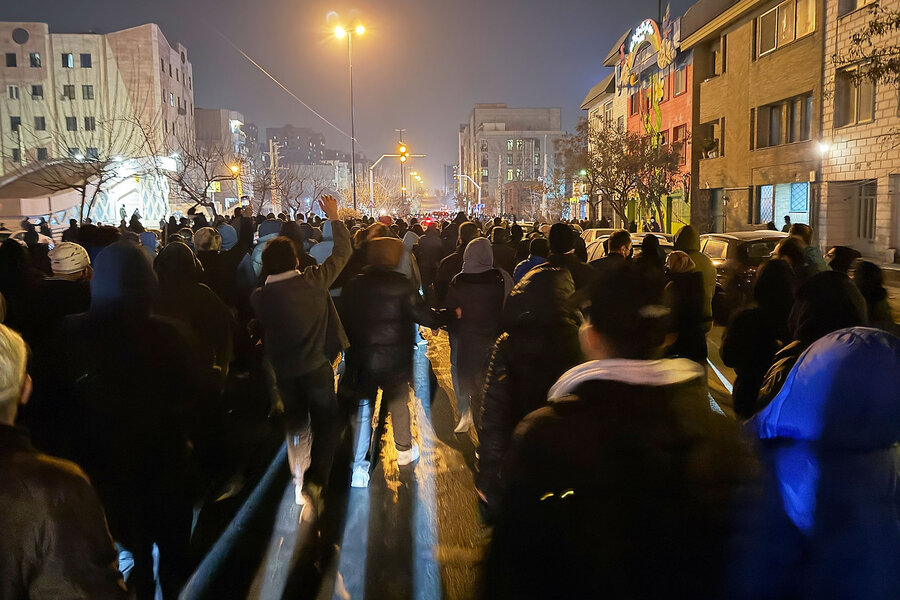
The risks are great – and could even be deadly – for Iranian civil engineering student Mohammad, as he daily joins thousands of university students for anti-regime protests that have erupted once more, despite the deadliest crackdown on dissent in the history of the Islamic Republic.
Amid these dangers, and frequent clashes with opposing hard-line students and regime enforcers on his Tehran campus, Mohammad says he is motivated to restore the momentum of nationwide protests that were brutally crushed on Jan. 8 and 9.
Mohammad also feels duty-bound, he says, to honor the memory of the at least 7,000 Iranian citizens who human rights activists confirmed were killed during that crackdown, to ensure that their sacrifice was not in vain.
Why We Wrote This
After anti-regime protests were suppressed with unprecedented lethality, students at more than half a dozen Iranian universities have courageously protested for days, despite the hard-line leadership’s portrayal of all protesters as “terrorists” and “criminals.”
“After the recent bloodshed, the regime thought we would retreat,” says Mohammad, a tall, bookish student at Amirkabir University of Technology in Tehran, who wears glasses and short-cropped black hair, and asks, for his protection, that his real name not be used.
Friends were gunned down
“Our message is that this regime cannot get away with its crimes, plus we are here to keep the momentum for its downfall,” says Mohammad. “If we allow them to breathe, give them any room for respite, they will get reinforced and return with greater savagery.”
It’s a courageous position, made by Mohammad and students at more than half a dozen universities for six days so far, in the shadow of a bid by Iran’s hard-line leadership and Revolutionary Guard commanders to portray all protesters as “terrorists” and “criminals” working for U.S. and Israeli intelligence.
The dead from the January crackdown include two of Mohammad’s friends, who were gunned down in the streets of Tehran. He has strong words for Iran’s uncompromising leadership, as well as disdain for U.S. President Donald Trump, who encouraged Iranian protesters and promised “rescue,” but has yet to act.
Amid Mr. Trump’s threats to strike Iran, the U.S. military has deployed two aircraft carrier battle groups and scores of fighter jets across the region. Iran-U.S. nuclear talks that could avert war resumed in Geneva on Thursday, but the nuclear talks are not to the point, many protesters say.
“This murderous cult”
“Our presence tells the world that, despite the horrific killings, we are determined to kick out this murderous cult, to signal bravery at a moment of mourning,” says Mohammad. “The regime killings add fuel to our fire. What actually kills us is fear. Fear is lethal. If we retreat, we are technically dead, this movement will be choked, and we’d betray all the blood shed on our streets and alleyways.”
University students are a particular Achilles’ heel for the regime, and are very carefully surveilled and controlled, since it was students who spearheaded protests that finally led to Iran’s 1979 Islamic Revolution, which overthrew the shah and paved the way for the Islamic Republic.
Videos of clashes this week on campuses show plainclothes pro-regime basij militia physically pummeling students, and even trying to climb a tree to remove a small hanging effigy of Iran’s supreme leader, Ayatollah Ali Khamenei, in the form of a rat. Mr. Khamenei is nicknamed “Rat Ali” by some Iranians, because he hid in a bunker throughout a 12-day war with Israel and the United States last June.
“As soon as we would start converging, they would come out of their nests,” Mohammad says of the pro-regime students and enforcers. “They were in a state of alert, very organized, carrying regime flags. But as for numbers, they have always been the minority – albeit a very, very loud, fierce, and violent minority.”
He saw two friends bleeding from the head, hit with rocks. Some basijis are armed with pistols.
Still hoping for intervention
“For the student gatherings, I want to note the audacity,” says Mohammad. “The slogans we are chanting have never been this frank and radical against Khamenei. … We are chanting for their departure, as millions of our fellow Iranians are. This is a unified call for punishment and regime change, and I have never seen this level of cohesion before.”
As for Mr. Trump, Mohammad wonders why the president encouraged them if he was not ready to strike.
“People were motivated, because they thought the kadkhoda [village chief] is out there to support them; he is the one who calls the shots,” says Mohammad. “We are still hoping for his intervention, but if he had acted in time, many, many lives would have been spared.
“I don’t personally see [Trump] as a hero,” he says. “He has been left with no justification for inaction, and failure to act is not just about his credibility – it could mean emboldening the regime; I would say giving it an insurance cover for years to come.”
An Iranian researcher contributed to this report.