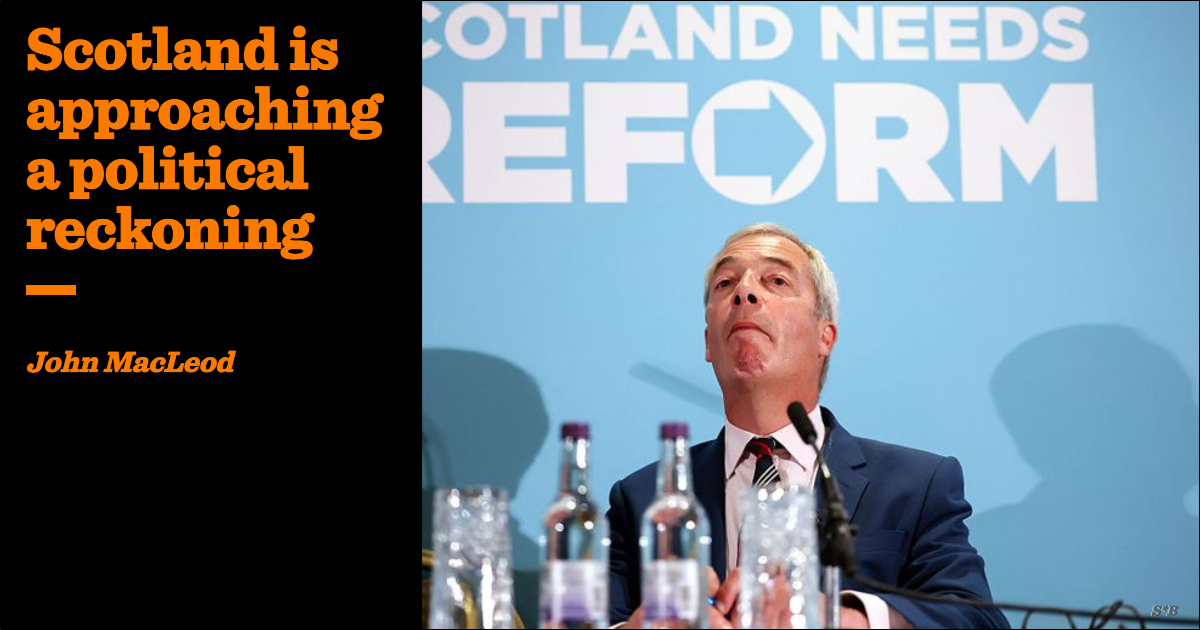
Reform has become a serious force in Scottish politics — but do not count out the SNP
At almost the last gasp of October, as giggly little witches and warlocks and demons went guising for Hallowe’en and the first fireworks thumped in the snell Scottish night, there was a local government by-election in Stirling East.
The seat had been held since 2017 by Bryan Flannagan for the Scottish Conservatives, who improbably supported Labour in Stirling Council control. It now, to widespread incredulity, fell to the Nationalists.
And not to some venerable pillar of the community. Cllr Josh Martin Fyvie, all simper and curls — he could have stepped out of a Caravaggio — was but eighteen. “My understanding is we’ve shifted control of the council,” oozed the cherub. “The people have had their voice heard, but this time the Labour Party cannot ignore it.”
Just a week later, the Nats did it again, snatching the Buckhaven, Methil and Wemyss Villages ward in Fife Council. Reform came a strong second: this, by the way, was Scotland’s third local by-election of the year born of a Labour councillor’s disgrace as a sexual predator.
The SNP, thanks to Cllr Fyvie, days later duly regained control of Stirling Council. They are once more atop the opinion-polls — 34 per cent — and, after two dreadful years, on something of a roll.
This was not in the script. The Nationalists are late in their fourth term of Holyrood rule. By all the normal rules of politics they should be discredited and broken. Their ministers wild-eyed; their backbenches stuffed with the has-beens and never-weres and everyone briefing against each other. Less Final Term than the Raft of the Medusa.
Not eighteen months ago, SNP MPs tumbled at the Westminster election like the clans at Culloden. They had endured sensational allegations against their most eminent elder statesman, the 2023 disintegration of his successor in a welter of political correctness and pronouns, the subsequent implosion of Humza Yousaf, a protracted police investigation over alleged financial malfeasance and the charging of their late, long-serving Chief Executive with embezzlement. Peter Murrell — at the time, Mr Nicola Sturgeon — denies all wrongdoing.
And, somehow, here they are this autumn — snatching by-elections with moppets younger than the iPhone and serenely top of the polls. Not that 34 per cent is that great — at the last Scottish Parliament election, in 2021, they won 47.7 per cent of the vote — but, after such torment, they’ll take it.
Especially when support for the parties of the Union is so hopelessly fragmented, the fortunes of Scottish Labour leader Anas Sarwar are so shackled to the dumpster-fire in Downing Street and Reform continue to enjoy a Scottish roll — second place in the polls, on 22 per cent, with our chatterati naturally wailing as if we were one minute to Kristallnacht.
Paul Hutcheon, of the Daily Record, argues next May’s Scottish Parliament election will boil down to two narratives. Labour’s claim that they alone can stop the Nationalists; the SNP’s insistence that only they can deny Reform — and whichever argument prevails will win the day.
There is real insight there: but it can only be taken so far. It is notoriously difficult, in any contest, for even an incumbent head of government to define the battleground. Edward Heath’s fate in February 1974 — the “Who Governs Britain?” election — is the best cautionary tale, though Neil Kinnock turning the 1992 hustings into a referendum on Neil Kinnock runs it close.
Reform’s impact on Scottish politics is extraordinary. For one, they have yet to win an actual election: no one will remember the 28.8 per cent and second place in Buckhaven, Methil and Wemyss Villages.
For another, their surge is an unsettling reminder that Scotland is not the chilled, progressive and exceptional country the Nationalists keep telling us we are. Not half a decade ago, immigration barely registered as an electoral concern: now 46 per cent of us tell pollsters it is one of the most important issues of the day.
More: Reform’s advance particularly unsettles the Scottish Tories (who came second in 2021, with thirty-one Holyrood seats) because it underlines how the Union itself is rapidly fading as an issue. The SNP has no credible mechanism for accomplishing independence nor shown any coherent grasp of how the question in the last decade has so changed. In 2014 it was simple: did we want to be an independent country?
Not now: do we choose to be an independent country and back in the European Union? A deeper concern for John Swinney and his colleagues is that Reform may be rapidly colonising the protest-vote, a-plague-on-all-your-houses territory the SNP has called its own for decades. “There’s a lot of people who voted to sort of give the establishment a kicking: for years they have used that to vote for the SNP but they are now starting to see them as part of the establishment,” glows one Reform insider.
There has been a striking failure everywhere to get to grips with the Reform insurgency, to identify the concerns driving it and to try and address them. Pundits and politicians variously try to ignore it, attack Nigel Farage himself in personal and at times puerile terms, or launch jeremiads against Reform in terms that serve only to insult those voters already aboard: people heartily sick of being told, by failed and flailing elites, what they are not allowed to think.
In 2013, trying to nip into an Edinburgh pub for a pint, Nigel Farage was chased down the Royal Mile by a howling mob and had to be bundled ignominiously into a taxi. His glib Midsomer Murders style and his weirdly amphibious face still grate on many Scots: but hatred to that degree has dissipated.
Farage is still the most consequential politician of our times, he is a formidable communicator, and his current approval ratings are little worse than those of Scottish opposition leaders generally. And far better than the current, cratering regard for Sir Keir Starmer.
Against that — and as the Nationalists themselves can grimly attest — swelling support does not equate to electoral organisation on the ground. It takes years to build serious membership, train an activist-base, mount a general and meaningful canvass and turn out your voters on the day.
On its first big surge, in October 1974, the SNP hit 30.7 per cent of the vote, but only eleven of Scotland’s seventy-one seats. From about 1986, local Nats started building a proper electoral machine in Kilmarnock and Loudon. The Scottish Parliament seat duly tumbled their way — two decades later. It was not always evident, especially among younger foot-soldiers, that the Nationalists needed rather fewer brilliant second-places and rather more mediocre firsts.
As matters stand now, Scotland’s electoral system heavily favours the SNP. It’s an odd one. Voters are handed two ballot-papers. On the lilac slip you put your cross by your choice of constituency MSP. On the peach paper, you put your cross by just a party, and from that count, and by fee-fi-fo-fum arithmetic, regional-list top-up MSPs are added to the lucky winners to engineer a supposed proportionality.
The outcome is seldom that proportional, there are inevitable absurdities — an MSP who has just been booted out in Falkirk Slagheap may yet be returned to Holyrood on the regional list, and often is — and it has allowed the Scottish Greens to throw their weight around since 1999 without ever, anywhere, winning a constituency. (Eight Green MSPs were in 2021 returned, on 8.1% of the vote.)
Then there was the 2011 election night when the SNP won a list-MSP in North-East Scotland, despite having won every single constituency-seat in North-East Scotland and moments after an expert had just assured BBC Scotland listeners it was impossible.
Worse, many voters seem to believe the regional-list ballot must be cast for your second preference. The irony is that a system deliberately cooked up in a 1990s Labour-Liberal Democrat love-in to disadvantage the SNP — whose support was much more evenly spread — has, since 2007, turned on its parents.
Once the Nationalists take a third or more of the constituency polls, they start winning seats in great numbers. In 2011 — in an electoral system supposed to prevent it — they won an overall majority, and fell just short of repeating that feat a decade later.
It is difficult, six months out, to see John Swinney and his troops again hitting such heights — but still harder to see how, nevertheless, the Nationalists will be dislodged from power in Edinburgh. According to present polls, Reform is set fair for twenty or more seats; and Reform is a party no one will work with.
Neither Reform nor the Nationalists are normal political parties
The situation is all the odder because, this close to the Holyrood election, Reform still has no Scottish leader and — its candidates have not so far been adopted or announced — we have still no idea who its MSPs might be.
In fact, neither Reform nor the Nationalists are normal political parties. The SNP is a cause, a tight-knit family, a band of brothers — something of a cult. It had a very, very long march from Winnie Ewing’s 1967 by-election triumph at Hamilton to winning power forty years later. It has simply no history of regicide and, since 2004, been extraordinarily disciplined. The Nationalists have had another great strength since the advent of devolution: its best and brightest have always wanted to be MSPs. The ambitious in the ranks of their opponents have largely preferred the House of Commons, giving their Holyrood confreres the faint whiff of the B-team.
There is also a great affection for stickers-in and long-in-the-tooth veterans. Angus Robertson, Cabinet Secretary for the Constitution, External Affairs and Culture, was ubiquitous in the SNP’s 1987 election campaign: he was then but seventeen and still at school. It is an abiding puzzle that so assured and able a man has never sought the leadership.
John Swinney himself signed up at the age of fifteen in 1979 — as he jokes, no one in that calamitous Nationalist year could have accused him of ambition — was the party’s National Secretary before he graduated, and entered the Commons in 1997. Though few now remember, this is actually his second outing as SNP leader: Swinney’s earlier stretch, from 2000 to 2004, was consequential for vital internal reforms, but electorally unhappy.
Reform is not strictly a party at all: it is a “company limited by guarantee” and, as recently as March, its majority-shareholder was Nigel Farage. Indeed, it would amount to nothing without him, which is why there is such murmured anxiety about the Member for Clacton’s security: Charlie Kirk’s appalling fate in September, and Trump’s narrow squeak at Butler, PA., underpinned how vulnerable such Marmite figures are to the unhinged and the fixated.
But there is a deep irony: as a movement, Reform reminds you very much of what the SNP used to be. Fiercely Eurosceptic, socially conservative, sometimes ill-disciplined and big on flags.
It was also in many regards a Christian party. Billy Wolfe, leader from 1969 to 1979 — though never an MP — was a pillar of the Scottish Congregational Union. Donald Stewart, the SNP’s first Westminster Parliamentary leader, was an adherent of the Free Church of Scotland; Gordon Wilson, sometime MP for Dundee East and Wolfe’s successor, would die in it. Both men voted against the decriminalisation of homosexuality in Scotland, in 1980; another colleague, George Thompson — from 1974 to 1979, MP for Galloway — fetched up as a Catholic priest.
What was once a relatively traditional and conservative force looks set to be the progressive alternative to Reform
Toto, I’ve a feeling we’re not in Kansas anymore. What was once a relatively traditional and conservative force looks set to be the “progressive” alternative to Reform — hollowed out, many argue, by sustained “entryism” since the 2014 referendum and especially the forces of woke.
A pivotal moment was the coronation of Nicola Sturgeon (unopposed) as Alex Salmond’s successor in November 2014 — a woman who, as her subsequent record proves, has psychologically never left the student-union and its late-Eighties obsession with sexual politics.
Helped along by a surge in its membership — within months, the SNP boasted more in its ranks than the Army — its centre of gravity shifted. From small-town and rural Scotland to something much more metropolitan and balefully Leftist — not in any way that helps the poor, but in a host of measures assailing traditional family, the authority of parents and the privacy of the home.
These days, from one wheeze to another, many of us see the SNP as a force for wickedness. A review commissioned by Scottish Government ministers and published on Friday 14th November, would totally decriminalise abortion, establish an automatic and absolute right to it in law, and advises against even the prohibition of sex-selection termination, much favoured in certain communities.
Or the merely disgusting: in February 2020, as Mhairi Black — SNP MP for Paisley and Renfrewshire South — sat approvingly by, a drag queen called FlowJob read stories to puzzled tots at Glencoats Primary School. Alerted to some appalling FlowJob material on social media, Renfrewshire Council later apologised.
But the SNP has long not been alone in such folly. All Holyrood’s mainstream parties have bent the knee in varying degrees to wokeness. Labour and the Liberal Democrats enthusiastically backed the Nationalist’s fruitloop gender-ID Bill in 2023 — subsequently struck down in the courts — and even the Scottish Tories could not keep all their troops in line.
Reform may actually bring us what the Scottish Parliament has lacked now for years: a coherent and principled Opposition. After all, it seems to stand for what, not that long ago, Scotland used to be. A world of decency and order and respect for the elderly. Disdain for the work-shy and the benefits-cheat; the police and the Forces in high esteem. Where the school day began with morning prayers and you rose, as one, with your schoolfellows whenever any adult entered the classroom.
As Reform and the Nationalists face off, the question is, perhaps, not really what Scotland should be, or where it might go. Rather, what sort of Scotland have we become?