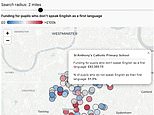
Schools are pocketing up to £700,000 each to teach pupils who don’t speak English as their first language, the Daily Mail can today reveal.
Two schools – one in Manchester and another in Northampton – this year collected at least £500,000 towards paying translators, bilingual teaching assistants and support materials, according to Department for Education figures.
The funding is not ring-fenced and is instead baked into a school’s overall budget, with councils saying it can be spent on ‘almost anything’.
Nationally, schools received a record £539million this year to cater for pupils who have English ‘as an additional language’ (EAL).
Figures for the 2026-27 academic year show this is set to rise to £572million. Costs are expected to soar by £157million since modern records began in 2020.
Critics have voiced anger over the rising cost to taxpayers, fuelled by immigration having spiralled to all-time highs.
Separate DfE statistics show English is now no longer the mother tongue for most pupils in parts of the country. For example, two-thirds of children in Newham, east London, speak another primary language.
Chris McGovern, of the Right-wing pressure group Campaign for Real Education, said policymakers must stop focusing on the ‘poor immigrant’.
He told the Daily Mail: ‘Stop pitying them, we obsess about it far too much and we don’t need to fret about them – we need to worry about the white working-class kids.
‘Of course children who don’t have the requisite English language skills need to be assimilated and have time and money spent but that should come before they enter the school system.’
Other campaigners have called for funding to be explicitly diverted to white working-class children, saying they are being ignored and left to fall behind.
Just one in five white working-class pupils achieve a good pass in English and maths, compared to 45.4 per cent across all demographics.
Mr McGovern said that one or two special centres or target schools should be set up within each local authority to provide a pre-education English course to children who struggle.
He added: ‘We have consistent and obvious annual evidence that it is the white working-class children who perform worse and need numeracy and literacy support, if there is money to be going around.
‘A lack of imagination is the big problem with the educational world but however we tackle it we need to focus on the right group – don’t pity the immigrant, they are the education system’s biggest success story.’
DfE bosses define the EAL as where pupils have ‘been exposed to a language other than English during early development and continues to be exposed to this language in the home or in the community’.
Someone born in Britain may still have English as an additional language and children classed as EAL may still be proficient in English.
Nationwide, English isn’t the first language of 1.8million pupils, or one in five, according to the 2024/25 school census. This has risen from 1.2million a decade ago.
Schools get extra cash for EAL pupils in the national funding formula, which supports them with the higher costs associated with educating those pupils. Local authorities then distribute the funds within their boundaries.
The algorithm also hands out cash to schools depending on the number of pupils with special needs and in deprivation.
Manchester Academy, a secondary school in the crime-ridden Moss Side suburb, took over £670,000 in EAL funding for 2025/26 – more than any other school.
Northampton International Academy (£517,287) and St Claudine’s Catholic School for Girls in Brent, north London (£459,659) rounded out the top three.
Nationwide, schools took an average of £27,418, or around £320 per pupil who does not speak English as a first language.
Most of the expenditure goes towards teachers who specialise in teaching English to foreign children, bilingual assistants, and even interpreters for parents’ evenings.
Job ads online ask for translators fluent in languages including Romanian, Arabic and Polish.
Around 2,000 schools from the Daily Mail’s audit will not show funding figures.
Of these, around 1,700 received no EAL funding from their local authority while the remainder have merged with new multi-academy trusts and generated new identity numbers which cannot be compared over time.
The findings come after the Daily Mail last year showed English is not the first language for the majority of pupils at more than 2,000 schools across the country.
Two schools did not have a single child who spoke English as their mother tongue.
The investigation raised concerns among critics that the slew of different languages being spoken can be incredibly disruptive for learning and integration.
Teachers have previously said schools were under mounting pressure from mass immigration and called on ministers to fund them properly to cope with the array of different languages that pupils speak.
EAL provision features in Ofsted’s new ranking system.
A Department for Education spokesman said: ‘Every child deserves a high-quality education, including children who speak English as an additional language.
‘We trust schools, who know their pupils best, to make decisions about how to invest their funding to support every child while getting the best value for money from overall resources.
‘It’s this Government’s mission to break the link between background and success, halving the disadvantage gap for this generation, so that every child can achieve and thrive.
‘The measures in the Schools White Paper will do this, including Mission North East and Mission Coastal that will improve outcomes for white working-class children and disadvantaged communities, alongside plans to radically reform the way disadvantage funding is given to schools.’