Pupils who have not been vaccinated against measles may be sent home from school if there is a local outbreak.
Health leaders in London are meeting today to discuss whether to stop unvaccinated children from coming into school.
It follows a decision made in the London borough of Enfield after an outbreak of the disease.
This year, north London has seen 100 confirmed cases of measles, with the number across the capital thought to be even higher.
Some of the children have been hospitalised by the virus, which can cause serious and even fatal complications if it spreads to the brain.
In 2024, the UK saw its worst measles outbreak on record, with 3,681 confirmed cases. In July, a child died after contracting the virus.
As a result, the UK officially lost its measles elimination status in January, as announced by the World Health Organisation.
Emma Best, health committee lead at the London Assembly will chair an extraordinary general meeting about the outbreak.
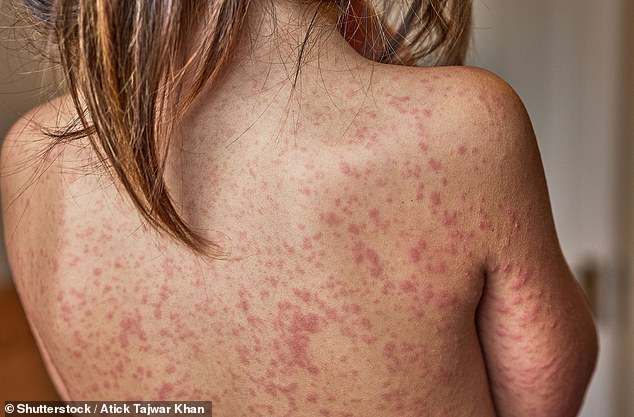
More than 60 suspected cases of measles are said to have been reported by seven schools and a nursery in Enfield
She told The Mirror: ‘We’re looking at this in London but the whole of the UK should be watching now. The first thing to say about measles is the level of contagion. It can appear as a cold or a runny nose at first so parents can still send their children into school with it so it has spread very quickly.
‘We think it’s alien that people can die from measles but over 100,000 people a year die from it globally. For many people it is a mild infection like the common cold but for some people it will be fatal.’
Measles, which mostly produces flu-like symptoms and the tell-tale rash, can cause very serious and even fatal health complications if it spreads to the lungs or the brain.
While many people recover, measles is highly infectious and spreads very easily among people who are not fully vaccinated against the disease.
Cold-like symptoms – including fever, cough, and a runny or blocked nose – are often the first signs. A few days later, some people develop small white spots inside the mouth, before the distinctive rash appears.
Just half of children in some parts of London have had both measles, mumps and rubella (MMR) jabs, but vaccination uptake has been slipping for years.
The MMR vaccine was updated last year to include chickenpox, varicella, to the jab.
But the life-threatening virus does not just affect children – babies, pregnant women and those with a weakened immune system are also at risk.
Health chiefs last month urged parents to make sure their children have not missed any doses, with experts warning that at least 95 per cent of the population needs to be vaccinated to prevent outbreaks.
Enfield’s director of public health, Dudu Sher-Arami, wrote to parents in Enfield to try and control the spread of disease.
Temporary vaccination centres have also been opened in a bid to boost herd immunity.
Professor Devi Sridhar, Personal Chair of Global Public Health, said: ‘It’s tragic to hear of children being hospitalised, but unfortunately it isn’t surprising.
‘We’ve seen outbreaks over the past couple of years and as far back as 2023, the UKHSA was warning that vaccination rates were so low that around a quarter of children starting school in London were unvaccinated.’
She added: ‘A major factor is logistical challenges for parents. Many children were born during the Covid period, when routine vaccination programmes were disrupted.
‘Even now, where rates have improved, that hasoften been due to practical measures such as mobile vaccination clinics and giving parents more flexibility to attend appointments.
‘It’s less about parents actively refusing vaccines and more about the realities of work, childcare, and everyday pressures.’
Measles spreads through airborne particles, through coughs and sneezes, and touching contaminated surfaces – which is partly why so many school children are affected.
The tell-tale rash will usually appear a few days later, starting on the face before spreading to the rest of the body.
One in five infected children will be hospitalised, with around one in 15 developing severe complications such as meningitis or sepsis.
The MMR vaccine has been offered to children in the UK since the late 1980s.
But uptake collapsed in the late 1990s and early 2000s after a now-discredited 1998 study by Andrew Wakefield falsely linked the jab to autism.
The claim triggered widespread fear, leading tens of thousands of parents to refuse the vaccine.