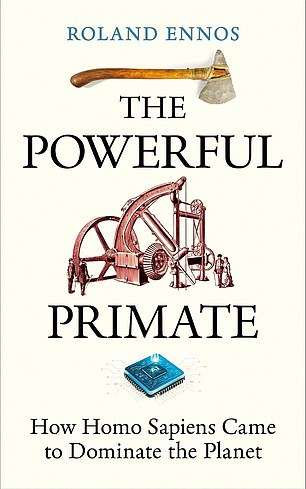
- The Powerful Primate by Roland Ennos (Oneworld £25, 304pp)
The Crystal Palace, which housed the Great Exhibition of 1851 in Hyde Park, was an engineering marvel. Made from iron, glass and wood, it was three times the size of St Paul’s Cathedral and yet was built in under five months. It housed over 100,000 exhibits and more than six million people visited.

Stones dragged, using animal fats or seaweed as lubricants
According to Roland Ennos, the palace, and indeed Britain’s economic and political power in the 19th century, depended on three new technologies – wrought iron, high pressure steam engines and the hydraulic press.
Ennos is a visiting professor of biological sciences at the University of Hull and his latest book is a history of how humans have used tools and technology to control and manipulate the world. He begins his account in the deep prehistoric past with our distant ancestors using sticks to prise edible roots from the ground, and then moves through sharpened flints to hand axes to metal woodworking tools that facilitated the development of wheeled vehicles and plank ships. We steam through the Industrial Revolution and end up on the brink of thinking machines.
Ennos writes clearly and concisely and delights in suggesting that some of the ideas taught at school were wrong. For example, the notion that large stones used for Stonehenge were moved by being rolled on the tops of logs. ‘For a start it would take a huge investment in time and energy to fell, debark, shape, and transport the large number of identical logs required,’ he writes. He suggests the stones were dragged, using animal fats or seaweed as lubricants.
The Powerful Primate is available now
Nor is he sold on the widely accepted theory that the advent of cereal farming was the key event that raised humans’ productivity. He argues that cereals ‘are difficult to harvest, process, and eat; and they are extremely hard work to grow’. For the most part, the book is an invigorating chronicle of human ingenuity but it ends on a gloomy note. Dominion over nature comes at a cost. We produce more food and worldly goods than ever before and more people are living relatively comfortable, healthy lives than ever before but we have damaged the planet and extracted more minerals in the past 50 years than in all of our previous history put together.
His solution? We need to use less energy, obviously, but he also believes we should abandon industrial cereal farming and focus instead on cultivating higher-yielding root crops, vegetables and fruit trees on small-scale plots. Not everyone will agree with Ennos’s conclusions but they are certainly food for thought.