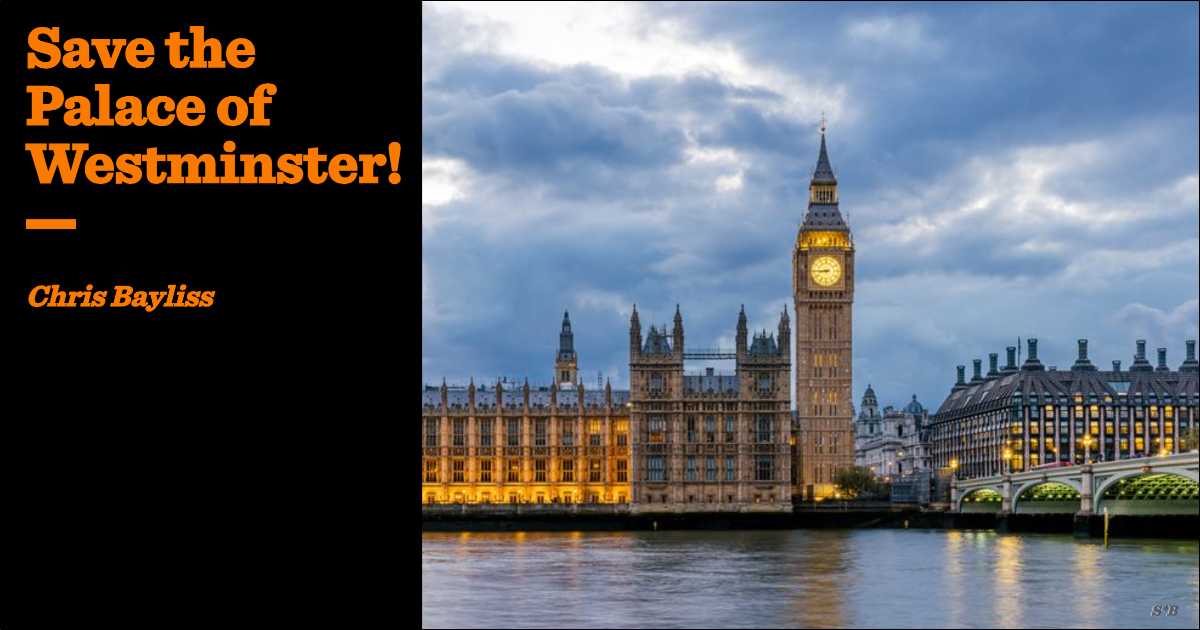
The refusal of the public procurement system to behave reasonably is not an excuse to destroy Parliament
As John Rentoul has taught us for many years, there are some questions in politics to which the answer is “no”. Many of these are the result of lazy headlines that are designed to be eye-catching, but in reality just end up with people arguing with the premise of the question rather than reading the article. But sometimes, we encounter ideas that need to be nipped in the bud at a far more intrinsic level. There are occasions when a line has to be drawn, which we insist shall not be crossed.
On Monday, Nicholas Boys-Smith set out, in these pages and in excruciating detail, the raft of failures that have led to the outrageous binary that parliamentarians will be expected to choose between for “the restoration and renewal” of the Palace of Westminster. In it, we find all of Whitehall’s worst shortcomings brought together in a single, monstrous document. These include an inability to consider trade-offs, an addiction to spurious consultation with “stakeholders”, a vast surfeit of management matched by a deficit in direction, a constant churn in senior personnel leading to an absence of institutional memory, innumeracy, and a belief that to work to a budget or a deadlines is to set oneself up for failure. But more menacingly than that, we find the casual distaste of far too many in SW1 for anything that might be mistaken for reverence for the past.
Faced with all of this, it is quite understandable that many will shrug their shoulders and suggest that the whole damn edifice ought to be torn down. Rebuild it from scratch, without all of the Gothic pomp and wainscotting — an ordinary, modern building fit for the times we live in. While we’re at it, perhaps stick it somewhere other than the middle of London. But to sympathise with this impulse is not to endorse it — instead, it must be resisted with all of our might. Readers will have to forgive the overwrought language; despite the many other existential crises we currently face as a country, the coming battle to save parliament is a defence of the physical presence of what is left of our ancient constitution. And we should be in no doubt that a battle is coming.
It is quite telling that, despite clear instructions from ministers under the last government, nobody within Whitehall managed to get a grip on the circus that the Renewal programme became, despite the undoubted embarrassment that it was going to cause. Ensuring the physical integrity and safety of the state’s landmark building is – given the immense administrative capacity of the British government – a relatively straightforward task, notwithstanding the complexities of restoring historic buildings. Instead, the coagulation of consultants who appear to be in control of the work waited until Labour were in power to make their move. The “Restoration and Renewal” report can reasonably be interpreted as an admission that the system cannot or will not undertake the task; it is clearly urging some kind of response.
I will therefore go further than Nicholas Boys-Smith does in his excellent piece — which followed his equally illuminating appearance on the Critic Show a few weeks earlier. I believe that the inevitable backlash to the report; in the form of calls to knock down the Palace and replace it with something new, or to move the legislature from Westminster entirely — was the intention of at least some of the people responsible for this document seeing the light of day. I am not usually one to indulge in conspiracy theories, mainly because I don’t believe that it is possible to keep a genuinely interesting piece of information contained within anything but the smallest circle of highly motivated individuals, and your average speculation of foul play usually relies on far too many people holding their tongues for too long to be plausible.
However, the plot against the Palace never required a long cast list of conspirators; merely a shared but unspoken sense of political aesthetics among a handful of senior officials. Beyond that, the Blob could be allowed to do what it does; it hardly takes Machiavellian scheming to get a nest of project consultants and engaged stakeholders to inflate a scope and a budget. The mandarins simply had to take a Nelsonian view of it all.
Whilst there is probably a deeper, perhaps more sub-conscious affection among the public for the Palace of Westminster than many would initially admit to, the building serves an icon for the collective political class, in all its grasping capriciousness. Its outline can be found adorning placards and banners of protest of all political stripes; it is the cathedral from which high-handed, uncaring and foolish edicts are handed down. The Restoration and Renewal document is an almost perfect caricature of what the average voter imagines happening within the Palace walls. There would, for many people, be something satisfyingly cathartic about seeing it physically crumble, and replaced. But with what?
The first answer that usually comes up is a building suited to the realities of modern government — something with lifts, wide corridors, conference rooms with projectors for slide shows, and plenty of office space for all of the staff that 21st century MPs bring with them. And this is the first sign that ought to give our hypothetical yeoman pause. Isn’t it “the realities of modern government” that people object to? If anything, the average person who objects to today’s Westminster would rather return to the type of public service that they imagine being offered in earlier times. But if a legislative headquarters were to be designed today, it would be tailored to the needs of the contemporary stakeholder state, with its ever expanding list of special interests to be consulted in ever more granular detail — and the corresponding growth in the bureaucracy to facilitate that. A building that physically resembled the Berlaymont in Brussels would be more likely, not less, to pump out the same style (and quantity) of pettifogging nonsense.
The other recommendation that we normally hear at this point concerns the design of the legislative chambers themselves. Rather than the confrontational opposing rows of benches that we associate with the Westminster model, we ought to have lawmakers sit in a semi-circular array, as a “modern” parliament does. This would be less confrontational, more consensual, and would, we are told, lead to a more mature style of government. While they are at it, MPs ought to be given proper, individual seats, perhaps with microphones on the desks in front of them, and buttons to vote on to avoid having to shuffle out into the lobbies.
Yet again, this ought to make the typical voter stop for a moment. If your concern is that our political system is already too clubbish, with a singular class of politicians who are all in it for themselves, then a more “consensual” style of politics is a further move in the wrong direction. While much of our elite may look enviously over at continental Europe and see a more “grownup” style of politics, what much of the public would likely find, if they cared to look, would be a variety of political cultures that are even less responsive to public opinion than our own. Democratic politics ought to be oppositional — the principle of loyal opposition is the cornerstone of our constitution, and the most powerful dynamic that keeps our politics competitive. If voters find British governments complacent and unresponsive now, they would quickly find it far worse without an opposition breathing down the cabinet’s necks across the floor of the Commons.
There is absolutely nothing the The Blob would love more than Parliament being ripped out of Westminster
The other suggestion that is inevitably mooted when we discuss what the Palace of Westminster could be replaced with is something that is not in Westminster, or London, at all. Wouldn’t it all work a lot better if we moved parliament to somewhere with more normal people? Many instinctively suggest their own hometown, or their nearest city — especially if that happens to be in The North. Bradford and Leeds are perennial favourites.
There is absolutely nothing the The Blob would love more than Parliament being ripped out of Westminster and packed off to the provinces. Inevitably, Ministers would be obliged to follow them, given the realities of parliamentary arithmetic, leaving Sir Humphrey and the Quangos to run the country as they saw fit. They would be free, finally, from the interference of elected representatives — liberated from parliament’s looming reminder of the existence of the demos, the public, right on Whitehall’s doorstep.
The legislative branch serves as the lightning rod for public dissatisfaction with government, because it is usually the most visible bit of it. In fact the public only ever tends to see the executive branch, represented by the Cabinet, when they are present in parliament. This is why parliament serves as the icon that it does, rather than Government Offices Great George Street or 70 Whitehall. But removing the bit of the state that the public elects from the vicinity of its actual operations will not rebalance the equation in the public’s favour.
So then, why not move the whole government, root and branch, out of Whitehall and reinstall them somewhere more real? De-camp the whole circus — and of course, the media will follow. At this point, I have to ask what it is exactly that anybody imagines goes on in Westminster that wouldn’t immediately be replicated wherever you chose to deposit all the people who are currently in Westminster. Denizens of the Westminster and Whitehall bubble found their way there because it is the nexus of power in this country; if the place is myopic and self-obsessed it is because it is full of the sort of people whose main objective in life is to ingratiate themselves with the powerful, and eventually to become powerful themselves. There is nothing inherent in the air or the soil on the north bank of the Thames twenty-six and a half miles upstream from the estuary that makes them like that.
In an ideal world, it might be nice to contrive the circumstances whereby the people who chose to wallow in the world of central government had to live among and socialise with nurses or mechanics or people who sell construction equipment for a living. That might help keep them grounded — although I would imagine that those people would themselves quickly tire of the company of your average SpAd or parliamentary researcher. But that is not what would happen if you uprooted Westminster and moved them all to Bradford. What would happen is that middle and working class people in private rented or owner-occupied accommodation would quickly be priced out of anywhere in a 30 mile radius of the British state’s new Bradminster HQ. Anything authentic would vanish and be replaced by outlets selling boiling hot coffee in cardboard cups for the price of half an hour’s honest work.
The bubble dwellers themselves would remain firmly in their bubble; they would continue to live as they currently do; in narrow enclaves of public sector professionals, surrounded by socially housed immigrant communities with whom they have zero meaningful interaction. In fact, our bubble people would if anything become even more cloistered among themselves than they are now; at least in London, they share space with an economically more powerful private sector professional class. But anywhere else, they would predominate totally over any other walk of life.
The Palace must stand, the ancient dignity and privilege of Parliament must be upheld
Organic capital cities, such as Paris or London or Moscow, do often seem to play a disproportionately dominant role in their respective countries, to the point they can seem to suck the political, cultural and economic life out of the rest of society. This is because they naturally combine a variety of different elites in a single place. But it is in contrived capital cities such as Bonn or Ankara, or purpose-built capitals like Washington D.C., Canberra and Brasilia, where political elites can truly live above the societies they govern. This is especially the case in places like Washington where productive economic sectors have been driven out, but a state-dependent urban underclass has been maintained which justify the political elite locking themselves away behind gates and walls. As would surely be the case in any alternative British capital given our current planning policies. A British Naypyidaw would be the ultimate political dead end.
Offering the British people the chance to tear down the Palace of Westminster would be the cruellest sleight of hand that our elites could possibly offer. What would supposedly be a satisfying populist gesture would in reality reinforce all of the dynamics that concentrate power in the hands of our new unhappy lords. There is no political impulse which anybody with a conservative or constitutionalist bone in their body ought to oppose more forcefully than this one. The Palace must stand, the ancient dignity and privilege of Parliament must be upheld, and the representatives of the people must remain physically in the centre of power where they belong. And the people responsible for the Restoration and Renewal document should be banished from public service.