The most powerful of the Gulf Arab countries is pushing for a diplomatic breakthrough to end the conflict between the United States and Iran. But the Kingdom of Saudi Arabia is also preparing for what to do if diplomacy fails to stop the war quickly.
As the United States is sending thousands more troops to the region – amid rumblings of a potential weekslong ground operation in Iran – Saudi Arabia is awaiting the outcome of last-ditch mediation efforts by Pakistan before considering military action of its own.
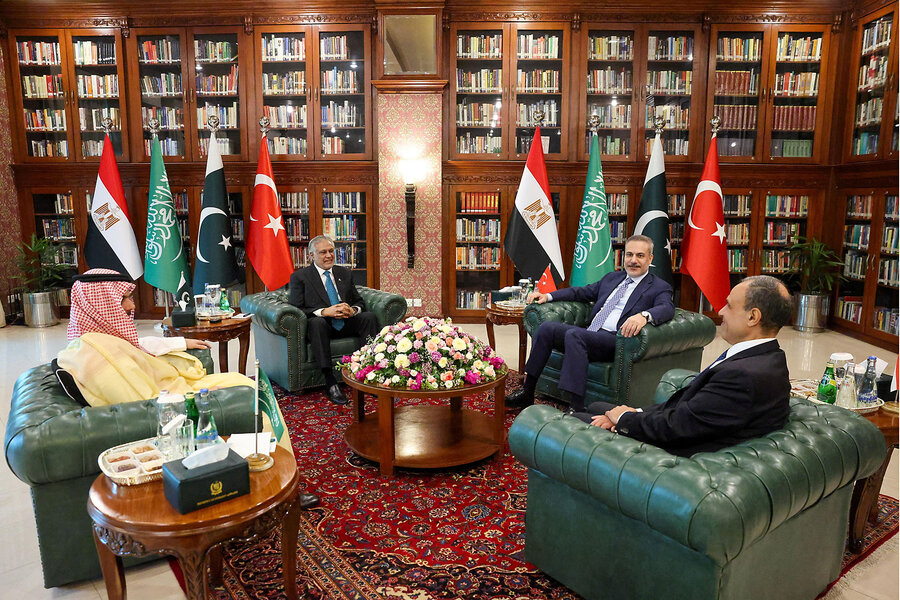
Saudi Arabia is pinning its hopes on Pakistan, which it endorsed Sunday along with Turkey and Egypt, to save the region and itself the costs of a prolonged war. Saudi officials are also talking to Iran on a daily basis, an official has confirmed with the Monitor.
Why We Wrote This
Saudi Arabia says it’s ready to take “all necessary measures” to defend itself from Iran. Riyadh is still hoping for a diplomatic breakthrough, but it’s also getting ready to exercise military options, if necessary
Yet separately, the country is preparing military options, beefing up its defenses, and planning for a possible show of force. This would be designed to make Iran “pay a price” for attacking Saudi Arabia and its neighbors, and to “deter it from doing it again,” according to a Saudi insider who is not authorized to speak with the news media.
Rather than joining the U.S. and Israeli war effort directly, Saudi officials and insiders say that such a demonstration of Saudi military capability would be part of defending the country’s territory and national interests.
Even if diplomacy wins out, and Saudi military action is averted, a deeper fundamental shift is underway in the kingdom, after being targeted by some 750 Iranian missile and drone attacks since the war began.
For decades, Riyadh relied passively on the American security umbrella. Saudi Arabia has recently spent years pursuing cooperation, diplomacy, and dealmaking to protect its interests in the region and its economic transition at home. Now, the government in Riyadh is taking matters in its own hands to boost its defense capacity and project military strength.
The kingdom has a lot to weigh – and to lose – in deciding how far it is willing to push back against Iran.
But the war has already changed the kingdom, analysts say. To keep its future safe, the Saudi government can no longer just speak softly, without also carrying a big stick.

Ukrainian Presidential Press Service/Reuters
Dialogue ‘not enough’
Diplomacy is the top priority for Saudi Arabia, which pursued a detente with rival Iran in 2023 as part of a China-brokered agreement. Up until the outbreak of this recent war, it had pushed the Trump administration to pursue talks to reach a solution for the dispute over Iran’s nuclear program, ballistic missile program, and support for proxy militias.
In recent years, under Crown Prince Mohammed bin Salman, Saudi Arabia has positioned itself on the global stage as a pivotal mediator, acting as an intermediary and hosting talks on Ukraine, Gaza, and the Israeli-Palestinian conflict.
But the Iran war has shown Saudi leaders the limits of diplomacy.
“It is our right to defend ourselves, our territory, people, and residents against this daily aggression, separate from the war,” a senior Saudi Foreign Ministry official told the Monitor.
The official stressed that Saudi Arabia has “no desire to attack Iran,” and “we have been encouraging a diplomatic solution even before the war.”
“If they stop attacking us, then there is no need to discuss military options. But if Iran continues to attack us, we will have to consider all options,” the official said.
If Pakistan-brokered talks do succeed, or the U.S. announces an end to hostilities, analysts and insiders say Saudi Arabia is still on track to boost its defense capabilities.
“Saudi Arabia will not be held hostage by anyone; not Iran, not any other regional actor, now or in the future,” says the Saudi insider with knowledge of ongoing deliberations in Riyadh.
“Saudi Arabia is unlikely to abandon diplomacy with Iran, but the balance has clearly shifted,” says Abdulaziz Sager, political analyst and chairman of the Jeddah-based Gulf Research Center.
“The lesson of this war is that dialogue on its own is not enough if it is not backed by credible deterrence, stronger air and missile defense, and clearer consequences for attacks on civilian and economic infrastructure,” Dr. Sager says.
As part of shoring up its defenses, Saudi Arabia last Thursday signed a security pact with Ukraine, under which the battle-hardened Ukrainian military would provide Riyadh with anti-drone defense systems.
Earlier in March, the crown prince reportedly authorized the Saudi military to retaliate should Iran hit Saudi Arabia’s desalination plants or electricity network. The kingdom is currently assessing its options for retaliation, according to the Saudi Foreign Ministry official.
“We are also likely to see greater investment in domestic defense manufacturing,” Dr. Sager added, noting that localizing the defense industry was already a top priority for Saudi Arabia before the Iran war started.
“If civilian and economic infrastructure can be repeatedly targeted, the Gulf will face a persistent and structural vulnerability even after a ceasefire,” Dr. Sager says.

Evelyn Hockstein/Reuters/File
Offensive action?
Western media outlets such as The Washington Post and The Guardian have reported that Saudi Arabia, along with the United Arab Emirates, is urging the Trump administration to continue its military campaign until Iran can no longer pose a threat to the Gulf.
Saudi Foreign Ministry officials have consistently denied that the kingdom has pushed for war.
U.S. President Donald Trump appeared to allude to Saudi and Gulf support for Iran’s defeat in recent off-the-cuff remarks, saying of the crown prince last week that “he’s a warrior. He’s fighting with us.” On Sunday evening, Mr. Trump said “Saudi Arabia’s fighting back hard. Qatar is fighting back. UAE is fighting back. Kuwait’s fighting back. Bahrain’s fighting back.”
Gulf Arab countries have not publicly allowed for the U.S. to use their airspace or bases to stage attacks on Iran; none has carried out retaliatory strikes against Iran, either separately or with the U.S.
But sources say Riyadh has concluded that for the kingdom’s long-term security, it must show it is able and willing to defend itself and exact a price from Iran without U.S. involvement.
Should diplomacy fail, Saudi Arabia is considering multiple options. According to the Saudi insider, these include amassing military forces along its coasts and borders; carrying out limited missile strikes on Iranian assets or its regional proxies; and allowing the U.S. to openly use Saudi airspace and bases to attack Iran.
As the Saudi approach shifts, other Gulf countries remain divided over their response to daily Iranian rocket and drone attacks. The UAE and Bahrain are pushing a tough, militaristic stance toward Iran. Qatar and Oman prefer a diplomatic approach to ending the war.
Any decision by Saudi Arabia – a country of 35 million people that is one-third the size of the continental U.S. and the largest in the Gulf region – would likely set the tone for the wider Arab world.
Riyadh is closely weighing the costs of any step that Iran might see as an escalation. The kingdom is currently enjoying relative calm; it has not been targeted as frequently as Israel, the UAE, or other Gulf countries have.

Intensified Iranian attacks would threaten Saudi Arabia’s post-oil economic transition and plunge a population unused to war into a major new conflict.
As of Tuesday, Saudi Arabia has been able to bypass Iran’s closure of the Strait of Hormuz, using an alternative pipeline bisecting the center of the country to export its oil. The pipeline runs from the now-troubled eastern coast to its western Red Sea coastline, carrying 7 million barrels of oil per day – now the entirety of Saudi oil exports.
The kingdom’s Red Sea ports have become the only points through which Saudi Arabia and its Gulf neighbors can import and export goods. Saudi airports, largely unaffected by the war, have been lifelines for neighboring Kuwait, Qatar, and Bahrain.
Should Saudi Arabia take offensive action, decision-makers in Riyadh expect that not only would Iran attack the Saudi pipeline, but that the Houthis, Iran’s proxy in Yemen, would also target and disrupt Red Sea ports, potentially sealing off the Gulf.
Another factor that Saudi Arabia is said to be considering is the wider impact on global energy markets, fearing an economic crisis whose trajectory few can predict.
“Saudi Arabia right now is taking on the responsibility of the entire global economy,” says Mohammed Alhamed, a Saudi geopolitical analyst and journalist in Riyadh. “They know that Iran’s retaliation will not only be against Saudi Arabia, but the global energy market.”
“Iran fighting Israel doesn’t disrupt global energy supplies,” Mr. Alhamed says, “Iran fighting Saudi Arabia does. Everyone should pray that Saudi Arabia does not join the war.”
But he says Saudi patience is running out.
“If diplomacy fails, I fully believe Saudi Arabia will join the war against Iran. Right now, Iran holds the cards as to what happens next.”