Saturn‘s largest moon Titan has ‘slushy tunnels’ beneath its surface that could potentially harbour alien life, a new study shows.
Scientists at NASA and the University of Washington have analysed data captured by the Cassini space probe, which completed more than 100 targeted flybys of Titan.
They reveal that the faraway moon has ‘a slushy high–pressure ice layer’ similar to the melting Arctic that could hide extraterrestrial life.
What’s more, it means Titan may not have a waterworld–style liquid ocean under its frozen surface as previously thought.
‘Instead of an open ocean like we have here on Earth, we’re probably looking at something more like Arctic sea ice or aquifers,’ said study author Professor Baptiste Journaux at the University of Washington.
‘[This] has implications for what type of life we might find, the availability of nutrients, energy and so on.’
Around 3,200 miles in diameter, Titan is described by NASA as an icy world whose surface is completely obscured by a golden hazy atmosphere.
It is the sole other place in the solar system known to have an Earth–like cycle of liquids raining from clouds, flowing across its surface, filling lakes and seas, and evaporating back into the sky – akin to the water cycle of our planet.

The six infrared images of Titan above were created by compiling data collected over the course of the Cassini mission. They depict how the surface of Titan looks beneath the foggy atmosphere, highlighting the variable surface of the moon
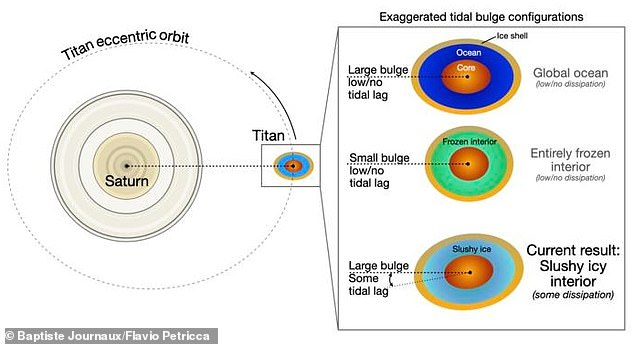
Titan’s frozen surface is thought to have water beneath it. According to the study, this is neither uniformly liquid, nor frozen solid, but slushy. This illustration shows the various ways Titan might respond to Saturn’s gravitational pull depending on its interior structure. Only the slushy interior produced the bulge and lag observed in the new study
NASA’s spacecraft Cassini launched from Cape Canaveral, Florida in October 1997 and spent two decades observing Saturn and its moons.
As Titan circled Saturn in an elliptical (not perfectly circular) orbit, the moon was observed changing shape depending on where it was in relation to Saturn.
In 2008, researchers proposed that Titan must possess a huge ocean beneath the surface to allow such significant ‘stretching and smushing’.
‘The deformation we detected during the initial analysis of the Cassini mission data could have been compatible with a global ocean,’ Professor Journaux said.
‘But now we know that isn’t the full story.’
For the study, scientists performed a reanalysis of radiation data acquired by Cassini using improved modern techniques.
Interestingly, they found that Titan’s shape–shifting or ‘flexing’ occurs about 15 hours after the peak of Saturn’s gravitational pull.
This time delay allowed scientists to estimate how much energy it takes to change Titan’s shape, allowing them to make conclusions about the moon’s interior.
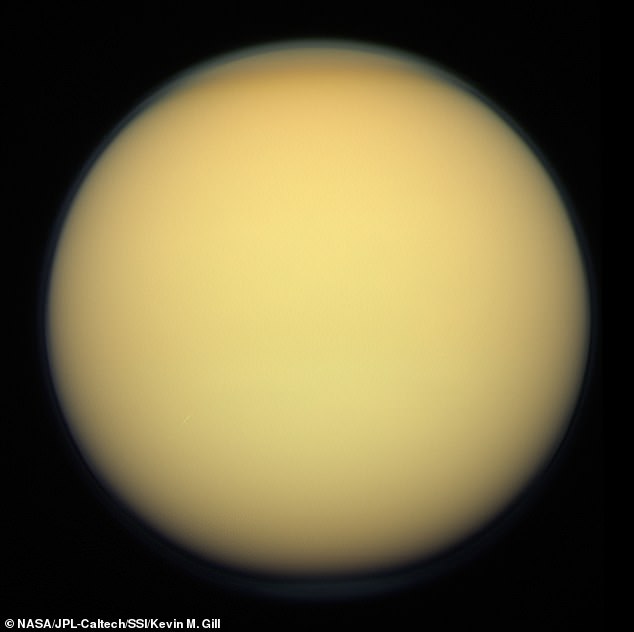
Titan, imaged by the Cassini orbiter, December 2011. A thick shroud of organic haze permanently obscures Titan’s surface from viewing in visible light
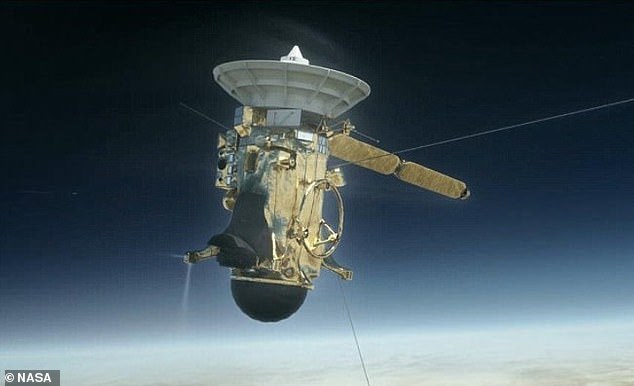
Cassini is depicted here in a NASA illustration. Cassini launched from Cape Canaveral, Florida in October 1997
Essentially, the amount of energy lost, or dissipated, in Titan was ‘very strong’ and much greater than would be observed if Titan were to have a global liquid ocean.
‘That was the smoking gun indicating that Titan’s interior is different from what was inferred from previous analyses,’ said study author Flavio Petricca at NASA.
According to the study, Titan’s frozen exterior hides more ice giving away to pockets of meltwater (water formed by the melting of snow and ice) near a rocky core.
The model they propose in their paper, published in Nature, features more slush and quite a bit less liquid water on Titan than previously thought.
The discovery of a slushy layer on Titan has ‘exciting implications’ for the search for life beyond our solar system as it expands the range of environments considered habitable.
Although the idea of a liquid ocean on Titan was a promising indication of life there, researchers believe the new findings might improve the odds of finding it.
Analyses indicate that the pockets of freshwater on Titan could reach 68°F (20°C) – which is the optimal temperature for life on Earth to thrive.
Any available nutrients would be more concentrated in a small volume of water, compared to an open ocean, which could facilitate the growth of simple organisms.
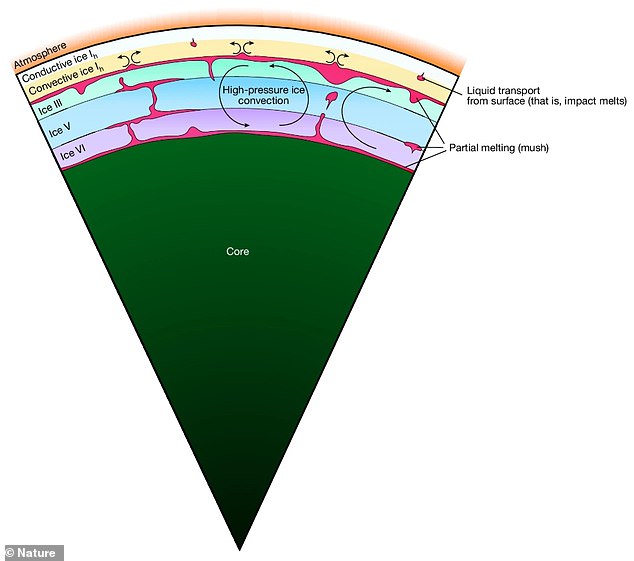
Below Titan’s frozen exterior is more ice giving way to slushy tunnels and pockets of meltwater (water formed by the melting of snow and ice) near a rocky core
More could be revealed about the moon’s habitability after NASA’s upcoming Dragonfly mission to Titan launches in July 2028.
The Dragonfly lander is expected to launch in July 2028 and take six years to reach Titan, arriving by 2034.
Scientists are still reaping the rewards of the rich data obtained by the Cassini robotic spacecraft, which was active for nearly 20 years after launching in October 1997.
Cassini’s mission ended in September 2017 when it was deliberately flown into Saturn’s upper atmosphere before it ran out of fuel.
In 2019, Cassini data revealed that a lake on Titan is rich with methane and 300 feet deep.
WHAT DID CASSINI DISCOVER DURING ITS 20-YEAR MISSION TO SATURN?
Cassini launched from Cape Canaveral, Florida in 1997, then spent seven years in transit followed by 13 years orbiting Saturn.
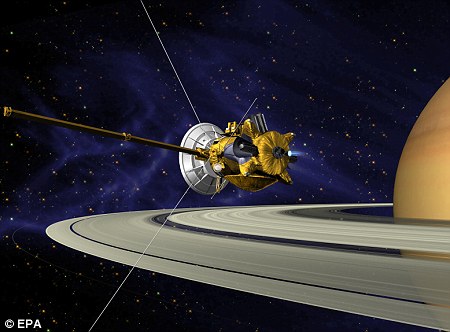
An artist’s impression of the Cassini spacecraft studying Saturn
In 2000 it spent six months studying Jupiter before reaching Saturn in 2004.
In that time, it discovered six more moons around Saturn, three-dimensional structures towering above Saturn’s rings, and a giant storm that raged across the planet for nearly a year.
On 13 December 2004 it made its first flyby of Saturn’s moons Titan and Dione.
On 24 December it released the European Space Agency-built Huygens probe on Saturn’s moon Titan to study its atmosphere and surface composition.
There it discovered eerie hydrocarbon lakes made from ethane and methane.
In 2008, Cassini completed its primary mission to explore the Saturn system and began its mission extension (the Cassini Equinox Mission).
In 2010 it began its second mission (Cassini Solstice Mission) which lasted until it exploded in Saturn’s atmosphere.
In December 2011, Cassini obtained the highest resolution images of Saturn’s moon Enceladus.
In December of the following year it tracked the transit of Venus to test the feasibility of observing planets outside our solar system.
In March 2013 Cassini made the last flyby of Saturn’s moon Rhea and measured its internal structure and gravitational pull.
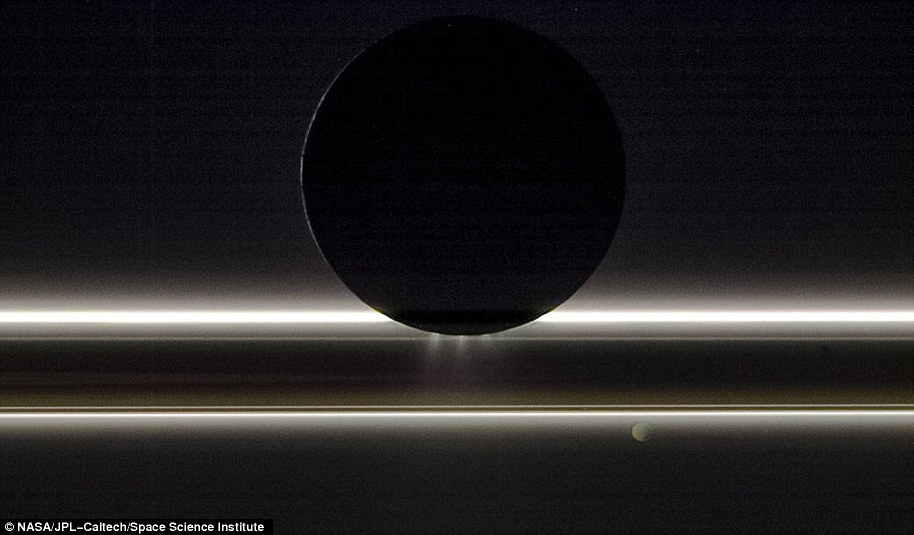
Cassini didn’t just study Saturn – it also captured incredible views of its many moons. In the image above, Saturn’s moon Enceladus can be seen drifting before the rings and the tiny moon Pandora. It was captured on Nov. 1, 2009, with the entire scene is backlit by the Sun
In July of that year Cassini captured a black-lit Saturn to examine the rings in fine detail and also captured an image of Earth.
In April of this year it completed its closest flyby of Titan and started its Grande Finale orbit which finished on September 15.
‘The mission has changed the way we think of where life may have developed beyond our Earth,’ said Andrew Coates, head of the Planetary Science Group at Mullard Space Science Laboratory at University College London.
‘As well as Mars, outer planet moons like Enceladus, Europa and even Titan are now top contenders for life elsewhere,’ he added. ‘We’ve completely rewritten the textbooks about Saturn.’