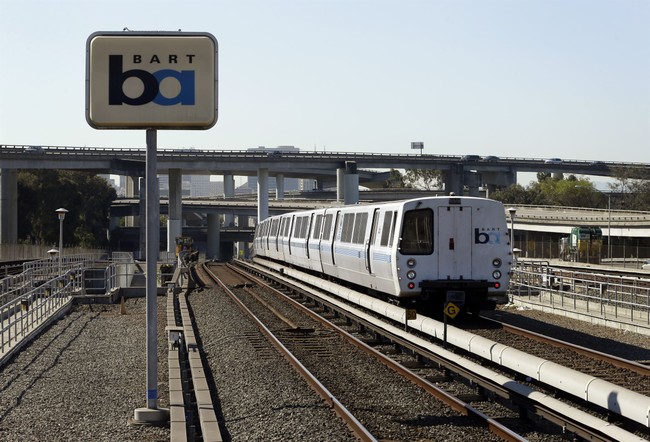
Last month the San Francisco Chronicle published a story warning that the Bay Area Rapid Transit system (BART) was in danger of major cuts unless voters passed a new tax to fund it this November. Today the NY Times has a story basically echoing those concerns. BART as it exists today will collapse unless a new source of funding arrives soon and that could eventually mean the collapse of the entire system. This is one part of the doom loop scenario which is still on the verge of happening even though no one talks about the doom loop anymore.
Seven years ago, BART trains would fill up quickly each weekday, with passengers taking every seat, jostling for space in the aisles and clutching every pole. Now, the trains often lumber into the city with a trickle of commuters rather than a crush.
BART’s future is dire. Its ridership cratered during the pandemic and remains less than half of what it once was. And the very future of the familiar white and blue trains, which have zipped around the Bay Area since 1972, is in doubt…
Fewer trains. Higher fares and parking fees. Ending service at 9 p.m. instead of midnight. Laying off a quarter of its work force. And shrinking the system almost back to its original footprint by shuttering 15 stations…
“This is about putting BART on life support,” Barnali Ghosh, a member of the BART board of directors, said at a slash-and-burn meeting in late February, noting that the system could shut down completely. “BART is not too big to fail.”
At this point, everyone knows why this is happening. The pandemic broke the connection between white collar office work and downtown office space. And that connection has never recovered, hence many fewer people taking the train to work and a lack of fares to support a train system designed for a lot more people than it currently sees in a week.
The decline in office workers downtown has already had a big impact on retailers who survived, in part, on the foot traffic all those office workers created. They city’s biggest mall has been emptied and dozens of major downtown retailers have closed for good already.
In a sense, BART is the last lifeline connecting the broader Bay Area to downtown. If BART cuts services dramatically as described above, downtown will be cut off for a lot of people who don’t own cars or simply don’t want to drive in SF traffic everyday.
Jornie Macalalag, 43, boarded a train in Antioch to head to the skilled nursing facility where she works in Daly City, a town nearly 50 miles away, just south of San Francisco. A home near her job would cost $1.2 million, so she saved hundreds of thousands of dollars by buying one near Antioch instead.
She does not know how to drive and calls in sick when BART service is disrupted. The closure of the Antioch station and others nearby would upend her life.
“I need to pass my driving test now,” she said, widening her eyes in worry.
There’s more to this story of course. Years ago when I started writing about BART’s problems, it wasn’t because ridership was down, it was because homeless people had turned BART stations into heroin dens. Commuters were literally stepping over the slouched bodies of addicts to get to their trains. And that problem got worse for years until about 2023. Those years changed a lot of people’s perceptions of how safe it was to ride the trains. Budget issues also created more frequent system shutdowns which made the trains seem less reliable. All of that played into the doom loop situation the train system is now facing.
Some riders recently said that BART’s frequent service disruptions — including occasional meltdowns — and unsociable behavior by some passengers made riding the train an exercise in fortitude.
“There should not be people smoking crack and cutting their toenails on BART,” said Justice Laub, the chief executive of a pet care app called Boop.
Commenters responding to this story also mentioned the condition of the trains. Here’s the top comment from someone in San Francisco.
Street people sprawling across seats during rush hour. Buskers with amplified music swinging from hand rails. No actions taken when you report a problem in the live chat. Passive staff who sit on their behinds in the booths. Infrequent service with sufficiently frequent issues that I have to leave a full train early to make an appointment. New, yet very slow (compare:Tokyo) fare gates. And it’s painfully loud. I have a high tolerance and so I still take it. I know quite a few people for whom these are dealbreakers. At least they reopened and have attendants at the restrooms, so the elevators and escalators are no longer toilets for the homeless.
It doesn’t sound pleasant. Even if you could take it, you might now want to bring your kids on the train. Another reader agrees safety is the main issue.
BART needs to focus on safety and then doing media and PR around that. People would come back to riding BART to the city. Back in the 90s I rode BART home from work late evenings and that is something that I would never do now. We don’t have enough public transportation in this country as it is BART is a huge benefit of living in east bay, focus on teamwork and involving the community in making it better so people ride again.
Several readers point to the fact that BART is highly unionized and workers make big salaries, get cheap benefits and pensions.
I agree with what Glazer said, but also think it is worth evaluating the hearty BART pensions and health care benefits for employees and their families. My health insurance premiums are thousands more for my family of four per month (thru my employer) than what BART employees have to pay, and I don’t receive the generous pension either when I retire. Why can’t the administrators tackle that, at least as a goodwill effort to help bring down costs, before adding more taxes?
This is the union way, load down the system with high costs and debt until it becomes unsustainable and then whine about management and capitalism. The unions have no goodwill. What have is contracts which they will fight for tooth and nail whether the system is broke or not.
Anyway, you get the idea. The system is on the verge of collapse. The state can’t rescue it and the unions won’t either. The only hope is the taxpayers who will be given a choice this fall. Pay more for a system fewer people use or watch it fall apart and potentially take more of downtown San Francisco with it.
Editor’s Note: Do you enjoy Hot Air’s conservative reporting that takes on the radical left and woke media? Support our work so that we can continue to bring you the truth.
Join Hot Air VIP and use promo code FIGHT to receive 60% off your membership.