If you haven’t seen “Sinners” and are wondering how a vampire movie set in the Jim Crow era is sweeping up at awards season this year, it’s because it is so much more than a horror flick.
Since its release date last April, writer-director Ryan Coogler has engaged casual fans and cinephiles alike with his genre-bending masterpiece, creating a populist appeal that’s as multilayered as the film itself.
And now, thanks to a record number of nominations leading up to the 98th Academy Awards on March 15, “Sinners” has gone from unheralded to undisputed among the Hollywood establishment. On March 1, the Actor Awards (formerly the Screen Actors Guild Awards) – the largest voting bloc in the Academy of Motion Picture Arts and Sciences – delivered best ensemble to “Sinners” and best male actor to its lead, Michael B. Jordan. Mr. Coogler, whose ensemble won in 2019 for “Black Panther,” became the first filmmaker to steer two ensembles to the guild’s top prize.
Why We Wrote This
“Sinners,” directed by Ryan Coogler, has received a record number of Oscar nominations and is a contender for best picture. The multilayered movie, which explores African American history and music, has added to the cultural dialogue around what makes a great movie and who gets to make it.
All signs had been pointing toward “One Battle After Another” (directed by Paul Thomas Anderson) for best picture as it scooped up wins this award season. But “Sinners,” which has grossed nearly $370 million worldwide, is now being praised as the highest-grossing original film in 15 years. That’s a drastic shift from early naysayers who claimed the movie, with its reported $90 million budget, wouldn’t appeal to a broad audience and wouldn’t recoup its losses. Instead, “Sinners” has added to the cultural dialogue around what makes a great movie and who gets to make it.

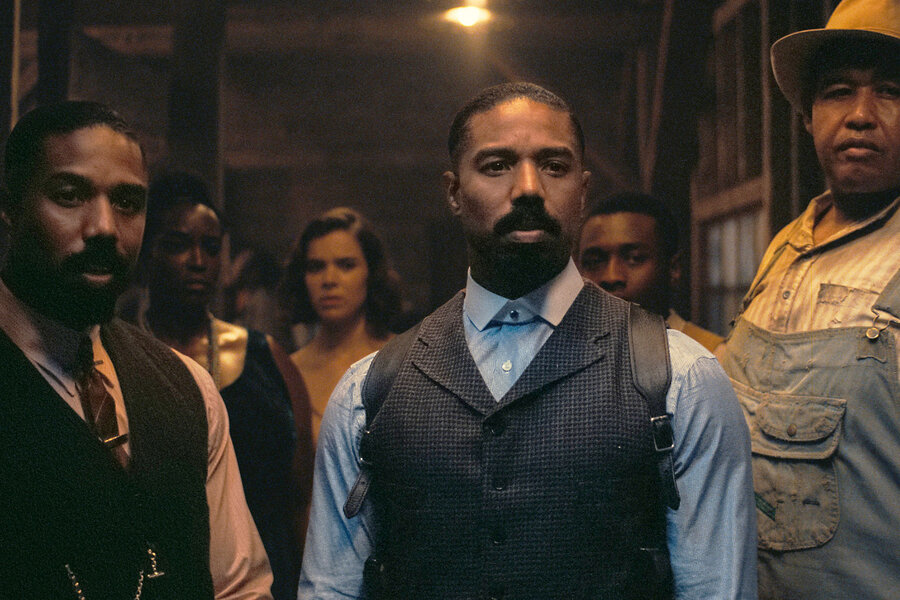
In short, viewing “Sinners” simply as a horror film is myopic. The two-hour film spends its first hour following twin Black entrepreneurs, Smoke and Stack (both played by Mr. Jordan), who return to Clarksdale, Mississippi, in 1932 after working for Al Capone in Chicago. They use their mob-earned wealth to buy an old sawmill from local Klansmen to open a juke joint. The depiction of Mississippi life, which by itself is a compelling and complex display of humanity, is one thing. But the arrival of vampires at the door of the juke joint – intended as a safe space for Black and marginalized people of the neighborhood to dance and mingle – in the subsequent hour proves to be much more perilous than life under Jim Crow.
Understanding the vampires in the film as culture vultures offers an entryway for viewers who might otherwise avoid a film filled with gory and salacious elements. Led by Irish banjo-playing Remmick (Jack O’Connell), the vampires want in. It is a villainous perspective comparable with the Armitages, a wealthy, suburban white family in Jordan Peele’s “Get Out,” whose liberalism is just as dangerous to Black people as the brutality of Klansmen lurking in “Sinners.”
What defines the movie is not the threats posed to the protagonists, but the triumph of African culture and the love that sustains it. It’s a way of life presented not just in the sociological view of Mississippi but also through the music’s intentionality, which celebrates the past, present, and Afrofuturism.
That sound is carried in many ways by Sammie, the “Preacher Boy” played by Miles Caton. But Sammie’s choice of a musical career over following in his father’s pastoral footsteps showed how African American religion doesn’t always land at the feet of the Black church. A soul-stirring foot-stomping confession in “I Lied to You” is a five-minute celebration in the junk joint that begins with Sammie’s solo and weaves its way through funk, rock, and hip-hop, as tribal dancers twirl through the scene.
“I Lied to You” is one departure in the film from traditional Christian practices. The dynamic Wunmi Mosaku, who portrays the healer and protector, Annie, also presents a departure from traditional Black church practices. Her character lends dignity and purpose to hoodoo and other forms of African spirituality in American life.
As part of the genius that defines Mr. Coogler’s work, the film’s themes of the emergence and preservation of African culture – as it mixes and melds in the social churn that is America – have found an echo in the weeks leading up to the Academy Awards. It’s evidence that, yes, life can imitate art. The movie’s plot to carve out a place of refuge for Black and marginalized people serves as an allegory for Black artists and ideas seeking to endure among the Hollywood establishment. Mr. Coogler leaned into that notion after “Sinners” won 13 NAACP Image Awards.
“There’s something powerful about standing in this room tonight,” Mr. Coogler said at the NAACP Image Awards. “[This is] a room where we don’t have to explain ourselves – or our stories aren’t footnotes, they’re the main text.”

Mr. Coogler also blurred the lines between art and life by casting blues legend Buddy Guy to play an older Sammie who, like the fictional character, forged a blues career after leaving Mississippi. Mr. Guy will join Mr. Caton and others at the upcoming Academy Awards to perform the nominated song, “I Lied to You.”
The director and his cast have also had to maintain their poise, grounded in the conviction of their art, in the face of controversies ranging from microaggressions to the macro. A now-infamous tweet from Variety belittled “Sinners’” $61 million global debut, a commentary quickly rebuked by A-lister Ben Stiller. More recently, a controversy at the BAFTA Awards in London involving a slur from an audience member led to a stunningly graceful response a week later from “Sinners” fan favorite Delroy Lindo, who plays a blues musician in the film.
“Before we start, I’d just like to officially say, we appreciate – I appreciate – we appreciate all the support and the love that we have been shown in the aftermath of what happened last weekend. It means a lot to us,” Mr. Lindo said at the NAACP Image Awards, reflecting on the outburst at the BAFTA Awards that came with an apology from the BBC. “It is an honor to be here amongst our people this evening. Among so many people who have shown us such incredible support. And it’s a classic case of something that could be very negative becoming very positive.”
It’s a narrative worthy of the mystique surrounding “Sinners” – a multilayered film that invites viewers to sit uncomfortably through depictions of racism and cultural appropriation to be rewarded with the freedom to love Black people out loud. It is a deep and abiding love – one that audience members are returning to again and again – that feels bigger than awards, even as “Sinners” continues to pile up trophies and has its sights on the industry’s biggest prizes.