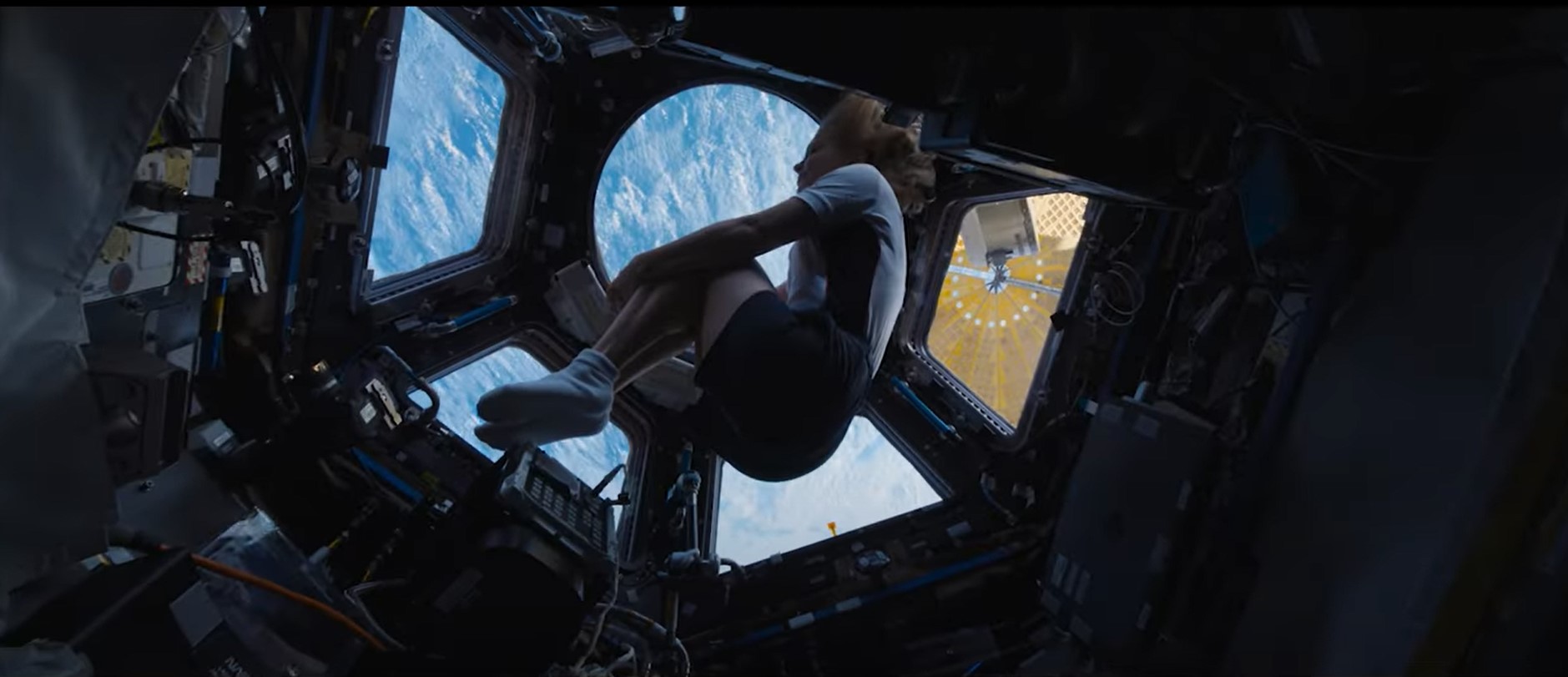
RUSSIA is planning to build an anti-gravity space station where astronauts can roam without floating.
Energia, the principal contractor for Russia’s human spaceflight program, has forwarded plans for the base which would replicate half of Earth’s gravity.
According to the Russian Federation Federal Service of Intellectual Property, the space station would “improve the design of a space system with artificial gravity in order to increase the safety of use by the crew.”
However, if successful, the move could be detrimental to humans, as low gravity is associated with cognition problems, muscle loss and heart deconditioning, among others.
The innovative design features a central spinning module which is tethered to rotating arms, triggering a force which would prevent astronauts from floating.
“The space system with artificial gravity includes an axial module with static and rotating parts, connected with the help of a hermetically sealed flexible junction, as well as habitable modules, rotation equipment and power sources,” according to the patent.

This means astronauts would be able to walk and work without floating.
Assembling the station would require multiple launches and assembly in orbit, and the station has been designed to be built from the inside out, with more habitation modules added to the arms as required
It comes after Russia also unveiled plans to build a nuclear power station on the moon within the next decade.
The ambitious project is intended to supply energy for Russia’s lunar space programme and a joint research station with China.
Russia’s state space corporation, Roscosmos, has said it plans to build a lunar power plant by 2036 and has signed a contract with the Lavochkin Association aerospace company to carry out the work.
The plant would provide power for rovers, an observatory, and infrastructure at the joint Russian-Chinese International Lunar Research Station.
“The project is an important step towards the creation of a permanently functioning scientific lunar station and the transition from one-time missions to a long-term lunar exploration program,” said Roscosmos in a statement.
While Roscosmos did not explicitly confirm that the plant would be nuclear-powered, Russia’s leading nuclear research organisations, Rosatom and the Kurchatov Institute, are involved.
Roscosmos head Dmitry Bakanov said the agency aims to use the power plant as a springboard to pursue future missions to Venus – Earth’s sister planet.
Russia is not alone in its interplanetary ambitions.
In August, Nasa announced plans to place a nuclear reactor on the Moon by the first quarter of the 2030 fiscal year.
“We’re in a race to the Moon, in a race with China,” said U.S. Transport Secretary Sean Duffy.
“To have a base on the Moon, we need energy.”
Although international rules prohibit placing nuclear weapons in space, there is no ban on nuclear energy sources.
The Moon, located about 250,000 miles from Earth, is believed to contain vast resources, including an estimated one million tonnes of helium-3.