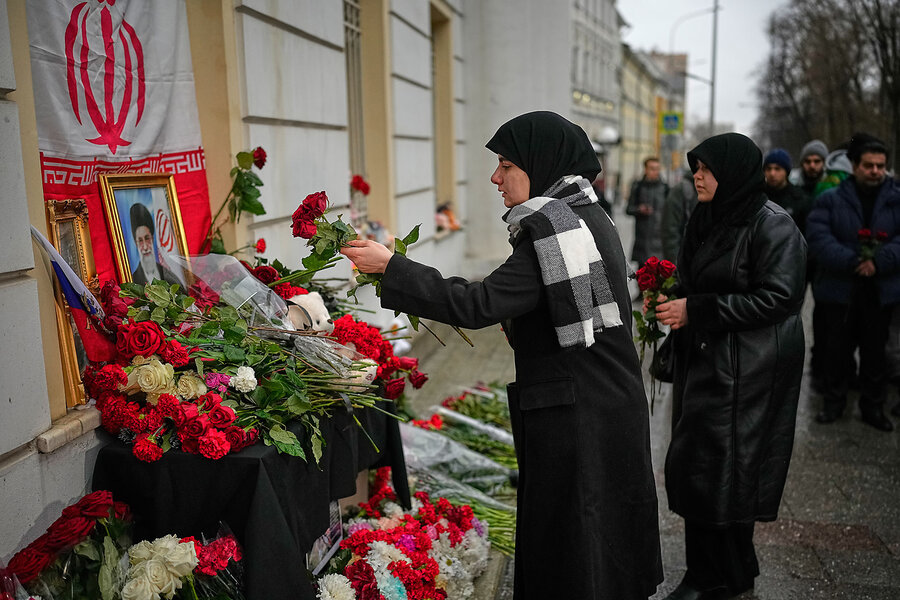
Russian leaders claim to be shocked by the way the United States and Israel launched a sudden attack on Iran last weekend, deliberately killing Ayatollah Ali Khamenei, the leader of a sovereign state.
But, so far, they’ve offered little indication of how they plan to respond to the mixed bag of consequences that grow more irreversible with each passing day.
The war is threatening another of the Kremlin’s key Mideast allies. It has also fueled an already growing distrust within Russia toward President Donald Trump, especially after the U.S. and Israel began their campaign while nuclear negotiations with Iran were ongoing. But at the same time, by destabilizing oil trade in the Persian Gulf, the war is also providing Russia with an unexpected boon: spiking oil prices, which will only benefit the country’s oil and gas trade.
Why We Wrote This
Russia is staying on the sidelines as the United States and Israel wage war against Iran. But the conflict is crystallizing Russian perspectives on President Donald Trump, and may reshape how the Kremlin deals with the White House.
Whatever happens, one thing Russia will not do is intervene directly, despite having signed a strategic partnership with Iran just last year.
Following last summer’s 12-day war in which the U.S. and Israel bombed Iranian nuclear facilities, President Vladimir Putin told journalists that not only did Russia’s relationship with Iran not include any mutual defense obligations, but also that the Iranians had shown no interest in the idea. Asked how he would react if Israel were to kill Iran’s supreme leader, Ayatollah Ali Khamenei, Mr. Putin brushed aside the question, saying “I don’t even want to discuss such a possibility.”
The Washington Post reported on Friday, however, that Russia is providing intelligence to Iran about the location of U.S. warships and aircraft in the Middle East.
Andrei Klimov, an official with the ruling United Russia Party, says that Russia condemns the “unprovoked aggression” against Iran and will express its views in the United Nations Security Council. But “this is not our war,” he says. “We didn’t start it, and we aren’t taking any part in it. Indeed, we are ready to help resolve the situation through diplomatic and other channels.”
Shifting influence in the Mideast
From a foreign policy perspective, the war in Iran is troubling for Russia. Moscow has already seen the overthrow of its long-time client in Syria, Bashar al-Assad, but the loss of Iran would be far more damaging to Russian strategic interests and regional credibility.

Office of the Iranian Supreme Leader/AP/File
Should the U.S. succeed in installing a pro-American government in Tehran, it might threaten Russia’s already diminishing influence in the South Caucasus, its own backyard. Some analysts paint a nightmare scenario for the Kremlin, in which a resurgent Donald Trump-led America restores unchallenged U.S. hegemony in the Middle East and elsewhere.
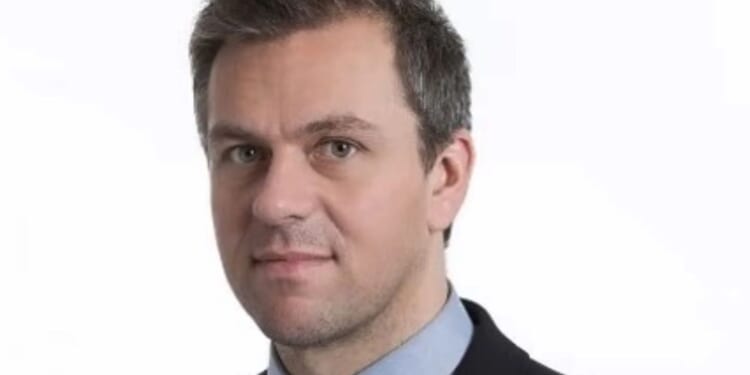
“After Syria, Venezuela and now Iran, nobody knows who will be next,” says Vladimir Sotnikov, an independent political expert based in Moscow. “What if the U.S. just keeps rolling on, reshaping the world in its own image? If this operation against Iran succeeds, it will be a serious blow to Russian interests in the Middle East.”
But over the past year, deft Russian diplomacy has managed to salvage Moscow’s influence in Syria, and it has even been able to keep its military bases in the country. Some analysts say the economic and geopolitical synergies between Russia and Iran are deep and might well outlast even a radical regime change. On the other hand, if the U.S. fails to accomplish its objectives in Iran, Russia might be well-placed to mediate.
“Russia could be very helpful, both for Iran and the U.S.,” if Mr. Trump wants to find an exit ramp from the situation, says Mr. Sotnikov. Russia played an important role in multisided negotiations that resulted in the Obama-era nuclear deal with Iran. It built the country’s civilian nuclear station, and to this day has hundreds of workers embedded in Iran’s program. “It’s too soon to say whether this will be a disaster for Russia, or something else.”
Silver linings?
On the plus side from Moscow’s point of view, the prices of oil and gas – Russia’s primary source of export income – began spiking on international markets almost immediately after the war began. They could surge even further if Iran succeeds in closing the vital Strait of Hormuz. About one-fifth of the world’s supply of those commodities moves through that waterway next to Iran’s southern coastline. India, which had been pivoting away from purchases of Russian oil at Washington’s behest, quickly began to reconsider its plans as the market supply dwindled.

U.S. weapons stockpiles, especially equipment that is vital to Ukraine’s defense against Russian air raids, were already under strain. Russian experts now say that with the U.S. and Israel burning up so much of this weaponry in the fight with Iran, those shifting priorities will work very much in Russia’s favor.
“In the short term at least, there are a lot of factors that look positive for Russian interests,” says Fyodor Lukyanov, editor of Russia in Global Affairs, a Moscow-based foreign policy journal. “The Americans are distracted, the Europeans are confused, and military supplies for Ukraine are diminished.”
But Russian leaders have expressed dismay at the way the war in Iran was launched in the midst of negotiations that by many accounts were showing progress. And Mr. Putin condemned the killing of the supreme leader as a “cynical” murder.
“The killing of Khamenei exceeds what was previously thought of as normal behavior,” says Mr. Lukyanov. “We used to take for granted the immunity of legitimate leaders of a state, a member of the U.N., people that you need to be able to talk with. No longer. We’ve never seen anything like this before.”
No more illusions
The thaw in U.S.-Russia relations that began a year ago with U.S.-sponsored peace negotiations over Ukraine might not be dead, but it’s been badly battered, says Dmitry Suslov, an expert with the Higher School of Economics in Moscow.
“We see that no matter what the U.S. declares, their policy is aggressive and aimed at imposing U.S. hegemony. Trump declared himself to be against intervention, and yet he has become an arch-interventionist,” he says. “We have seen that, for the U.S., negotiations are fake, just a ruse to provide cover for preparing military actions. The U.S. cannot be trusted.”
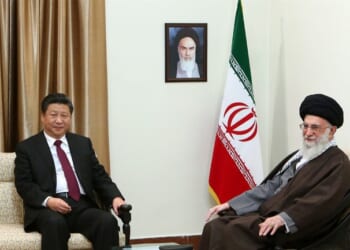
Russia and China might be driven closer together as a result of this war, says Mr. Suslov. The two countries’ political statements about the war are almost identical. The incentives for the two Eurasian giants to cooperate have grown significantly, including Russia’s importance as a reliable supplier of energy and resources to China. Both will likely step up their outreach to the Global South, including their leadership in the BRICS economic association.
“The U.S. may use this situation to declare the BRICS to be a paper tiger. After all, they can’t help one of their own who comes under attack,” says Mr. Suslov. “Russia will likely try to facilitate a more coordinated response, to criticize actions and bring countries of the global majority” into greater alignment.
But there are no more illusions in Moscow that Mr. Trump might prove to be a friend of Russia, says Mr. Lukyanov.
“More people here are saying that we are really going to miss Joe Biden and his administration. They might have been anti-Russian, but at least they knew some limits. It doesn’t look like Trump does.”