Rough sleepers will receive a lump sum payment of £2,000 to spend on whatever they want as part of a new study aiming to see if it helps them find housing quicker.
Researchers at King’s College London will follow those given the funding for a year after 250 homeless people in Belfast and London were recruited to take part in a trial.
While half of the participants involved will be given the cash which will be transferred directly into their bank accounts, the remaining 125 will receive nothing.
Those taking part have been screened to ensure that giving them the one-off payment will not harm them – and those with addiction issues have been excluded.
In a pilot phase of the trial, people were said to have bought furniture or household items for new accommodation or paid for clothes or courses to look for work.
Others purchased a second-hand car to drive their children to school. One paid off debts, another funded driving lessons and a third used it as savings for a business.
Further items purchased included children’s clothes, Christmas presents, a holiday abroad, sports equipment, a TV, mobile phone, gym membership, books or clothes.
While some participants gave money to relatives or friends, others had not spent all of the cash within three months and put it in a bank account as savings.
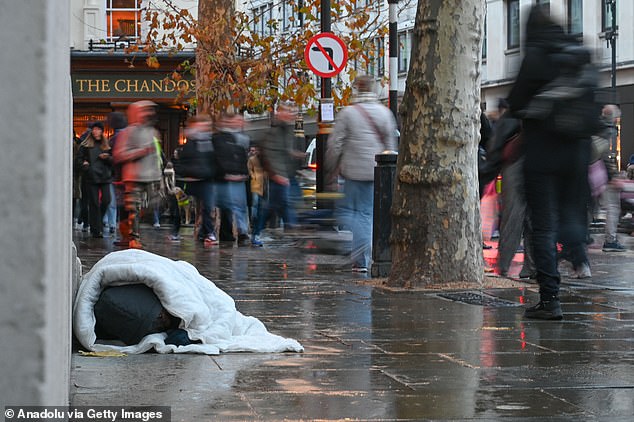
People living on the streets in London this month as homelessness remains a major issue
It is unclear whether the participants were British or foreign nationals.
The research, which is the first of its kind in the UK, emulates a smaller study in Vancouver, Canada in 2018.
That study found that rough sleepers who received the payment spent a lot less time homeless and didn’t increase their spending on alcohol and drugs.
The trial in the UK has been supported by registered charity The Centre for Homelessness Impact (CFIH) trial, the Big Issue reported.
The organisation transferred the lump sum directly into the bank accounts of people with recent experience of rough sleeping or staying in temporary accommodation.
The final results of the study are not expected to be published until 2027.
Ligia Teixeira, chief executive of the Centre for Homelessness Impact, said: ‘Our cash transfers project is rooted in a straightforward yet powerful belief: when people have direct access to resources, they gain agency over their lives and livelihoods.
‘By challenging outdated assumptions about how support is delivered, we hope to see not just immediate relief but real shifts in economic participation, decision-making and resilience.
‘We need to ask ourselves what is best for all of us in society. Do we continue to invest in an ever growing crisis system or do we give those at risk even better opportunities to self exit?’
The Daily Mail has contacted King’s College London and the Centre for Homelessness Impact for comment.
The study comes amid a huge surge in people sleeping rough across the UK – with 300,000 people facing the ‘worst’ form of homelessness.
Ministers have been warned that Labour’s early prisoner release scheme and an increase in migrants being released from asylum seeker accommodation are partly to blame.
The landmark report, released last month by Heriot-Watt University, revealed that homelessness levels stood at 299,100 across England in 2024 – a 21 per cent rise since 2022 and a 45 per cent spike since 2012.
There has also been a 70 per cent increase in the number of people approaching councils for homelessness assistance – with local authorities in London and across the north of England worst affected.
‘Homelessness resulting from evictions from UK asylum accommodation was up by 37% in the last year, influenced by the acceleration of Home Office decisions on claims,’ the study said.
‘At the same time, homelessness resulting from discharge from hospitals, prisons and other institutions went up 22% in the last year. This is likely in part the result of the UK Government’s early prison release scheme which has added pressure on council finances.’
The Home Office’s decision to halve the number of days most people granted asylum can stay in government accommodation has also been blamed for leaving migrants homeless.