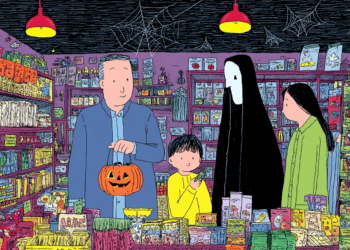
In a new “Sesame Street” skit, Cookie Monster’s pie has gone missing. Enter super sleuth Beignet Blanc. The muppet hilariously mimics Benoit Blanc, the Southern gentleman detective played by Daniel Craig in the “Knives Out” movie series. But uncovering the culprit in “Forks Out” is a piece of cake, or pie, compared with Blanc’s case in the new “Wake Up Dead Man: A Knives Out Mystery.”
The third “Knives Out” movie, streaming Friday on Netflix, features a murder committed inside a room that had no one except the victim in it. Not just a whodunit, but a howdunit. For series writer and director Rian Johnson, the story is an opportunity to examine religious faith. The plot centers around the murder of a controversial preacher Monsignor Wicks (Josh Brolin). Suspicion falls on his apprentice. Young priest Jud Duplenticy (Josh O’Connor) disagreed with Wicks’ vindictive and judgmental sermons. The hateful rhetoric alienated all but a faithful remnant. Only right-wing politician Cy Draven (Daryl McCormack) seems to find Wicks inspiring. Blanc, the detective – sporting a new shaggy hairdo – not only tries to solve the case but also spars with Father Jud over theology.
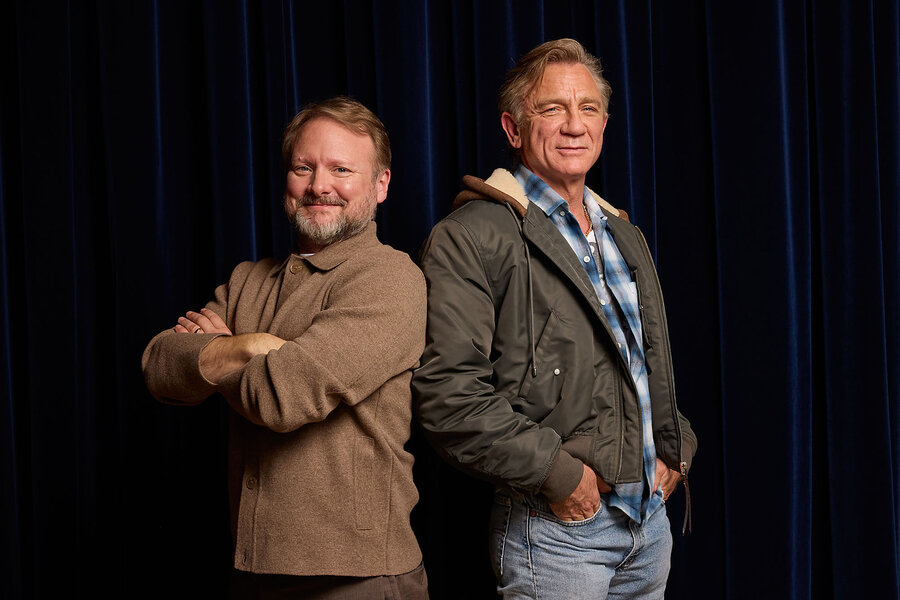
The Monitor interviewed Mr. Johnson, who also created the TV series “Poker Face” and directed movies such as “Star Wars: The Last Jedi,” via Zoom. The conversation has been edited for length and clarity.
Why We Wrote This
For “Knives Out” series writer and director Rian Johnson, the third outing is not just a locked-room mystery, but an opportunity to examine religious faith.
Rian, you have shot down the idea of doing a “Knives Out” movie consisting of Muppet characters. So, what was your reaction to watching “Forks Out,” the “Sesame Street” spoof of your detective series?
I can’t remember a more joyous three minutes of my life than watching that. I mean, Grover said my name!
How does “Wake Up Dead Man” hold up a mirror to what you’re seeing in today’s religious landscape, including how that intersects with our political landscape?
The basic fundamental question at the heart of the movie is, [as] Father Jud says, it is “arms wide” versus “fists up.” A welcoming stance versus an us-against-them mentality. … The idea that we’re under siege and have to fight the world, that’s definitely one of the very real aspects that I felt when I was part of the church – in addition to all the things that Father Jud represents, of the arms open, of loving your enemies and of helping the world. Those two things were always in conflict for me when I was in the church.
It’s absolutely, obviously, not just in the world of the church. … That theme, I can point right back at myself just in my scrollings on social media and getting angry at the big “Them” out there, with a capital T. So, it’s both timely and something that I’ve been wrestling with since I was a kid.

John Wilson/Netflix © 2025
So, through the process of writing the script and looking at all those tensions that you examined in a movie, did you come to any resolutions yourself through that process?
For me, writing this script was a way of forcing myself to delve back into my life as a believer. I found I couldn’t write this central character of Father Jud, Josh O’Connor’s character … from my current perspective. I really, like a method actor, had to put myself back through the eyes of framing the world around me through a relationship with Christ.
The big thing, I suppose, [was] reconnecting with, and just appreciating, “Love your enemy.” That being the hardest assignment in the world, especially right now, and that being the thing that I find in myself today, even as a nonbeliever, that I need to do more of.
In the movie, there is that question of whether rational logic and revelation can be reconciled. So, when you were writing the script about a seemingly unsolvable mystery, did you have a moment as a writer when you got stuck and you couldn’t figure out a story problem, but then arrived at a solution through a seeming revelation?
Every writer will tell you this. We like to think that we’re constructing a Lego set, or constructing a crossword puzzle, or pick your analogy. The reality is, when we write, we’re always deep-sea fishing and we’re always casting into deep waters. The reality is, it is like in the movie, the moment of revelation sometimes when you’ve been working on something in the script and, suddenly, the solution presents itself. I think any writer will tell you, you only get a few of them per script. So, when those God rays shine through the window and you think, “Oh, this is what it needs to be,” it feels like a revelation as opposed to the solution to a math problem.
In “Star Wars: The Last Jedi,” you introduced the idea that the Force is accessible to anyone. It’s not just something for a select few. Is that a metaphor, perhaps, about faith being accessible to all? Something that transcends human institutions or an investiture order?
Well, it’s definitely what I was brought up in, regarding faith. I like that notion. I like that idea. It feels to me like if there’s hope in the world, that’s where it’s gonna come from. It’s not just the privileged few of a certain bloodline that get access to the basic thing that powers the universe.
Tell me a bit about the visual language of “Wake Up Dead Man” and how you and cinematographer Steve Yedlin made use of darkness and light.
The first conversation I had with Steve is, I really wanted to get theatrical with the outside natural world affecting the interior spaces of the church and our sets. I grew up in Colorado where the clouds move very fast. If you don’t like the weather, wait five minutes. And so the feeling of being in a room and having it be sunny and brightly lit, and then two seconds later it’s like God turns the lights off. And what that does emotionally to the tone of the room is something I felt a lot in life, and don’t see in movies very often. So, Steve did a lot of work so that we could have all of the lights surrounding this church set on a light control system on his computer so that we could play it almost like music, the light changes.
What are some of your favorite movies that examine faith and religion?
To do research when I was writing this script, my aunt and uncle in Denver – who are very Catholic – connected me with their priest, Father Scott. I went out to Denver and went to dinner with him and he invited five of his priest friends. I got to have an “ask me anything” session with like six young American Catholic priests. … Anyway, I asked them what their favorite movie about a priest was and they told me this movie “Calvary” with Brendan Gleeson.
I watched this movie, and it is extraordinary. It’s because it is not soft on the edges at all about faith. It’s very much about the abuse scandal and it’s the psychological trauma of that in Ireland. It’s also a dark comedy; it’s very funny, but it is hard edged. [What] the priests loved about it is that the central character is very human, but also genuinely trying to to be a good priest, and the movie is a true look at a very hard topic.
How did you cast Josh O’Connor as the priest, Father Jud?
I saw him in “Challengers” and thought he was great. But then I saw him in an Italian film called “La Chimera,” where he gives a beautiful performance that is very different than the one in “Challengers.” I got a sense of his range. And then I sat down and met him and, just as a human being, I just felt this instant warmth and connection from him. And I just instantly felt like I think he would really bring a sincerity to this that the part relies on. So, man, I’m so grateful that we got him for this. He really is the heart and soul of the movie.