This article is taken from the February 2026 issue of The Critic. To get the full magazine why not subscribe? Get five issues for just £25.
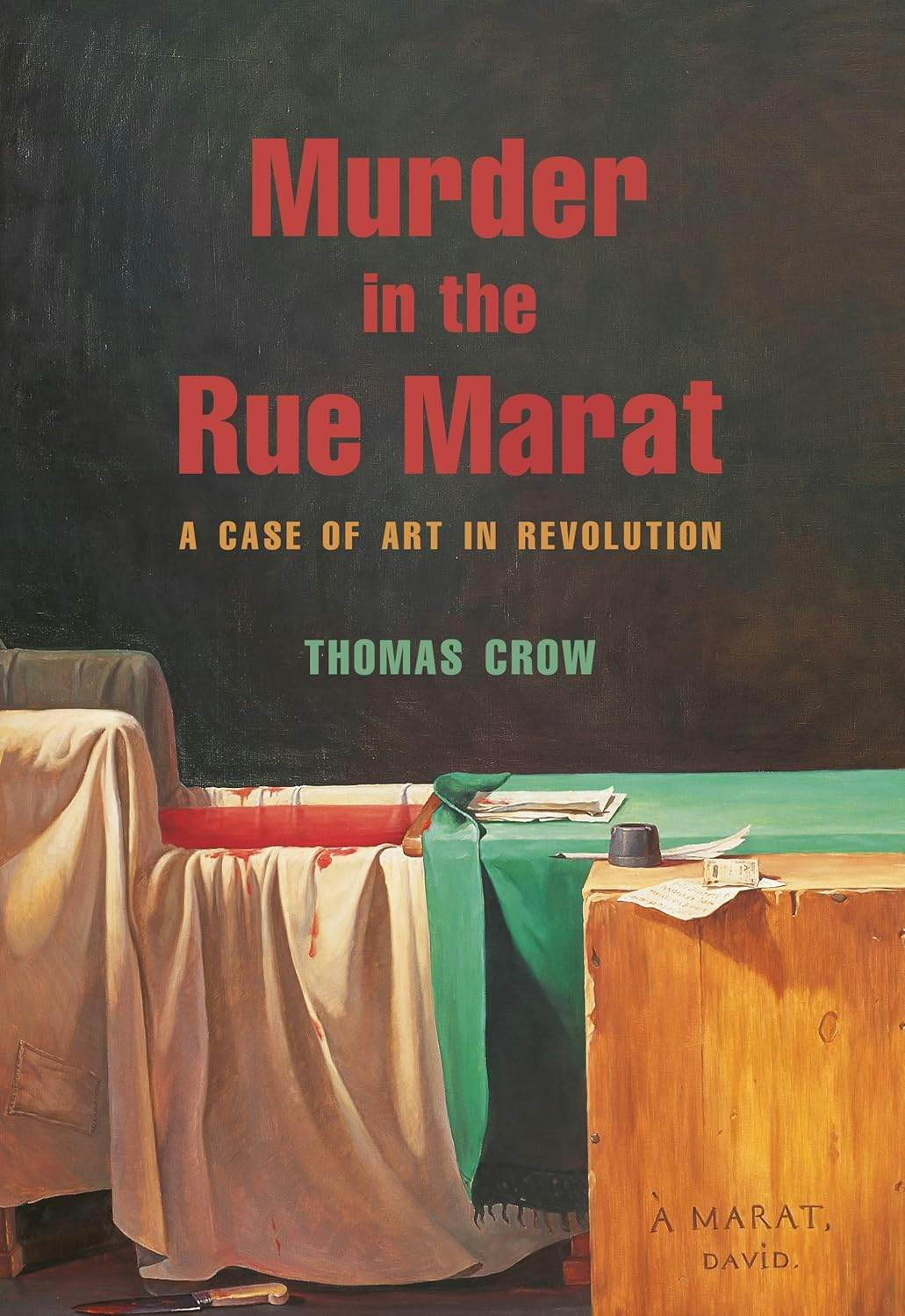
Jacques-Louis David’s The Death of Marat is one of the most visceral paintings of the French Revolution. Painted in late 1793, it shows the radical firebrand Jean-Paul Marat just moments after he was stabbed in his bath by Charlotte Corday.
There’s an air of chilling immediacy about it — as if we’ve just burst into the room. Marat is slumped to one side. In his left hand, he is still holding the note Corday used to trick her way into his house. On the floor, the murder weapon still glistens with blood. What makes the painting so striking, however, is its religiosity.
As art historians have often noted, Marat’s pose looks a lot like Michelangelo’s Pietà or Caravaggio’s Entombment of Christ. His face, usually twisted with fury, is beatific, even saintly; his quill resembles a martyr’s palm; and the green baize of his table seems to promise new life — as if he had sacrificed himself for the revolution. According to Thomas Crow, however, the religious dimension of David’s Marat runs much deeper than even this suggests. The key, he believes, lies in a crafty — but hitherto overlooked — bit of artistic cribbing.
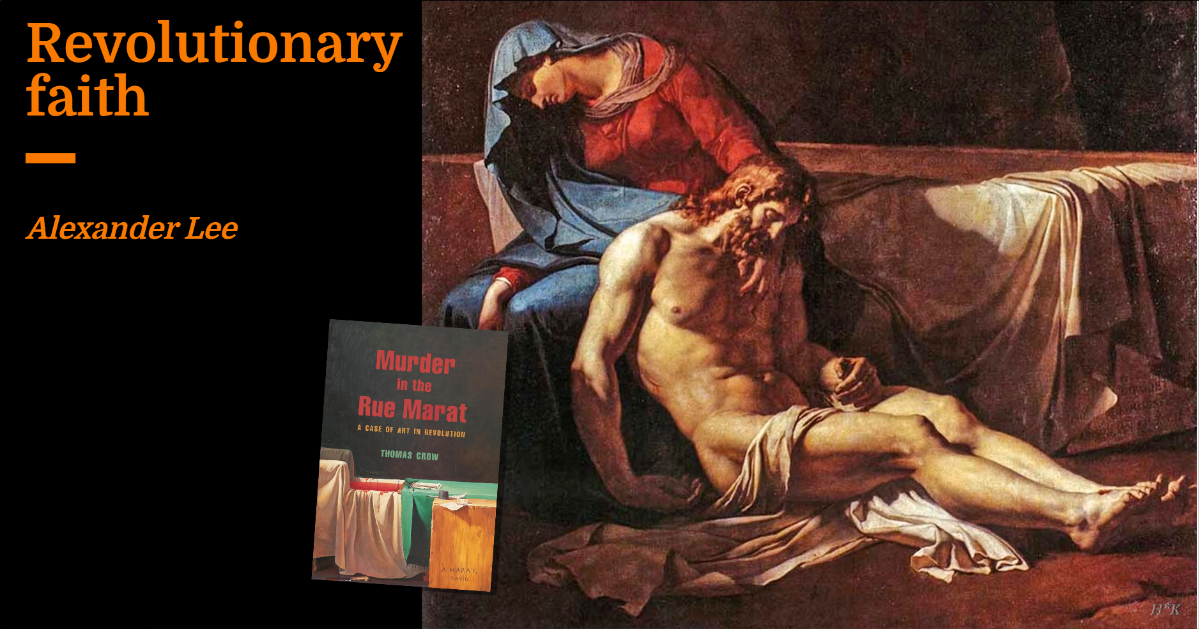
When David was commissioned to paint Marat’s assassination, Crow argues, he didn’t look for inspiration in Michelangelo or Caravaggio, instead turning to his former pupil Anne-Louis Girodet. Today best known for his brooding portrait of Chateaubriand, Girodet was then a rising star. After leaving David’s workshop, he travelled to Italy, where he distinguished himself both as a passionate revolutionary and a precursor of Romanticism.
David always had a soft spot for Girodet. He kept up a lively correspondence with his protégé and even arranged for the Committee of Public Safety to send him money whilst he was in Naples. But David liked Girodet’s work even more. He particularly admired a Pietà he had painted for an otherwise obscure village church in south west France. He liked it so much, in fact, that when he came to paint The Death of Marat, he decided to copy it.
The similarities are striking. Like David’s Marat, Girodet’s Pietà is divided into two parts: one light, the other dark. The line traced by Mary’s head and shoulder is exactly the same as Marat’s. And Christ’s lifeless arm hangs limply down, just like that of the revolutionary hero.
The implications were clear. In copying Girodet’s Pietà, David wasn’t just comparing Marat to Christ: he was saying that Marat was Christ. And not just that — Marat was Mary, too. Unlike other revolutionaries, who had followed a winding path to republicanism, David believed, Marat had got there in a single bound. In effect, he was his own progenitor, his own son.
This was a perilous claim to make. By then, de-Christianisation had already been enshrined as a key plank of the revolution — so casting Marat in such overtly messianic garb was a hazardous thing to do.
It was dangerous for another reason, too. In emphasising Marat’s Christ-like “sacrifice”, David risked exacerbating the tensions aroused by his murder and provoking further acts of violent retribution.
Instead, Crow argues, David used the portrait to appeal for calm. Just as in Girodet’s Pietà, the horror of death is minimised: but for a few drops of blood on Marat’s chest, you could be fooled into thinking he was simply asleep. His eyes have a peaceful air, as if to suggest life after death. His thumb points to the word “benevolence”. The tombstone-like crate which he used as a writing table indicates that his most fitting memorial was his work.
All this makes the legacy of David’s Marat more intriguing. In just over 200 years, David’s portrait has been copied, imitated and reimagined countless times. It was turned on its head by Honoré Daumier in 1834, and appeared in myriad film and music posters during the 1960s. Yet, as Crow shows, it is only by recognising the subtlety of David’s work that it can properly be understood.
Where this book falls down is its length. Although only 166 pages, it is in desperate need of a trim. As it is, a fascinating and revealing story is buried beneath a mass of self-indulgent reminiscences. All too often, the narrative is interrupted with pointless digressions on structuralism or Balzac’s Sarrasine. Crow rarely uses one word when ten or twenty will do. If you can fight your way through the weeds, however, it is certainly worth the effort. For all its faults, the book really does revolutionise how we view one of history’s most revolutionary paintings.