The little camp sits unnoticed, dwarfed by towering glass office blocks and hidden by the thronging crowds of central London.
At first glance it seems little more than a line of discarded belongings pushed up against the wall of a service road: a row of tents, a few battered folding chairs, and communal makeshift kitchens overhung by tarpaulin and old sleeping bags.
Look closer, though, and there are clues to who lives here: bikes parked up and secured against railings, some with bags attached bearing the names Deliveroo, Uber Eats and Just Eat.
The men who live here are members of a new class of homeless – self-employed riders, delivering takeaway food across the capital from dawn to dusk but forced to sleep rough because they say their wages are not enough to secure even a shared room.
In 2025, the UK’s online food delivery market was estimated to be worth more than £14.3billion.
It represents the epitome of 21st century convenience: from junk food to gourmet dishes to your door within minutes of tapping the order into an app.
Yet behind this is a workforce, many of whom live hand to mouth. And they are not always who you might expect them to be.
Among the 20,000 or so food delivery riders in the capital are 20-something graduates and trained professionals barely scraping a living even as the delivery industry booms.
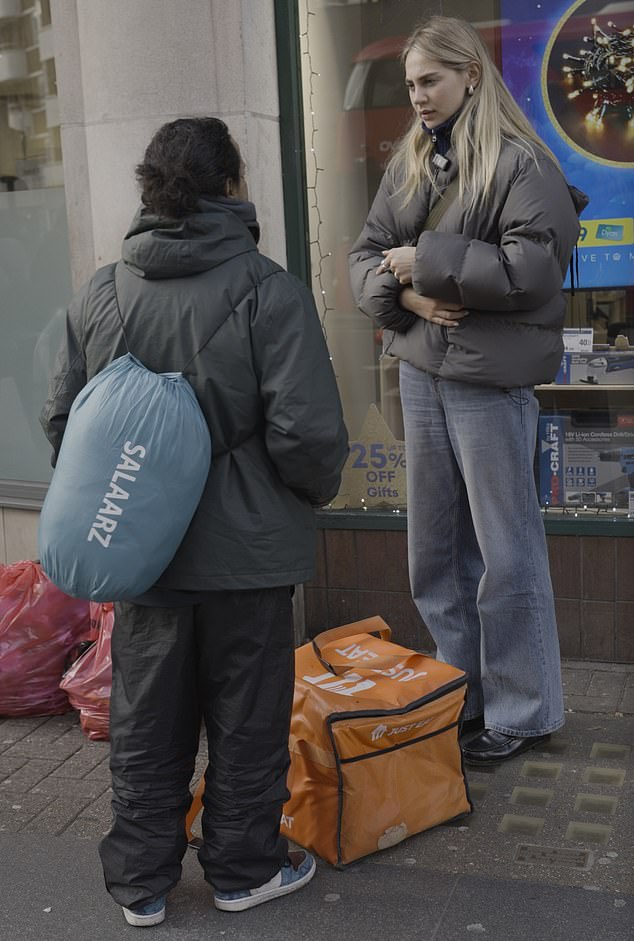
For Underground: UK, the Daily Mail’s new investigative video series charting life beneath the surface of young Britain, Mimi Yates (pictured) spent three weeks walking the city streets, seeking out delivery bike riders to learn about their lives
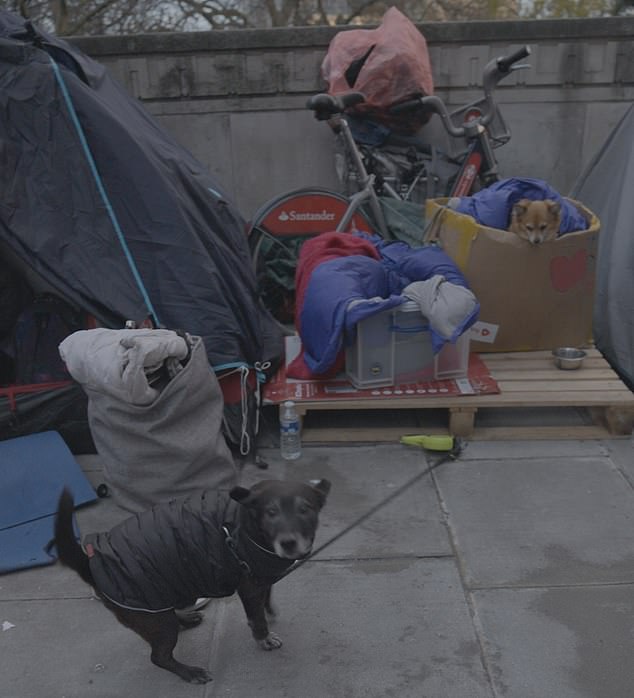
The men living at a makeshift camp (pictured) in central London are members of a new class of homeless – self-employed riders, delivering takeaway food across the capital from dawn to dusk but forced to sleep rough because they say their wages are not enough to secure even a shared room
So, who are people who make it happen? For Underground: UK, the Daily Mail’s new investigative video series charting life beneath the surface of young Britain, I spent three weeks walking the city streets, seeking out the men on bikes to learn about their lives.
It took several visits to the camp near Warren Street Tube before I found someone willing to speak.
Rami*, 27, from Morocco, eagerly took up my offer of a Chesterfield Red cigarette.
He spends his days waiting for his phone to buzz with the next order, hanging around outside restaurants for bags of food to be handed over, or on the road speeding from delivery to delivery.
Each drop offers a brief tormenting glimpse of warm homes and the ordinary rhythms of a life he can’t afford.
Small, with a gentle face and easy smile, Rami is well-spoken. Slung beneath his orange Just Eat delivery bag, he has a rolled-up sleeping bag flattened against his back for when he gets a chance to nap.
We stood together in the bitter cold for more than an hour before his first job came in.
‘It’s when I wake up here that it hits me,’ he tells me. ‘I was so ambitious when I came to the UK.
‘I came here to be rich, to be a big businessman. Now, I am homeless.’ He hasn’t told his family. ‘I’m too embarrassed,’ he says, eyes filling with tears.
Delivery companies pay per drop rather than per hour – sometimes as little as £2.80.
Riders said the platforms’ ‘pay floors’ do not pay like a ‘real’ minimum wage – as when demand is slow, they can spend long stretches waiting for orders without earning anything.
Over the course of a long shift, the sums can be pitiful. Several riders estimated they earn between £50 and £80 for a 12-hour day – the equivalent of barely half the hourly minimum wage.
On slow nights, one told me he made £15 after four hours on the road. Meanwhile, the average room to rent in London now costs close to £1,000 a month.
Rami says he works between 70 and 90 hours a week as he tries to save enough for a deposit on a room.
He knows other riders who stretch their hours even further by sleeping in a McDonald’s or KFC between shifts before getting back on their bikes.
‘And it can be freezing. Sometimes, we cry with pain,’ Rami says.
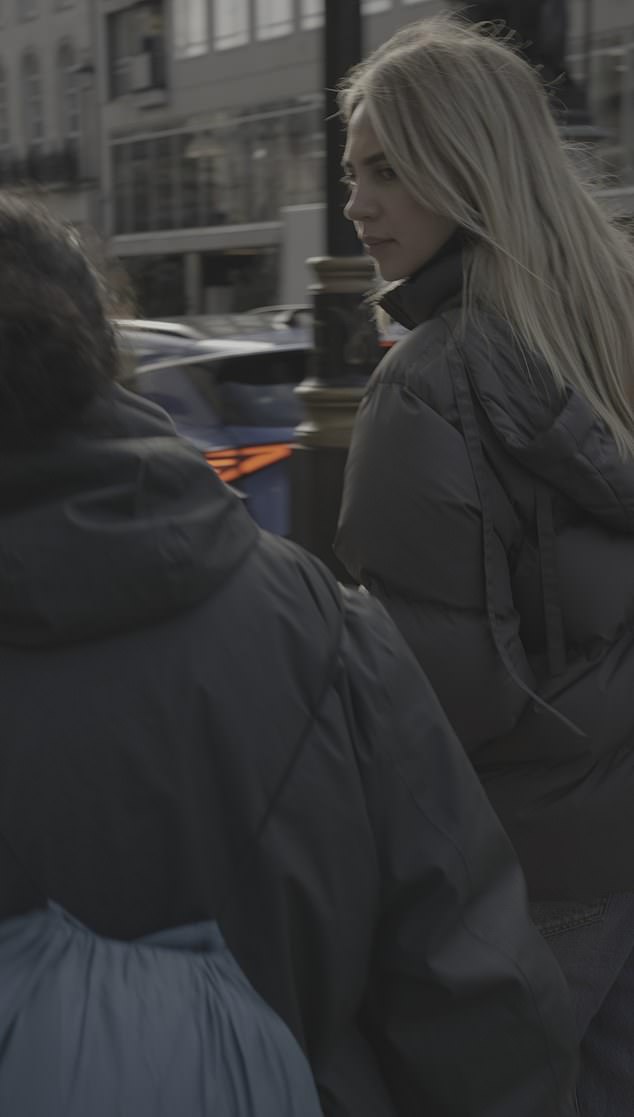
It took several visits to the site near Warren Street Tube before I found someone willing to speak. Pictured: Mimi talking with a delivery rider
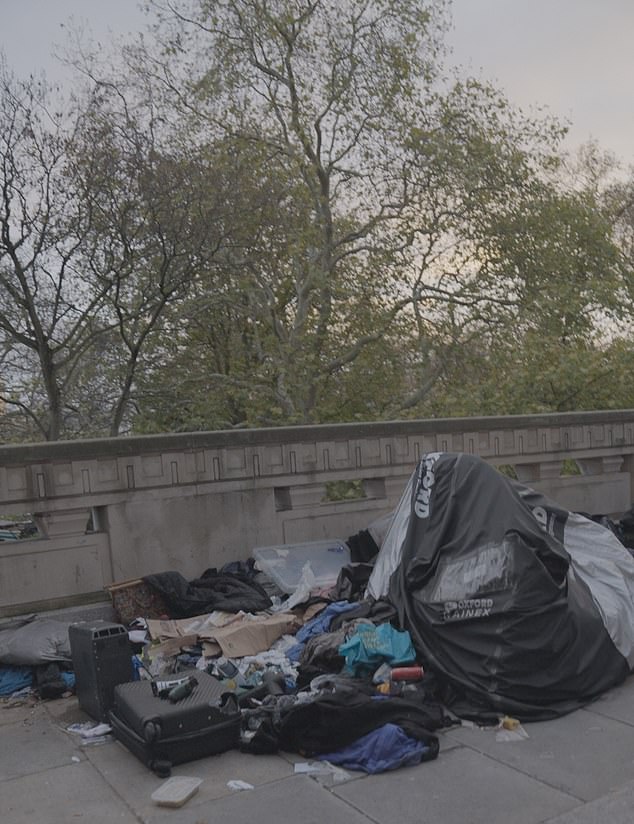
Rami, 27, from Morocco, eagerly took up my offer of a Chesterfield Red cigarette. He spends his days waiting for his phone to buzz with the next order. Pictured: The central London camp he lives in
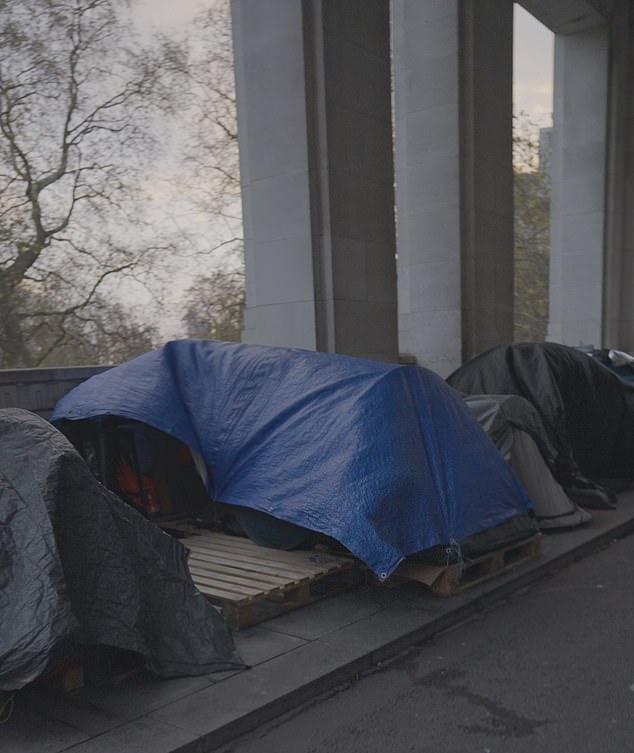
Each food drop-off offers a brief tormenting glimpse of warm homes and the ordinary rhythms of a life he can’t afford. Pictured: The central London camp he lives in
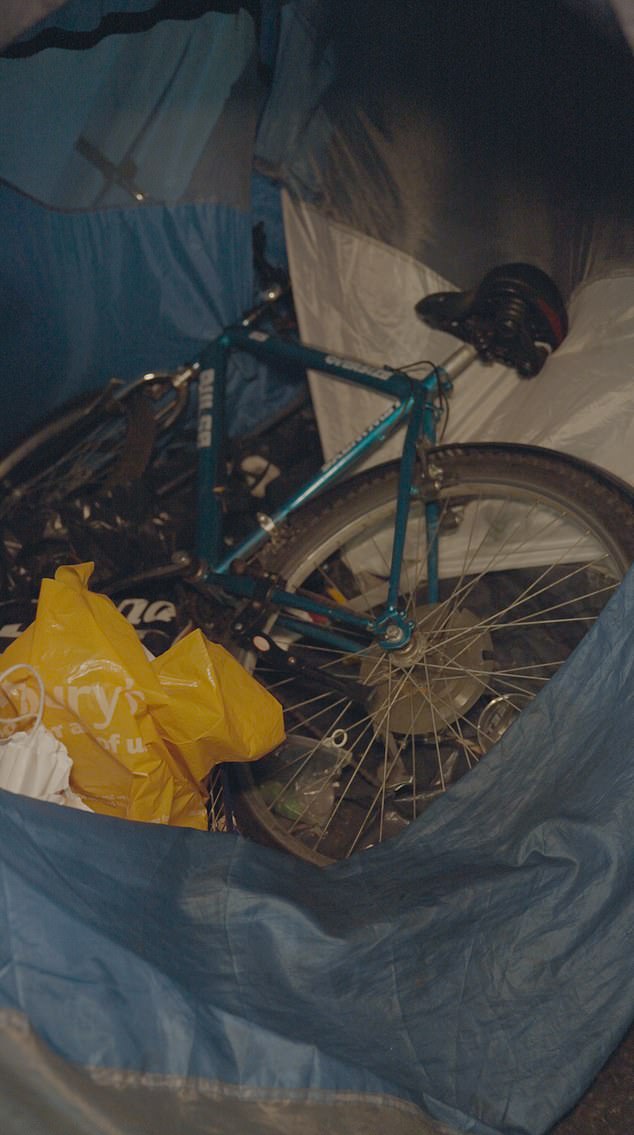
Delivery companies pay per drop rather than per hour – sometimes as little as £2.80. Pictured: The central London camp where many riders live
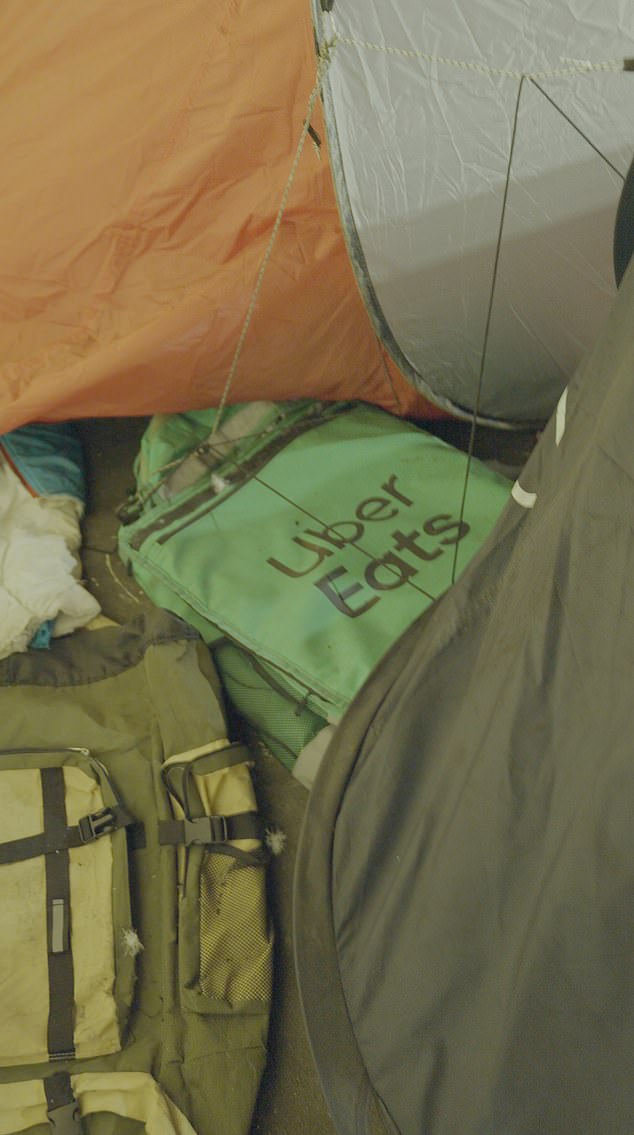
Over the course of a long shift, the sums can be pitiful. Several riders estimated they earn between £50 and £80 for a 12-hour day – the equivalent of barely half the hourly minimum wage. Pictured: The London camp populated by many food delivery drivers
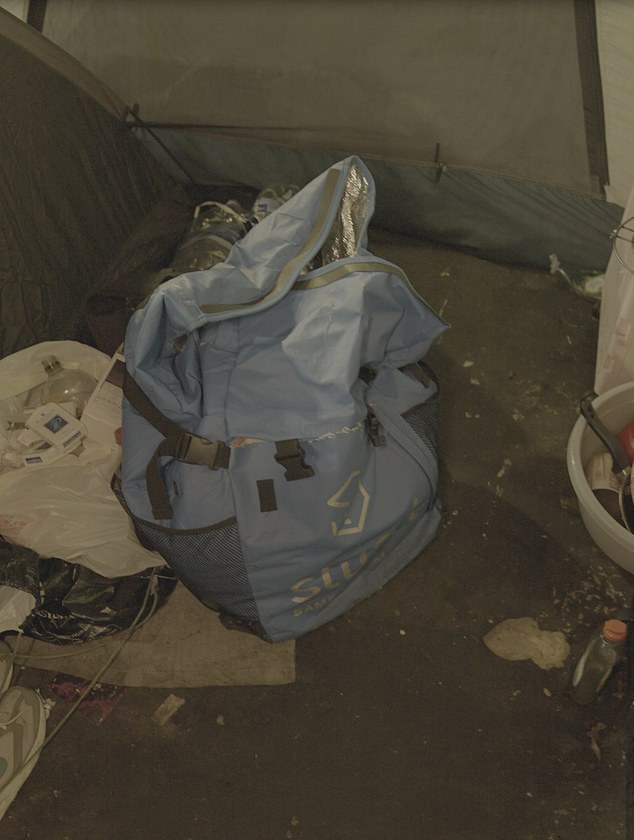
On slow nights, one told me he made £15 after four hours on the road. Meanwhile, the average room to rent in London now costs close to £1,000 a month. Pictured: The roadside London camp populated by food delivery riders
It was the pandemic that changed everything in this business. Food delivery boomed during lockdown as delivery apps proliferated and thousands of new riders were signed up.
When lockdown ended and demand fell, competition for every order intensified. What had once been a steady stream of deliveries became a scramble for work, gradually driving down the pay for each job. On top of that, Deliveroo and Just Eat operate a ‘stacked delivery’ system.
If two neighbouring customers order from the same restaurant – or two restaurants close together – the rider may be offered both jobs at once.
In theory, this means more work in less time. In practice, I was told the second delivery often pays very little.
Riders told me that ‘stacked orders’ mean the additional drop pays around half of the minimum per job, although the apps are still charging both customers the full delivery fee.
The tools needed to work also come at a cost. Owning a bike isn’t an option on these streets. If it’s stolen, the riders cannot work at all.
Rami took me down into a labyrinthine car park beneath a department store. Alongside rows of Ferraris and limousines, there is a small, official bike depot – with rows of rental stands where riders collect and return bikes.
They trickle in, unlocking bikes and strapping on their delivery bags. Rami nods to a few of them as we pass.
The cheapest e-bikes cost around £50 a week to rent. Riders are expected to return them to the depots every 12 hours or risk being fined.
One rider tells me that his phone battery has died mid-shift many times, leaving him unable to log the bike back into the system in time.
The penalty can wipe out the equivalent of five hours’ work.
And of course, to work at all, riders need a phone – and data – to stay active online.
Dean, 33, relies on pay-as-you-go credit, sometimes begging for money just to keep his phone running – and him working.
The young Briton bemoans the poor pay: ‘This is why I can’t have a wife, kids, a home and a mortgage. Because of this.
‘It’s a vicious cycle really – I don’t want people knowing I’m homeless but sometimes it’s obvious. I’ve been fired from previous jobs for it.’
Riders told me they must buy their own insulated branded bags too – and both of Rami’s were swiped in the last week.
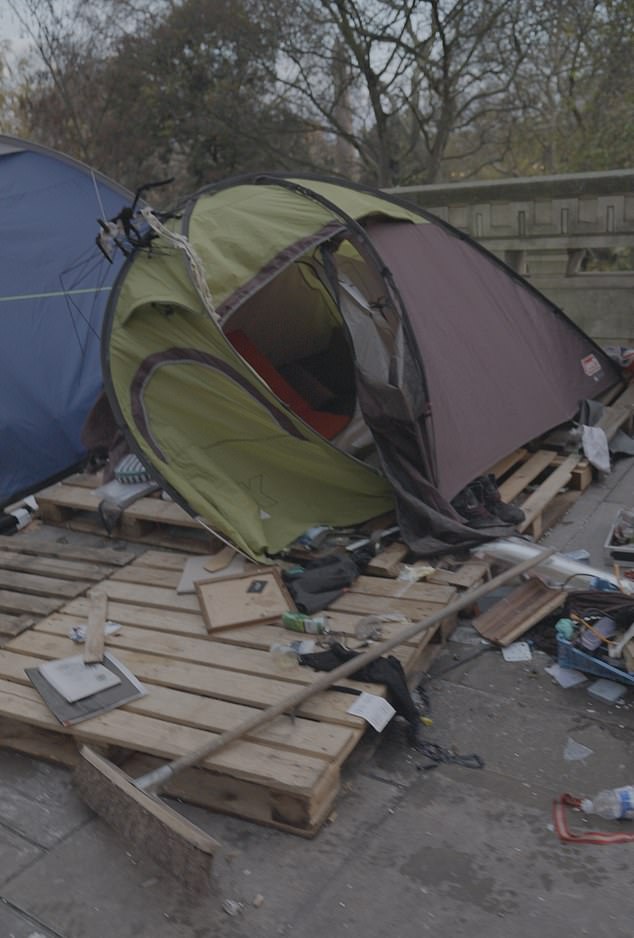
It was the pandemic that changed everything in this business. Food delivery boomed during lockdown as delivery apps proliferated and thousands of new riders were signed up. When lockdown ended and demand fell, competition for every order intensified. Pictured: The central London camp populated by food delivery riders
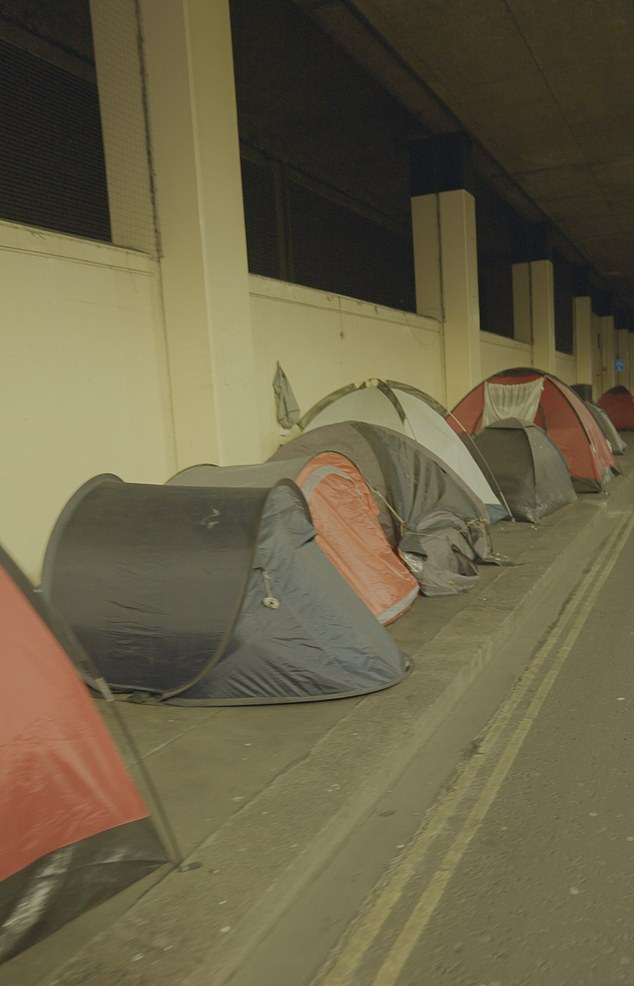
What had once been a steady stream of deliveries became a scramble for work, gradually driving down the pay for each job. Pictured: The makeshift London camp

Rami took me down into a labyrinthine car park (pictured) beneath a department store. Alongside rows of Ferraris and limousines, there is a small, official bike depot
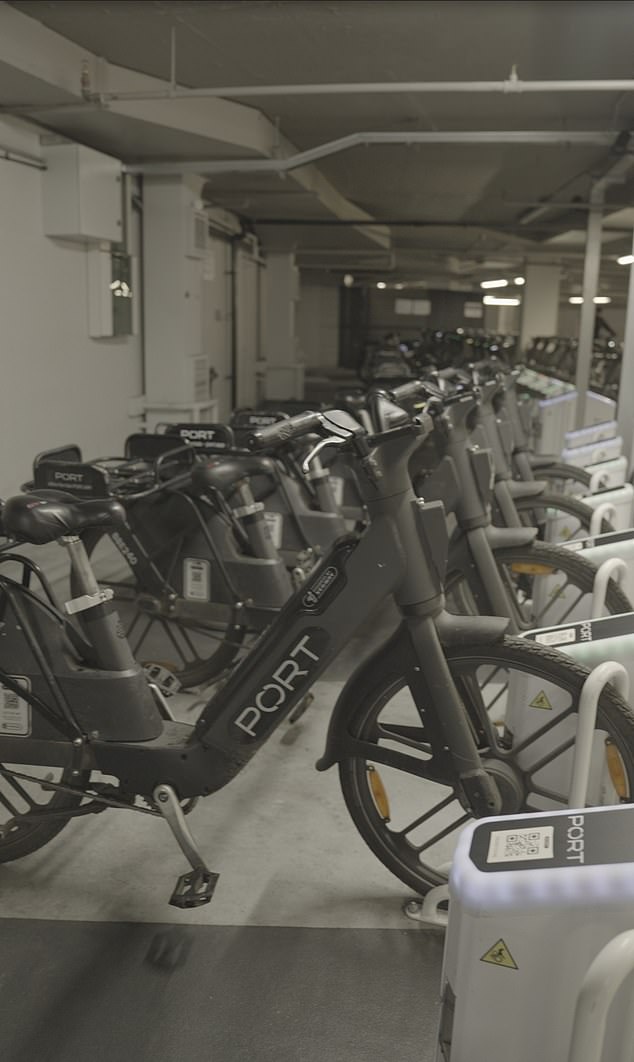
It has rows of rental stands (pictured) where riders collect and return bikes
‘I cannot work without them. They cost me £25 each to replace.’ For riders who are earning very little per delivery, any razor-thin margin disappears quickly.
By now, you may have assumed that my new friend Rami is an illegal immigrant: undocumented and intent on exploiting the system. But the reality is more complicated.
Rami and many of those I met tell me they are legally entitled to work in the UK. They came to London through legal routes or, like Dean, grew up here, albeit on the poverty line.
Of course, I have no way of verifying their stories but Rami showed me documentation which appeared to confirm he has been in the UK since 2021 and has the right to work.
His story echoed those I heard repeatedly. ‘My principle is to work – otherwise, you are stealing from the system. I can do good things in this country, intellectually,’ Rami tells me.
‘I studied economics at an international university in Morocco. And this is a hard life for someone who has a degree.
‘I am not used to the street. Now, I feel like I am dying.’
There are riders working illegally, too, of course. In the UK, asylum seekers are generally not allowed to take paid employment during the first 12 months of their claim or until it is approved. But the gig economy has created ways around that rule.
Several riders described a shadow market in ‘account renting’ in which individuals with the legal right to work sign up to delivery platforms then sublet their accounts to illegal migrants or asylum seekers with the going rate around £50 a week.
For the desperate, it can feel like the only option. But it is risky.
I spoke to people who had worked long shifts expecting to be paid in cash by the account holder, only for that person to disappear – blocking their number or simply never showing up.
Others told me of people for whom account renting is itself a business. They control multiple delivery accounts and sublet them for a fee.
I spoke to one young man who lives in a camp beneath one of London’s bridges.
His tent was set slightly apart from others and had small lanterns illuminating the inside.
Dressed in a smart trench-style jacket, he spoke in near perfect English, addressing me as ‘Madam’.
He qualified as a nurse in India, he told me, but was a delivery rider now and supporting his wife and child back home.

Rami and many of those Mimi (pictured) met told her they are legally entitled to work in the UK. They came to London through legal routes or grew up here, albeit on the poverty line
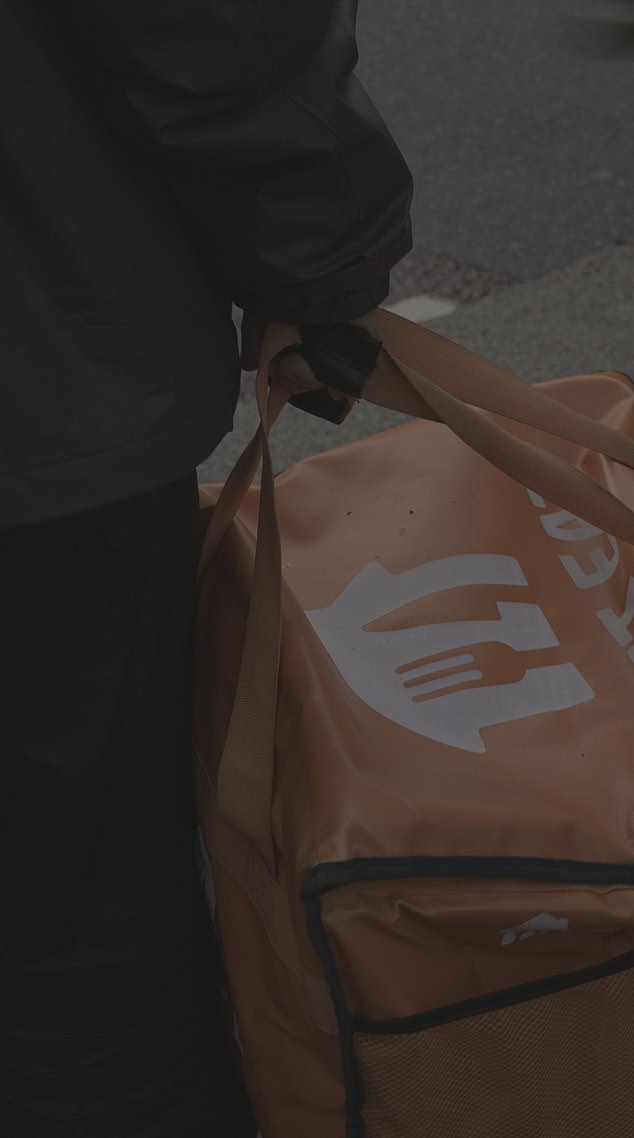
There are riders working illegally, too, of course. In the UK, asylum seekers are generally not allowed to take paid employment during the first 12 months of their claim or until it is approved. But the gig economy has created ways around that rule. Pictured: A food delivery rider
They don’t know he sleeps rough but he hopes to return to nursing once the ‘system allows me’.
‘I made more money begging. But this [delivery riding] is the only clean money we can get.
‘Even if someone is not a criminal, certain circumstances can make them one.’
‘Clean’ means legal. Without it, some say their options turn darker.
Dean echoed this. ‘It’s so easy to get pulled into drugs and everything. But I know I deserve better than that, so I try to keep going.’
Last year, the Home Office launched a partnership with major delivery firms to increase identity checks and introduce more frequent facial-recognition verification to ensure the person riding the bike matches the account holder.
The crackdown has led to ‘blitz’ operations across the country. According to the Home Office, more than 170 delivery riders working illegally were arrested during a week-long operation in November.
Just this month, the Home Office Immigration Enforcement Team swooped on a caravan site in Croydon and arrested nine men and nine women found to be using delivery accounts rented from someone with the legal right to work.
Border Security Minister Alex Norris said new enforcement measures were intended to ‘clamp down on illegal working in the delivery sector and root out this criminality from our communities’.
But unable to work legally and increasingly unable to ‘rent’ accounts, some riders told me they had been pushed towards street crime and drug dealing.
Whether a rider is legal or not, the job itself is high risk.
The streets riders cycle through daily are some of the busiest in Europe. Long hours, heavy traffic and exhaustion mean accidents are common.
Research from University College London suggests gig economy riders are around 11 per cent more likely to be involved in crashes that cause injury to themselves and others than restaurant-employed delivery riders.
Riders paid per delivery were far more likely to take risks on the road to maximise earnings and maintain their ratings on the app. If performance drops, they are at risk of losing their job.
At Humdingers, a soup kitchen in East London, I meet Robert Hunningher, a former chef who trained in London’s top kitchens before building his own catering business. Its profits help provide hot meals for thousands.
Cold evenings bring in delivery riders along with other rough sleepers, he tells me. Some are even wearing their backpacks bulging with sushi, burgers and curries bound for other stomachs.
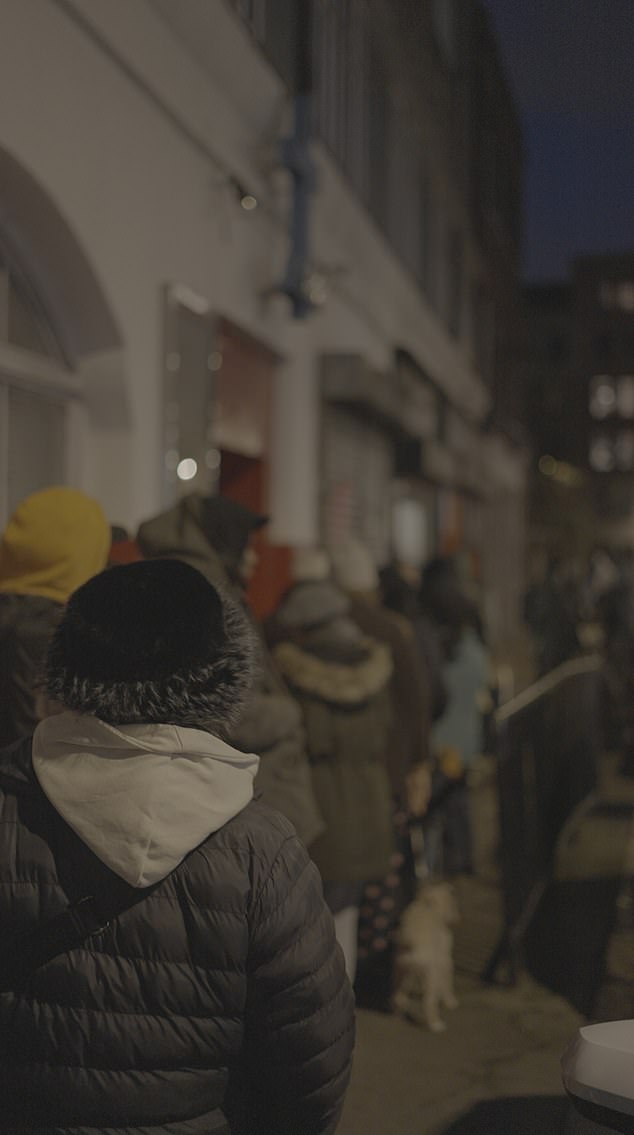
Cold evenings bring delivery riders in to soup kitchens along with other rough sleepers. Some are even wearing their backpacks bulging with sushi, burgers and curries bound for other stomachs. Pictured: A queue for a soup kitchen
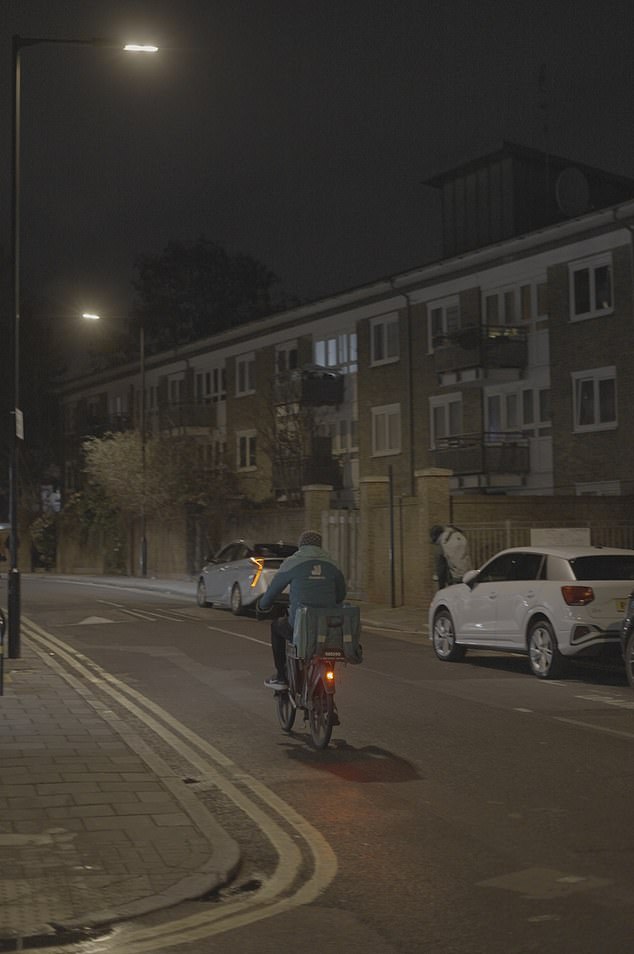
There is a bitter irony about ordering a Friday night takeaway treat when chances are the person delivering it will queue for their own food in a soup kitchen. Pictured: A food delivery rider
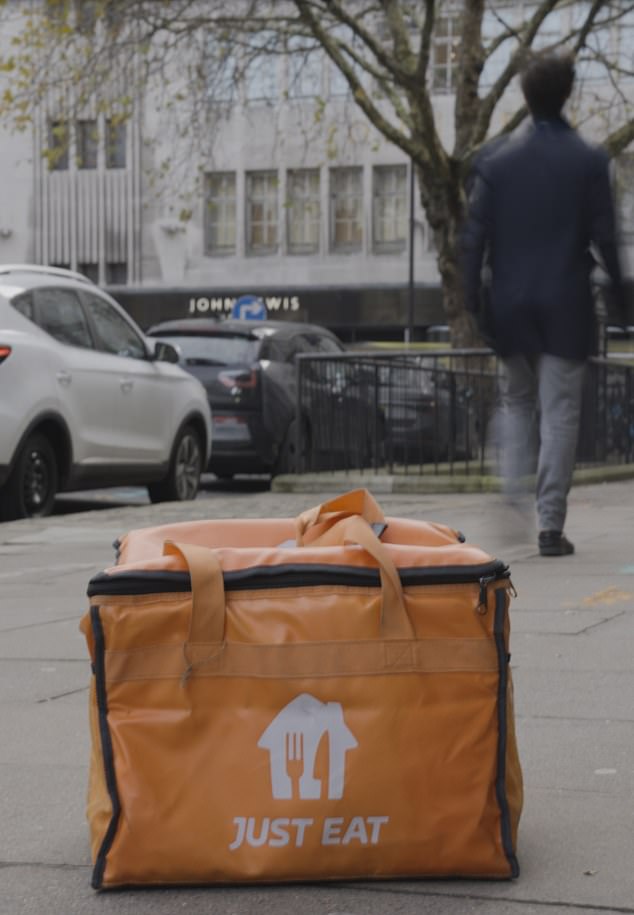
The next time I get my ‘hangover’ Katsu curry, I’ll be offering the rider more than just the delivery code. Pictured: A rider’s food delivery bag
‘I would say about 20 per cent of the people coming here are delivery drivers,’ he tells me.
‘They work all hours, some of them nearly 24 hours a day, because they have nowhere else to go.’
He knows riders who sleep in bike shelters full of vermin and recalls one of the regulars, Dave, who was left with a serious leg injury after a crash.
Because he was classified as self-employed, there was no sick pay and no safety net. ‘[His employers] just abandoned him,’ Robert says.
‘We advised him to get help but he didn’t want to go any further as he said they wouldn’t give him work when he got better.
‘At least the [staff] guys on the bikes, if they get hit, they get time off in a warm hospital,’ he adds ruefully.
There is a bitter irony about ordering a Friday night takeaway treat when chances are the person delivering it will queue for their own food in a soup kitchen.
‘These companies are greedy,’ Rami tells me before we part. ‘They know they can do it, because there will always be cheap hands.’
The next time I get my ‘hangover’ Katsu curry, I’ll be offering the rider more than just the delivery code.
Here are the delivery firms’ responses.
A Deliveroo spokesperson said ‘We are extremely concerned to hear these reports and take these claims seriously.
‘We have requested further information to investigate these, and we encourage anyone affected to contact us directly.
‘Deliveroo riders are self-employed and choose when and where they work, with many working across multiple platforms or alongside other jobs.
‘All riders earn at least a minimum hourly rate while on an order, which is above the National Living Wage and is reviewed annually with the GMB union.
‘However, the majority earn more than this.
‘We are committed to improving self-employed work and have introduced protections including vehicle cost contributions, fuel relief, insurance, sick pay, educational training and more.’
Uber Eats said: ‘The safety and wellbeing of everyone who uses our platform is our top priority and we work closely with our union partner, GMB, to ensure couriers’ interests are always represented.
‘We know that the vast majority of couriers are satisfied with their experience on the app and enjoy the freedom of working when and where they choose, however, we regularly engage with couriers to look at how we can improve.
‘Uber Eats is deeply committed to tackling illegal work and we have industry-leading identity and video verification technology to conduct randomised daily ID checks.
‘We are continually improving our processes to prevent abuse of the platform and work closely with the government on this issue.’
And Just Eat told us: ‘Couriers are the backbone of our business.
‘They are self employed independent contractors and they consistently tell us that the flexibility of the work allows them to structure their working hours around other life commitments.
‘Our data shows that couriers delivering for Just Eat earn over national living wage for the time they are on an order, with regular incentives to help maximise their earnings.
‘We will continue support with any specific concerns from couriers.’
*Some names have been changed for anonymity.