Experts have revealed the worst food pairings for nutrient absorption, and it’s bad news if you like a coffee with your breakfast.
While getting the right nutrients might seem as simple as eating the right foods, the situation is actually more complex than it might seem.
The way you combine foods can be just as important as what you eat, with some pairings unlocking the nutrients trapped in other ingredients.
However, some food pairings can actually block each other, leaving you without the nutritional benefits of either.
From coffee with iron-rich breakfast cereals to leafy spinach and cheese, these pairings could be sabotaging your otherwise healthy diet.
According to food experts at Which?, combining the wrong foods might mean you are blocking your body’s natural ability to absorb iron, calcium, zinc, and vitamin B.
If you have a healthy diet, you shouldn’t need to worry too much, but if you are low on certain minerals or vitamins, you could be depriving yourself of beneficial nutrients.
So, there are the nutrient-blocking food pairings you should be avoiding and the absorption-boosting combos to try instead.
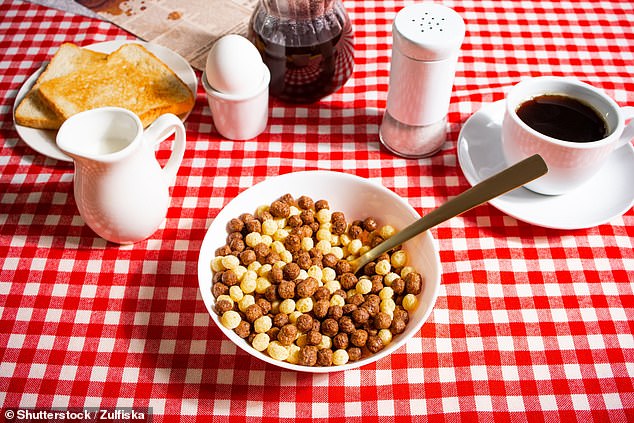
If you like a cup of coffee with your morning cereal, you might be blocking most of the nutrients in your breakfast (stock image)
The worst food pairings for nutrient absorption
A cup of tea or coffee and a bowl of cereal is probably one of the most common ways to start the day.
However, the unfortunate truth is that your morning brew is likely preventing you from getting the full benefits of your nutrient-rich breakfast.
Polyphenols and tannins in tea and coffee are great antioxidants, but they bind with iron in your digestive tract, making the molecule too large to absorb.
This is especially problematic for vegetarians who rely on plant-based sources of iron to stay healthy.
The solution is to simply stagger your caffeine intake so that it doesn’t align with mealtimes.
Research suggests that drinking tea or coffee about an hour before or after eating has little effect on iron uptake, while drinking during meals reduces absorption dramatically.
Another common food pairing that might be blocking your nutrient intake is leafy greens and calcium-rich foods like cheese.
Join the debate
How do you feel about giving up your morning coffee with breakfast if it means better nutrition?
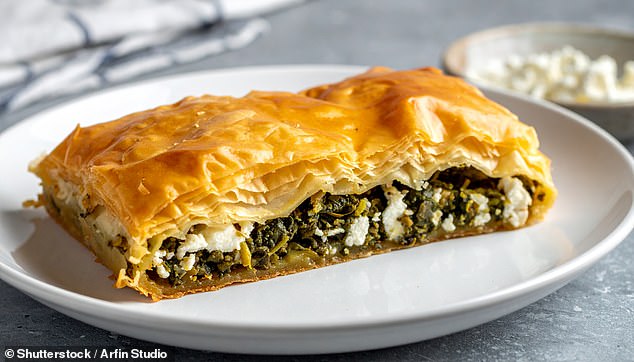
Oxalate-rich veg like spinach can actually block the absorption of calcium by binding with it in your gut. That means a spinach and feta spanakopita isn’t a good pairing for nutrient absorption (stock image)
Leafy veg, like spinach, Swiss chard, and beet greens, are naturally rich in chemicals called oxalates.
Oxalates bind with calcium so that it becomes too large to be absorbed into the bloodstream effectively.
So, if you’re partial to a spinach and feta spanakopita, you’re probably not getting the full nutrients out of your cheese.
To reduce the amount of calcium that gets blocked, you can steam your greens first, which significantly reduces their oxalate levels.
However, this pairing is a double-edged sword, since any oxalates not bound to calcium will travel through the gut into the kidneys, where they can form kidney stones.
So, if you are particularly prone to kidney stones, it’s worth pairing your greens with a source of calcium like cheese.
Finally, and perhaps most disappointingly, a nice glass of wine and a steak is actually a terrible pairing for nutrient absorption.
The problem is that alcohol in wine or beer damages cells in the digestive tract that are responsible for absorbing particular nutrients.
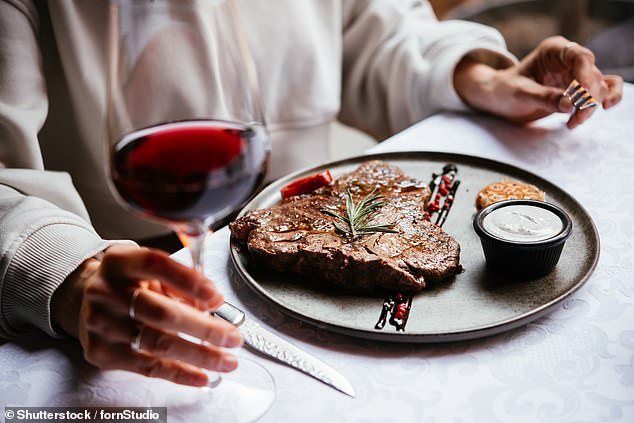
Alcohol in wine or beer damages cells in the digestive tract that are responsible for absorbing the vitamins B1, B12, and folic acid found in meat (stock image)
In particular, research has shown that this impairs the uptake of vitamin B1, B12, and folic acid.
These just so happen to be nutrients that red meat and fish are particularly rich in.
Unfortunately, there isn’t a way around this issue except to hold off drinking during meals or take vitamin supplements when you aren’t drinking.
The best food pairings for nutrient absorption
However, it isn’t all doom and gloom, and there are some delicious food pairings that actually help get more nutrients out of your food.
While pairing spinach and cheese might be off the menu, spinach and lemon is a great combination.
Spinach and lentils are rich in a type of iron called non-heme iron, as opposed to the heme iron found in meat.
Non-heme iron is usually less readily absorbed because it binds with other compounds in the gut, but vitamin C can help break it down into a form that is more easily absorbed.
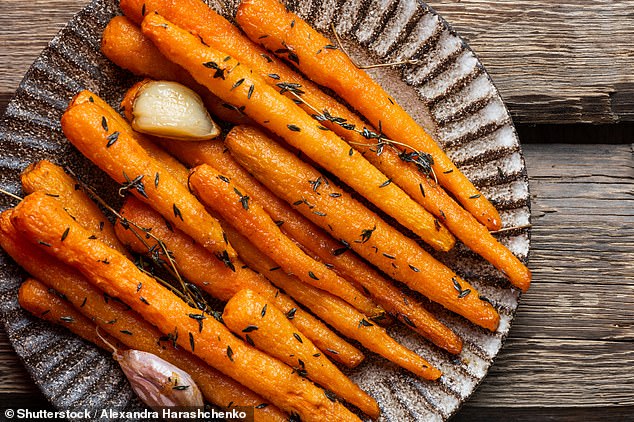
Vitamins A, D, E, and K are fat-soluble, which means adding a healthy fat like olive oil to your roast veg can boost your nutrient uptake (stock image)
So, adding a squeeze of lemon or lime juice to your spinach can make it much more nutritious.
Additionally, in great news for home cooks, healthy fats like olive oil are a great nutritional pairing for most vegetables.
Vitamins A, D, E, and K are all fat-soluble, which means the body can absorb them better when they are mixed with a fat-based ‘carrier’.
Adding some dietary fat to your cooking helps to dissolve the vitamins so that they can be absorbed by the body.
That means drizzling a little olive oil over roast carrots will boost your vitamin A intake, while adding some avocado to a kale salad will help get more vitamin K.