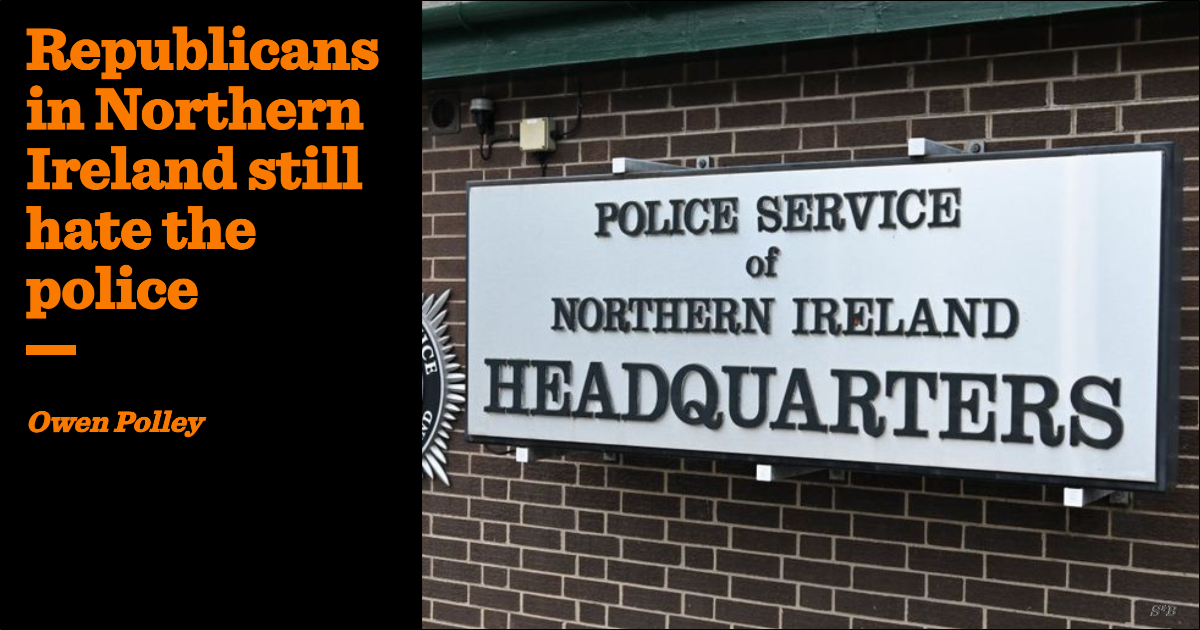
Northern Ireland’s former police force, the Royal Ulster Constabulary, was respected around the world for the skills and bravery it displayed during a murderous terrorist campaign. Of course, it was also hated by Irish republicans, who targeted officers ruthlessly in their attempts to tip the province into outright civil war. As a result, in the wake of the Belfast (Good Friday) Agreement, it was disbanded, as a sop to Sinn Fein.
For the first ten years of its existence (2001-2011), the RUC’s less prestigious replacement, the Police Service of Northern Ireland (PSNI), was bound by a “50/50” recruitment policy. This effectively meant that it was required to discriminate in favour of the minority Catholic community, to address a perceived imbalance in representation. The proportion of Catholics in the force duly increased, until it reached the target of 30 per cent, with the rest made up of people from Protestant or other backgrounds.
The problem was that, despite all the reforms and the change to its composition, republicans still hated the police. Some of them remained involved in crime, while their favoured political party, Sinn Fein, was directed by the army council of a proscribed organisation, the IRA. A small rump of Irish separatist terrorists continued to attempt to kill or injure officers, with mixed success, particularly if they were perceived to come from a nationalist background. And the force was treated with suspicion and hostility by Sinn Fein, which saw its role as holding the police to account rather than offering them genuine support.
Against this backdrop, republicans in Northern Ireland are presenting the latest PSNI recruitment figures as a “crisis” and insinuating that it is institutionally biased against their community. A recent campaign to take on more officers resulted in 4,100 applications, of which 27 per cent came from people with a Catholic background. This is the lowest figure since 2013, according to data released by the police service, and two points down from last year. The latest census figures showed that approximately 42 per cent of people in Northern Ireland describe themselves as Catholic.
The idea that this constitutes a crisis, or that the figures reflect a sectarian culture within the PSNI, is blatantly scurrilous. The former Ireland rugby international and unionist politician, Trevor Ringland, who campaigns for reconciliation, wrote in last week’s Belfast News Letter that, while police recruits require many qualities, a particular “religion or constitutional preference” should not be among them. “There is still a degree of hostility to the police service in some corners of nationalism,” Mr Ringland wrote, “A more constructive attitude to these issues (from politicians) is the single thing that would make an even more representative force possible.”
In fact, the PSNI has gone to extraordinary lengths to ingratiate itself to nationalists and Sinn Fein. In 2021, two junior officers were unlawfully disciplined for arresting a man for disorderly behaviour at a commemoration in Belfast that infringed Covid regulations. The High Court judge who ruled on the case said that senior officers took this action to allay the threat of Sinn Fein abandoning its support for policing. In the wake of the incident, as part of a “frenzy of activity”, Sinn Fein’s policing spokesman, Gerry Kelly, had even called the deputy chief constable directly.
Many grassroots officers, backed by the Police Federation, expressed anger that the force’s disciplinary procedures had seemingly been guided by the political needs of Sinn Fein rather than fairness. Indeed, the PSNI’s lawyers effectively argued in court that keeping Sinn Fein happy was in the public interest.
This was not an isolated example. In another incident during the pandemic, Sinn Fein politicians flouted lockdown rules during a huge public funeral for the IRA thug, Bobby Storey. It later emerged in a PPS report that the PSNI was aware of republicans’ plans for this event, and facilitated it, rather than imposing the law.
The chief constable at that time was Simon Byrne. He had previously issued a grovelling apology to republicans after posing outside Crossmaglen police station with heavily armed colleagues in 2019. As a form of penance for this supposed offence, he commissioned a review into policing in the South Armagh area (known as Bandit Country during the Troubles because it was such a bastion of support for the IRA), by the group Campaign for Restorative Justice. No less a figure than the former Irish Taoiseach, Garret Fitzgerald, alleged this organisation was established by Sinn Fein and that some of its members had been involved in intimidating families out of Northern Ireland.
The current PSNI chief constable, Jon Boutcher, has seemed equally keen to gain favour from republicans. He was forced to apologise to the family of a victim of the IRA, after attending the launch of a book alleging that the so-called Glenanne Gang of loyalists colluded with the state to murder several Catholics in the 1970s. This republican conspiracy theory was recently debunked by the Kenova Report, which concluded that no such group existed as a coherent entity. Boutcher also previously recommended that the government should apologise for its intelligence operations within the IRA.
If Sinn Fein genuinely wanted to increase nationalist representation, it would encourage its supporters to join the police
The truth is that the PSNI is now an impressively representative force, given the legacy of the Troubles. While 8 per cent of the RUC comprised Catholic officers, the equivalent figure for the modern service is 32 per cent. If there is still a disparity with Northern Ireland’s population, this is because of lingering hostility to the police among Irish nationalists. In republican communities in particular, officers continue to risk ostracisation, injury and even death, as the BBC drama Blue Lights vividly portrayed.
If Sinn Fein genuinely wanted to increase nationalist representation, it would encourage its supporters to join the police and act as proper upholders of the rule of law, rather than making unfounded allegations that the force has a unionist culture. The truth is, as with many other institutions in Northern Ireland, republicans do not really want to make the PSNI representative. Instead, they want it to grovel and scrape for their recognition and effectively subject it to their control.