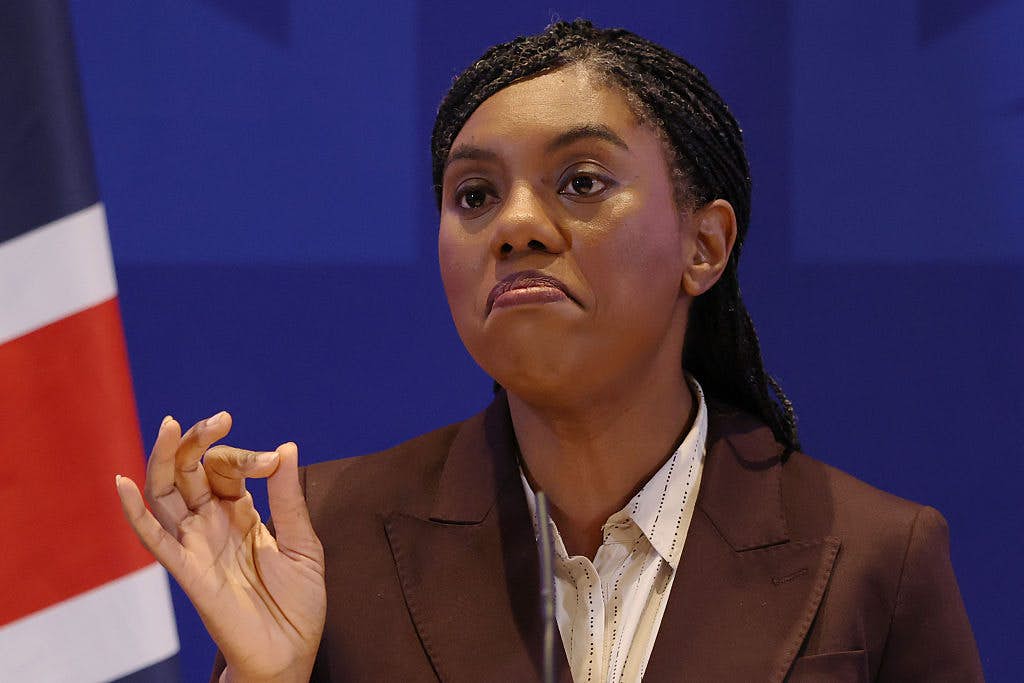

Right in the middle of a fairly standard Kemi Badenoch speech on welfare on Tuesday morning, an extraordinary thing happened. It was a moment so unexpected that no one in the room seemed to notice it had happened.
The Conservative leader was holding her second event in two days, a shift in her approach to opposition. She had the airwaves to herself: after months in which Nigel Farage dominated the agenda, he has gone to ground, tired of questions about which members of his party are Russian agents and what racist abuse he allegedly said to which schoolboy. Presumably he can still be reached via his personal TV channel, GB News, if you enclose a stamped, addressed envelope.
It was a speech about getting people back to work, loaded with international comparisons. Not the useful sort, where we look at how other people have handled problems and see what we can learn, but the completely random kind that are designed to make numbers sound big.
“Right now, in Britain there are more than six million working-age people claiming benefits instead of working,” Badenoch told us. “That’s more than the entire population of Norway.” OK, so… is a Norway more or less than a Sweden? If we can get the number to the level of a Denmark, will that be an improvement?
The tour of the Nordic-Baltic region continued. “There are now more children in the UK growing up in households where no one works than the entire population of Estonia,” Badenoch said. How many is that? Four million? Two billion? Fifty thousand? The speech was turning into a sort of nightmare pub quiz. What would we learn next? That the equivalent of the population of Luxembourg is added to unemployment rolls every year? That there were more left-handed people in the East Midlands than the entire population of Malta?
And then it happened. Another shift from Badenoch has been in her tone. The first year of her leadership has been in the “denial” stage of grief, where she broadly insisted that the country had made a terrible mistake in voting out the Tories, who had been a model of good government. Perhaps having noted that the Tories are currently polling in third place, and might soon be in fourth, she has adopted a new tone, accepting that the Norway-sized jobless numbers didn’t appear out of nowhere, and that some of these Estonia-sized problems may in fact have existed under the government of which she was a part.
There was, Badenoch went on, quoting Adam Smith, “a lot of ruin in a nation”. Britain could take the blows it was receiving. “For all that is going wrong now, and let’s be honest has gone wrong in the past, nations can absorb shocks,” she said. “The financial crisis, Brexit, Covid. Countries with strong institutions and productive people do not collapse overnight. Even foolish policies take time to do real, lasting damage.”
Sorry, just go back a second there, Kemi. Those economic shocks you listed, the things that had gone wrong, what were they? The financial crisis, yes, Covid, yes, what was the other one?
It excited no comment at the time. Journalists didn’t ask her about it afterwards. But what was Brexit, the great triumph of the last Conservative government, the fantastic moment of freedom that Daniel “Nostradamus” Hannan assured us would be celebrated with nationwide firework displays every year, the moment that furious MPs demanded Big Ben should chime to mark, doing alongside the financial crisis and Covid, so very awfully close to the word “foolish”?
The answer might seem obvious. To much of the country it is obvious: Brexit is an unpopular disaster. But those whose memories stretch back to the beginning of the decade will recall that politicians who muttered even in the privacy of their hearts that trade barriers might harm the economy found themselves denounced in newspapers. Here was a Conservative leader saying it. Oh Daily Mail, who now are the enemies of the people? Oh Telegraph, where is thy “Mutineers” front page?
Who would speak for Brexit?
As it happened, the Liberal Democrats had a vote down on Tuesday afternoon calling for a customs union with the EU. It was a bit of procedure, binding no one to anything, so it didn’t matter, but it was notable that the Tory benches were empty, just 21 of them there. No Mark Francois, no Iain Duncan Smith. Who would speak for Brexit?
The job went to Simon Hoare, a man who voted Remain. His speech contained no lofty talk of sovereignty, just a sad appeal to practicality. In the end the vote was tied, 100 each side, and Deputy Speaker Caroline Nokes, a Tory Remainer, smiled as, in line with procedure, she voted to pass the motion. Neither Badenoch nor Mr Brexit himself, Farage, had shown up for the vote.
I’ve thought for years that at some point a Conservative leader was going to have to stand up and apologise for the mess their party made of Brexit, not just for the result but for the whole sorry process, from the referendum called to settle an internal Tory row through the claims about money for the NHS, via Theresa May’s refusal to discuss the trade-offs and Boris Johnson’s inability to admit what he’d agreed. But perhaps I’m wrong.
Maybe the party is simply going to pretend the whole thing never happened. When British government economic and foreign policy from 2016 to 2024 does come up, it will be treated as an act of God, like a tornado or a pandemic. Can they style it out? Perhaps this is their leader’s moment. If anyone can simply insist, in the face of all the evidence, that her truth is the real one, it’s Badenoch.