
If there is one overriding message that Reform UK has built itself on, it is that the British establishment has not listened to the British people.
Most British people oppose mass migration. Both Labour and Conservative governments have sent immigration rates sky-rocketing. Most British people want the state to be tough on crime. Both Labour and Conservative governments have neglected prisons and the courts. Reform UK has been presented as the alternative to this inflexible elite status quo.
This message has launched the party up their polls. For their next trick, Nigel Farage and friends have identified another grievance of the British public. British people are sick — yes, sick — of the establishment dragging its feet before participating in ill-considered American wars.
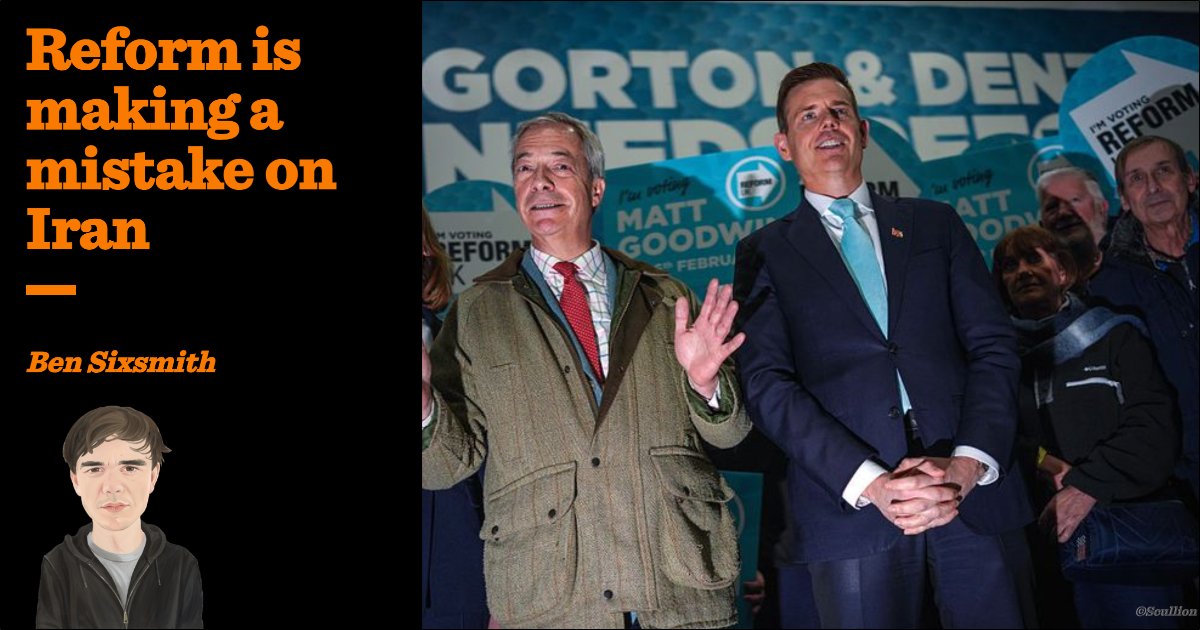
Thankfully, Reform is here to give a voice to popular discontent. “The US used to be our closest ally,” thunders Suella Braverman, “Starmer has let the UK down.” “Starmer is such an embarrassment,” laments Matt Goodwin, “He is destroying the special relationship.” “The Prime Minister needs … back the Americans in this vital fight against Iran!” Nigel Farage cried over the weekend.
Finally, the British public is being represented. Up and down the land, voters have been screaming:
“Why, why are we not helping to attack Iran!?”
“Please can we join another Middle Eastern war?”
“Doesn’t Keir Starmer know that this could endanger the Special Relationship?”
That Starmer’s indecisiveness has offended Donald Trump is a cause of special horror — Trump being universally beloved among Britons, up there with the late Queen, James Bond and Paddington Bear.
Okay, I’ll stop. Back in reality, about half the British people oppose the war, with about another quarter being undecided. Trump is extremely unpopular.
Whatever you, personally, think about the intervention, in other words, this is the opposite of a vote-winning cause. Granted, politics is not always about doing what voters want. Sometimes voters are wrong. But this suggests that Reform leaders should be making their case — that they should be trying to convince people instead of talking as if they are preaching to the choir.
In a Critic piece following the appointment of the veteran neoconservative Alan Mendoza as Reform UK’s “Chief Advisor on Global Affairs”, James Lachrymose commented:
Farage and the dissident right once celebrated their opposition to foreign entanglements, decrying the interventions in Libya and Iraq. Mendoza’s appointment suggests his metamorphosis from an independent-minded Powellite to an interventionist Atlanticist is now completed. A Reform government is now likely to fit the mould of British foreign policy throughout the twenty-first century: breathless Atlanticism and slavish adherence to the Washington line.
This sounded like a pessimistic diagnosis, but Reform is doing nothing to suggest that it is wrong. One should not expect the party to be anti-American. But if it is going to present itself as being the alternative to the Blairite settlement, it is absurd to promote the “Special Relationship” in unqualified terms — like announcing an alternative to modern art that turns out to be an unmade bed and the preserved corpse of a shark. This is even truer when the current American-Israeli war seems so improvisational and perilous, with various dreadful outcomes being at least possible. Hitching the Reform name to adventure is risky at best.
More broadly, British right-wingers have been fretting that Starmer’s initial unwillingness to assist the US had something to do with his fear of alienating Muslim voters. Harry Cole of The Sun even raised this with Donald Trump. It might be true that demographic change will make British governments less willing to get involved in Middle Eastern wars. As a restrictionist, I can’t think of a less convincing argument against demographic change.
There was no need to take such a full-throated supportive position
Another thing that should concern Reform is that the Greens have taken such a strong stance against the war. As Alex Yates has pointed out in these pages, the Greens are a lot less radical than they pretend to be. More of an extreme commitment to renewables, more mass migration, and more spending is not an alternative to the status quo — it represents the radicalisation of the status quo. Yet a clear and uncompromising anti-interventionist position when it comes to Middle Eastern war is something different. If, as is very possible — though I accept not certain — the war goes terribly, horrifyingly wrong, the Greens will profit.
Again, I’m not suggesting that Farage should rail against Uncle Sam like the Stock Exchange’s answer to Jeremy Corbyn. But there was no need to take such a full-throated supportive position. I think some right-wingers are at risk of assuming that all of their opinions express that of the silent majority. But foreign policy hawkishness is a niche perspective — that of SW1 think tanks and the shoutier broadsheets. The public is more sceptical — and while this is no guarantee of correctness, it can be very much correct.