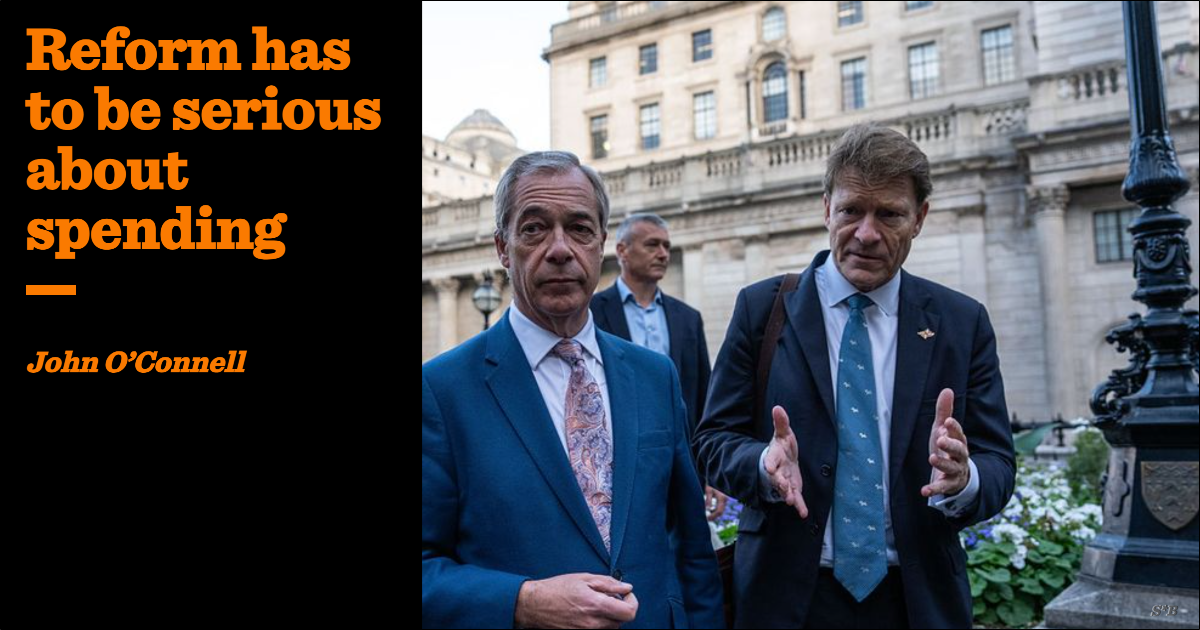
Much ink has been spilled debating whether Reform UK are serious about the prospect of governing. Almost as much as has been spilled on whether they will be capable. They remain a party of just a handful of MPs, albeit with their ranks bolstered by the addition of a score of councillors, plus a couple of metro mayors. They are growing their back office team, with a significant expansion in staffing, particularly those with policy acumen, but they nevertheless remain light on the ground.
The fundamental problem the UK faces is what to do about the unsustainability of the national debt, and government spending
But as we all know, leadership starts from the top. As the Conservative Party showed consistently while in government, no amount of policy brains, intellectual firepower or governing experience could make up for the fact that the leadership of the party consistently shied away from making the case for what should be core conservative principles. That’s how we ended up with record spending, a record tax burden, a booming welfare bill and unprecedented levels of migration. And what last week showed is that Reform UK certainly are serious about governing.
The fundamental problem the UK faces is what to do about the unsustainability of the national debt, and government spending. It’s a point that cannot be repeated enough. The national debt is already at around 100 per cent of GDP, and that’s with the tax burden being stretched to breaking point. There is no room for manoeuvre. We had almost £5,000 to our debt every second. But the electorate are still some way from being ready to accept the inevitable. Just 3 per cent think we spend too much on the NHS and 5 per cent on pensions. Compare that to 58 per cent who think we spend too much on foreign aid. Now foreign aid remains ripe for cutting, but in terms of overall government spending it is a rounding error.
That contrasts with the state pension, and public sector pensions, the unfunded liabilities for which run into the many trillions — £9 trillion according to our research on the real national debt in 2024. That’s more than three times the size of the UK economy.
The Adam Smith Institute has forecast that the state pension could be financially unsustainable by 2035, the moment when welfare payouts are expected to exceed the funds going into the National Insurance Investment Fund Account.
Now what to do about this problem. The conflict between the need to significantly reduce spending on pensions with the imperative to build an electoral coalition that can give you the mandate to do so. Unfortunately our political class has decided to resolve that conflict by focusing on the latter while hoping the former goes away. The path of simply following public opinion, because after all you need to win 326 seats to be able to do anything.
There is an alternative, which is to lead the public. To demonstrate to them, over and over again, at every opportunity, on every platform possible that they’ve been sold a lie. They’ve been told that we can have a healthy, thriving economy with low taxes, good public services and also state largesse to look after them from cradle to grave. That they’ve paid in all their lives and are now simply receiving what they’re due. That public sector workers can continue to receive gold-plated retirements through defined benefit schemes which have disappeared almost everywhere.
Reform UK, and particularly Richard Tice, are showing signs that they want to do that. They have made clear in recent days that nothing is off the table, including the state pension and the unsustainable triple lock. They have made clear that they want to scrap defined benefit pensions in the public sector. These are necessary moves, but it doesn’t make them any less brave.
Nigel Farage did, on the other hand, say that significant tax cuts are “unrealistic” for now. Clearly with the state of the public finances, without significant action on spending, meaningful tax cuts become more difficult to execute. But we must not give into the idea that tax cuts are a luxury to be indulged in when the economy is booming. Tax cuts, and simplification to some extent, are one of the most important levers in boosting growth and investment. It is precisely when the economy is weak that they are most needed.
But the clear signal is that Reform is serious about spending. That they do have the understanding and willingness to make the case for, and take the actions necessary, to reduce the size of the state. And with that, meaningful tax cuts — the sort of tax cuts we detail in our single income tax proposal — need not be unrealistic.