Rachel Reeves is under growing pressure to help desperate drivers today as it emerged the government is in line for an £8billion windfall from soaring energy prices.
The Chancellor is still refusing to follow a host of countries including Australia, Spain and Poland in trimming duty on fuel at the pumps in response to Middle East chaos.
But while surging oil costs have left motorists paying more than £1.80 for a litre of diesel and £1.52 for petrol, the Treasury is believed to be seeing a £20million a day boost to revenues.
That is from a combination of higher VAT income on fuel, the levy on North Sea profits, and ‘excess profit’ taxes on power generators.
Although debt interest payments are increasing, higher inflation is also expected to ramp up the income tax take.
Millions of Brits will be dragged deeper into the system by pay increases, after Ms Reeves froze tax thresholds until 2031.
The estimates come as Keir Starmer hosts another Cobra emergency meeting over the looming hit from the Iran crisis. The Tories have insisted he needs to take action instead of holding more talks.
Donald Trump has apparently told aides he is considering ending his military campaign even if Tehran does not reopen the critical Strait of Hormuz – through which around a fifth of the world’s oil supplies normally pass.
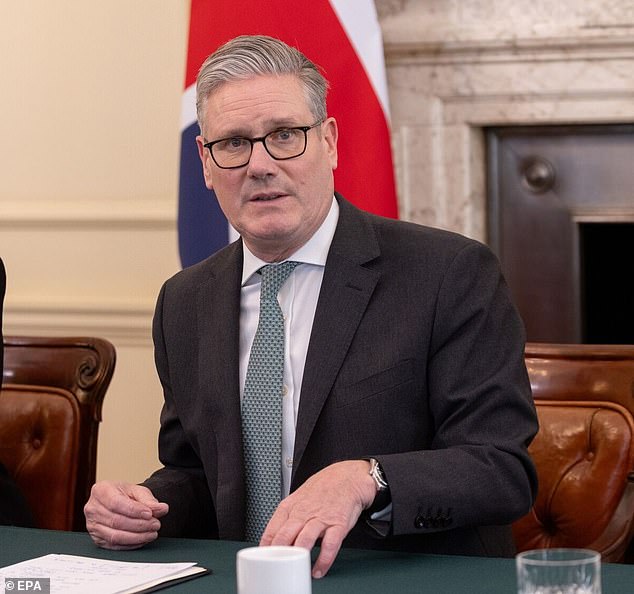
Keir Starmer is hosting another Cobra emergency meeting today over the looming hit from the Iran crisis
Ministers have been continuing to issue reassuring messages to the public to carry on booking flights abroad and driving as normal.
Sir Keir called energy and shipping firms into Downing Street yesterday to urge them to work together to limit the impact.
Ms Reeves has made clear any bailout is unlikely to be announced soon, and will be targeted at benefits claimants instead of middle-income households.
However, concerns are mounting privately about the economic consequences. Some ministers want the PM to be more direct with the public about what the country faces.
The International Monetary Fund said the war was ‘reviving the spectre of the 2021-2022 gas crisis’ in Europe, with Italy and the United Kingdom ‘especially exposed by their reliance on gas-fired power’.
Lars Jensen, former director of shipping giant Maersk, warned the crisis could be worse than the energy shocks of the 1970s – which caused a global recession.
In a round of broadcast interviews this morning, Treasury Chief Secretary James Murray refused to say whether further action would be taken on energy bills or on keeping the fuel duty freeze in place after September.
He told BBC Breakfast: ‘People are worried over the next three months that because of what they see happening in the Middle East, bills might go up. They can be reassured that bills will in fact come down over the next three months and that provides real help for people now.’
He added: ‘We’re monitoring the situation about what happens further down the line and obviously none of us really know exactly how long the war in the Middle East is going to continue, we don’t know how that’s going to play out, but the Prime Minister and the Chancellor are monitoring that closely, making contingency plans for what might happen further down the line.’
Mr Murray also questioned the analysis in The Times of the potential windfall for government.
He told LBC: ‘If the VAT receipts from energy increase, that can often be because people are spending less money on other goods and items, and that means overall where people pay VAT shifts from other items over to energy and fuel. Now because VAT on energy and fuel are typically at 5 per cent, rather than the standard 20 per cent, that can actually mean overall revenue goes down. So it’s not quite as straightforward as you point out.’
Kemi Badenoch has urged the PM to drop his ‘bonkers’ ban on new drilling in the North Sea.
The Tory leader, who visited Aberdeen yesterday, said: ‘He doesn’t need to have any more meetings, the oil and gas sector has said what it is they need.’
In recent days, energy analysts have called on ministers to act to conserve key supplies through measures like lowering motorway speed limits and suspending domestic flights.
But Downing Street yesterday played down the need for immediate action, saying the UK remains well supplied.
Sir Keir said he was focused on ‘de-escalation’ of the crisis that has led to the blocking of the Strait of Hormuz, which normally carries 20 per cent of the world’s oil. It’s not our war,’ he said.
‘But it is our duty to protect British citizens.’
One Whitehall source said: ‘It is still early days and there is a balance to be struck between freaking people out and preparing them for some tough decisions ahead, but the longer this goes on the more serious it is looking.’
According to analysis for The Times, the Government is set to get around £3.5billion a year from the energy profits levy on North Sea oil and an extra £2.4billion from gas sales.
Hundreds of millions would also be raised in taxes from Britain’s power generators, who have been charged excess profit levies since the outbreak of war in Ukraine.
The RAC has also suggested the Government could earn an extra £2billion from VAT on petrol sales.