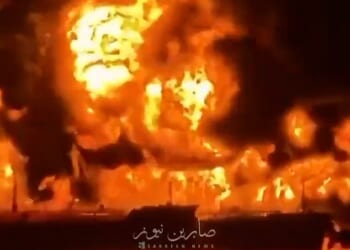
Three massive explosions rocked Dubai at 11.26 local time yesterday morning. A friend in the United Arab Emirates, terrified, sent me three messages – and in speaking out, ran a risk as dangerous as the missiles.
Earlier, at the city’s airport, four people had been injured after a pair of drones evaded the air defences, sending passengers and staff scrambling from the plate-glass windows and heading for the shelters.
Despite the obvious dangers, Dubai International (DXB) remains open, running a reduced service.
On Saturday, a drone was caught on video sending up a huge pall of smoke near the terminal. The official Dubai Media Office continued to insist that ‘no incident’ had occurred at the airport.
Iranian barrages, during the 13 days of the war so far, have been worst in the mornings and at night, according to another of my contacts. But no time of day can be considered safe. The images of Dubai’s president and its crown prince, strolling around the shopping mall and dining in restaurants, are elaborately staged propaganda, a dangerous lie.
The truth is that the holidaymakers, and anyone else who can afford to leave, are fleeing for dear life. High-rise hotels, with rapidly dwindling occupancy, have been ordered to close rooms above the tenth floor, and restaurateurs along the Dubai Marina and Jumeirah Beach are desperately trying to lure inside the remnants of passing trade.
British financial giant Standard Chartered yesterday evacuated its entire staff from the prestigious Dubai International Financial Centre after an Iranian threat to target economic and banking interests linked to the US and Israel.
Tehran’s Revolutionary Guard has listed the tech giants Google, Microsoft, Palantir, IBM, Nvidia and Oracle among targeted US companies, warning people to stay at least a kilometre away from banks. That puts a target on just about every expat and tourist area in Dubai, if not the whole city state.
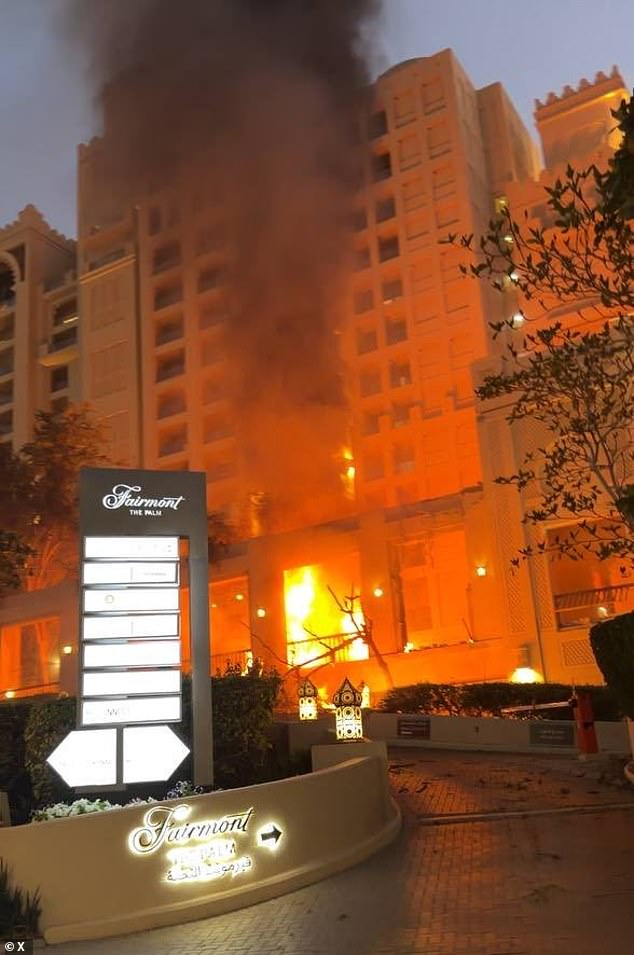
Fairmont hotel set ablaze in Dubai by Iran. The truth is that the holidaymakers, and anyone else who can afford to leave, are fleeing for dear life
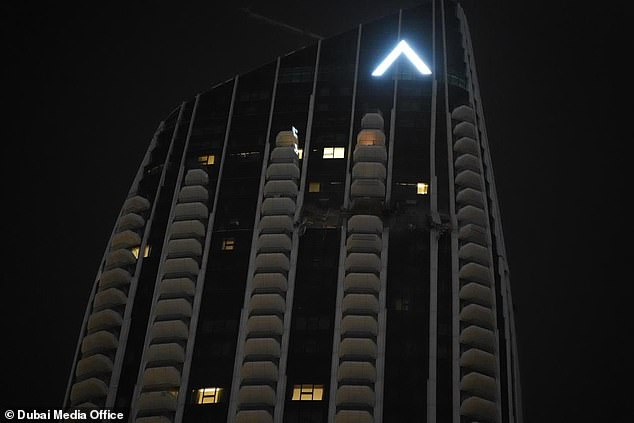
A high-rise building burst into flames on Thursday morning. High-rise hotels, with rapidly dwindling occupancy, have been ordered to close rooms above the tenth floo
Our own government has provided far from enough aid to British nationals in the region, mostly leaving them to fend for themselves. This disgusts but does not surprise me: the Foreign Office is notoriously useless, wielding no real influence at all in the Gulf.
‘War is Peace. Freedom is Slavery. Ignorance is Strength,’ ran the slogans of Big Brother in George Orwell’s Nineteen Eighty-Four. Anyone unlucky enough to be stuck in Dubai is being forced to live those three chilling axioms every single day.
And, as I shall explain, I know what it’s like to find yourself on the wrong side of the regime.
When the bombs started to fall on February 28, the UAE authorities sent out mass texts to practically all the 240,000 Britons, as well as hundreds of thousands of other Westerners, issuing dire warnings that nobody was to post anything about the terror raining down on them from the skies: nothing that ‘results in inciting panic among people’.
When it became obvious those messages were not getting through, more texts followed with even more explicit threats. Barely two weeks on, residents are now being encouraged to inform on their friends and neighbours, and to report anyone who dares even to mention the missile attacks, let alone film them.
For the army of online influencers in Dubai, who make their living by showcasing every tiny detail of their existences on social media, this clampdown has come as an unfathomable shock.
Absolutely no content can be posted that could damage the Dubai brand.
That means no pictures of missile damage, no footage of interceptor missiles taking out drones, no audio of explosions, no panicked selfie videos recorded in cellars, bunkers or safe rooms.

Absolutely no content can be posted by influencers that could damage the Dubai brand
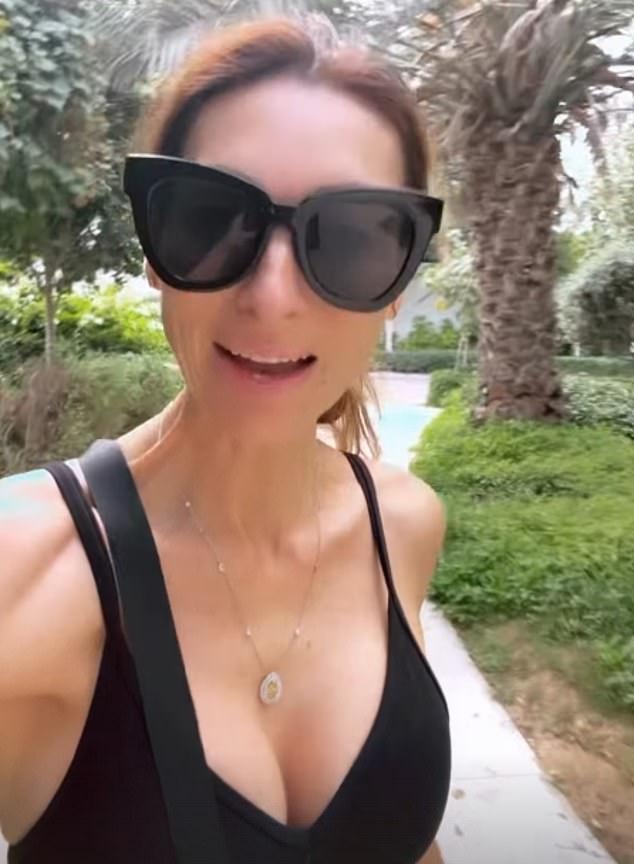
That means no pictures of missile damage, no footage of interceptor missiles taking out drones (Pictured: Luisa Zissman in a social media video)
Those who fail to obey the edict are finding out just what it means to upset the Emiratis. At least one person has been arrested for filming a missile strike.
They now face a fate that will be horrific beyond imagining.
Any foreigners, including holidaymakers, who dare to criticise or insult the UAE government, causing ‘reputational harm’ to the country, can face bankrupting fines of up to £200,000, as well as a decade or even life in prison – then deportation if they are lucky enough to get out. Those who own property can face even more swingeing sanctions.
I don’t blame the influencers – as anyone can tell from a glance at Instagram or TikTok – who are sticking faithfully to the party line. But it does make for a bizarre sight. Social media offers endless videos of young mums in bikinis on the beach with their babies, party-goers sipping alcohol-laden cocktails in nightclubs, and shoppers cooing over bling-encrusted handbags in designer stores.
A significant number of these posts follow the same unsettling formula, often down to the exact same words: ‘Don’t worry the UAE is keeping us safe,’ is a frequently touted phrase.
The influencers proclaim they are not scared because, ‘I know who protects us’ – accompanied by an image of Sheikh Mohammed bin Rashid Al Maktoum, the ageing ruler of the UAE.
Though he is approaching 80, a wizened and raddled old man, the pictures always show him in his youth, like Oscar Wilde’s Dorian Gray.
The Sheikh’s great weakness is his vanity, and so the 30ft billboards on buildings, and the portraits that hang in every home, show a likeness as airbrushed and curated as any fading Hollywood star.
No one is exempt from the strictures on social media. Even firefighters and paramedics have been jailed for posting photos of fires and other emergencies. Nothing bad is allowed to happen in this tax-free paradise – and anyone who exposes that pretence is liable to suffer swift punishment.
WhatsApp video and voice calls are banned in Dubai, because they are encrypted and therefore harder for the regime to spy on. For most people, it’s only possible to speak freely once they are out of the UAE.
One tells the Daily Mail that she has been speaking to a friend trapped in Dubai, who is petrified of saying the wrong thing: ‘There are drones and missiles coming at the place every day.
‘People have died and there are countless injured, but luckily there haven’t yet been mass casualties. But we do read reports about a shortage of interceptor missiles and rockets, so to pretend it’s all rosy is quite a stretch.’
Another resident says it is impossible to know who is listening to private phone conversations. ‘You just never know what’s being listened in to with things like [Israeli-designed] Pegasus spyware, which we know the UAE has,’ she says.
I’m certain that Pegasus or similar eavesdropping software has been implanted on phones throughout the expat community – because I was the first victim of such a hack, nearly five years ago, when I, as their legal representative, was helping the daughter of the Dubai ruler, Princess Latifa, and her stepmother Princess Haya escape the very control and coercion influencers now face.
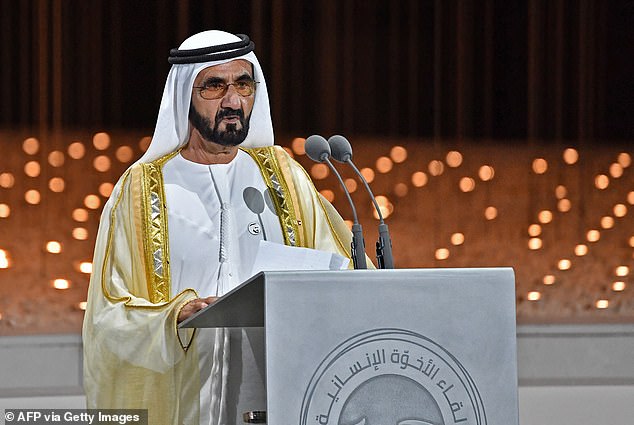
Though he is approaching 80, a wizened and raddled old man, pictures always show Dubai ruler Sheikh Mohammed bin Rashid Al-Maktoum in his youth, like Oscar Wilde’s Dorian Gray

Those who fail to obey the edict are finding out just what it means to upset the Emiratis (Pictured: Arabella Chi in a social media video)
In fact, later this month sees the tenth anniversary of my escape from Dubai and my return to Britain (with the claims against me dismissed by the courts), after an ordeal lasting two years that almost destroyed me.
I had no idea I’d upset the dictatorial regime until I walked into a trap. And then it was too late.
For several years, I’d been living on and off in Dubai, even before 2013 when I was managing director of Leeds United football club.
The following year, a financial dispute arose between one of my companies and the GFH Finance Group, an Islamic investment bank based in the Gulf states.
Hoping to smooth over the problem, I flew out to the UAE at their invitation. My first-class flight was paid for.
With hindsight, I realise how naive this sounds. But at the time, it was business as usual.
My opposite number didn’t turn up for the meeting. Instead, a young man with his baseball cap on backwards walked into the conference room and ordered me to follow him.
I was quite sure I’d done nothing wrong – nothing that couldn’t be sorted out, that is, with a couple of phone calls and perhaps a fine, paid in cash to the right people.
It’s how Dubai works.
Even as I followed this man, obviously a government policeman, out of the building, I was stopping to say ‘hi’ to people I knew.
It wasn’t until he pushed me into the back of a shabby Toyota Corolla that I began to realise I was in trouble.
We drove a short distance to a police station, a dirty concrete box, where men with guns began yelling at me. It was all surreal – until they dragged me into the next room, shoved me to the floor and began beating me.
It was less than 12 hours since I’d stepped off my flight. Now I was being kicked and tasered in a police interview room.
That was just the beginning of the most nightmarish experience of my life, nearly two years of unremitting hell.
I was raped, beaten with a broom handle, and forced to watch as another man was murdered in front of me – tortured to death, with a policeman’s foot on his throat.
The stench in Dubai’s Al-Awir prison was unbelievable, with raw sewage leaking onto the floor of my overcrowded cell. The toilets were buckets filled with dirty water, or holes in the floor, swarming with flies.
No bleach or disinfectant was provided, because prisoners might use it to kill themselves.
Our food was nutritionless slop, and I remain convinced it was laced with drugs to subdue and control us.
The temptation to take my own life was very strong – but prisoners who tried that and failed could end up in mental institutions where conditions were even worse and there was little hope of ever being released.
I’ve since learned that women, who are held in a different part of the same building, are treated even more brutally.
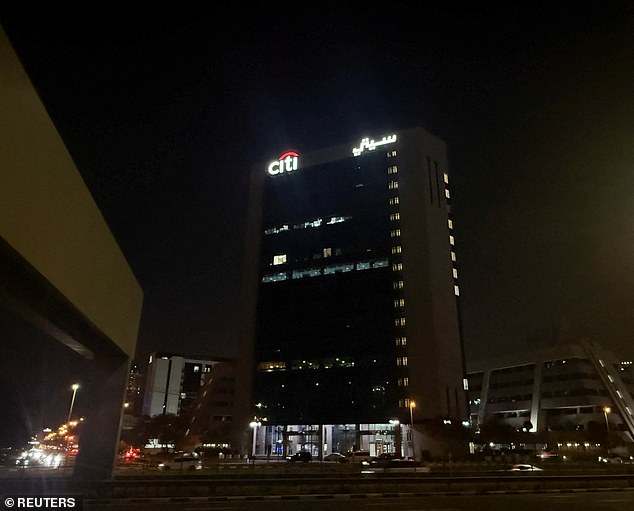
Banks, including Citi, stepped up precautions on Tuesday after a series of strikes on Dubai
Any influencer who blunders into that hellhole will be at constant risk of rape and torture, the main punishments which sadistic guards inflict routinely. They also carry out mock executions, putting bags over prisoners’ heads and driving them out into the desert where they are told they will be shot.
This is what awaits anyone who crosses Mohammed bin Rashid Al Maktoum and his government. Addicted to their own good publicity, the rulers have encouraged an influx of influencers, who are pampered and given tax-free luxuries just as long as they say the right thing at all times.
The influencers can’t bear to leave, because to do so means abandoning their gilded lives.
In reality, these social media butterflies are like galley slaves, chained to their oars in the ‘Good Ship’ Dubai.
David Haigh is the founder and managing director of Dubai Watch, a UK-based human rights watchdog