A rare, diamond-encrusted Fabergé egg crafted for Russian royalty is set to fetch an eye-watering £20 million in a record-breaking Christie’s auction that begins today.
One of the world’s foremost authorities on Faberge, Kieran McCarthy, told the Daily Mail that the breathtaking, 112-year-old curio is ‘the most iconic example of decorative art ever’ for its exquisite craftsmanship as well as its legacy.
Of the 50 Imperial eggs crafted by the House of Fabergé for Tsars Alexander III and Nicholas II, 43 remain in existence – but only seven of these are owned privately.
According to Mr McCarthy, however, only three Imperial Faberge eggs are in ‘truly private’ hands – making the auction of the delicate Winter Egg something of a milestone moment.
The first Imperial egg that Faberge created was commissioned by Russian emperor, Tsar Alexander III in 1885, as an Easter present for his wife, Tsarina Maria Feodorovna, sister of the future Queen Alexandra.
She was so enamoured by the white enamel egg, with a gorgeous gold interior and the tiny golden hen hidden inside, that the Emperor continued the tradition every year until his death from nephritis in November 1894.
Their son, Tsesarevich Nicholas, increased the Imperial commission when he became emperor, and ordered two eggs – one for his beloved mother, the dowager, and the other for his equally beloved wife, Empress Alexandra.
After the initial egg, Faberge had been declared ‘goldsmith by special appointment to the Imperial Crown’ and given complete freedom to create whatever they so desired – as long as each egg contained a ‘surprise’.

A rare, diamond-encrusted Fabergé egg crafted for Russian royalty is set to fetch an eye-watering £20 million in a record-breaking Christie’s auction that begins today
And the Winter Egg really does ‘eclipse almost all else’, Mr McMcarthy said, while highlighting its ‘incredible craftsmanship’.
It is one of two Imperial eggs that were designed by Alma Pihl, the granddaughter of Faberge’s workmaster August Holmstrom.
Mr McCarthy, who is the co-managing director at Wartski, the British antique jewellery dealer specialising in Faberge, told this newspaper that the Winter Egg was the climax of inspiration from a series of jewels that were, in fact, created for Swedish oil baron Emanuel Nobel.
In late 1912, Pihl was in the Faberge atelier in St Petersburg, trying to design a collection of jewellery for the nephew of Alfred Nobel, when she looked up and saw that the windows in the roof of the atelier were covered in ice and snowflakes.
Inspired, she created a series called the Winter Jewels, in which she used rock crystal encrusted with platinum and diamonds to create frost patterns.
She then repeated this idea, even more sumptuously, of course, with the 1913 Easter Imperial Egg for Tsar Nicholas’s mother, Dowager Empress, Maria Feodorovna.
Margo Oganesian, the head of Christie’s Fabergé and Russian Works of Art department, compared the four-inch tall egg with over 4,500 diamonds to a ‘luxurious Kinder Surprise chocolate’.
Rock crystal is exceptionally difficult to carve without cracking and, as Ms Oganesian, explained, the procedure of applying platinum set with thousands of diamonds ‘would have been really hard to create’.

Alma Pihl, the granddaughter of Faberge’s workmaster August Holmstrom, designed the 1913 Easter Imperial Egg for Tsar Nicholas’s mother, Dowager Empress, Maria Feodorovna (pictured)
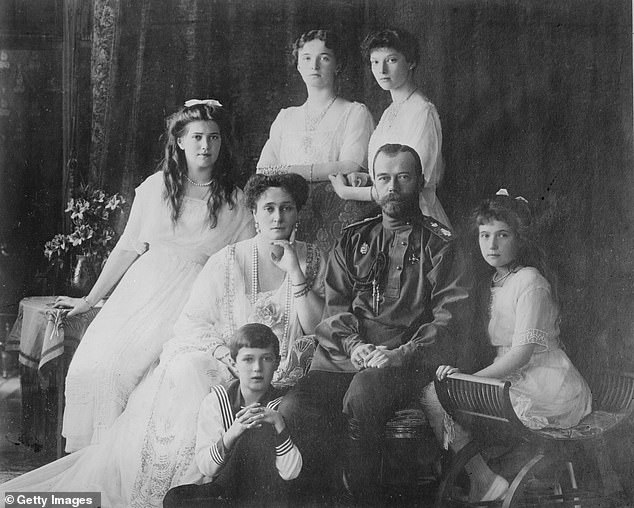
Tsar Nicholas and his wife, Empress Alexandra, with their three children, before the Russian revolution

Margo Oganesian, the head of Christie’s Fabergé and Russian Works of Art department, compared the four-inch tall egg with over 4,500 diamonds to a ‘luxurious Kinder Surprise chocolate’
The effect is one of utter magnificence: minuscule rose-cut diamonds set in platinum are applied onto the crystal surface as sparkling snowflakes, whilst further diamonds are over the base as though the ice is melting in rivulets.
The ‘surprise’ is a diamond and platinum basket, filled with a posy of finely carved white quartz wood anemones, rising from a bed of gold moss, to symbolise the beginning of spring.
Two years after Tsar Nicholas and his family were executed in 1918, the egg was sold for £450 to Wartski in London, who became the main dealers of the imperial jeweller’s objets d’art.
In 1934, it went to Lord Alington of Crichel House in Dorset, for £1,500.
Since then, this intricate collector’s item has changed hands many times. Most recently, it was acquired by a distant relative of the Emir of Qatar for $9.6 million (around £7.2 million) at a Christie’s auction in New York in 2002.
But tonight, at Christie’s, the egg considered by the world’s foremost expert on Faberge to be ‘the greatest of them all, the most iconic example of decorative art ever, with no comparables,’ will be (metaphorically we hope!) under the hammer and potentially shatter all records.
What a Christmas present to be given this winter.