For generations now, the GOP has been far more comfortable than its opponents in quoting Bible verses and talking about how Christianity informs its politics. Democrats, meanwhile, have largely shied away from public proclamations of faith – such that critics say they have seemed apologetic about Christianity.
But a new crop of Democratic leaders is hoping to flip the script. Members of Congress across the United States – from Sen. Raphael Warnock of Georgia to Rep. Marie Gluesenkamp Perez of Washington, along with Kentucky Gov. Andy Beshear – are talking more about how their public service is rooted in their Christian faith.
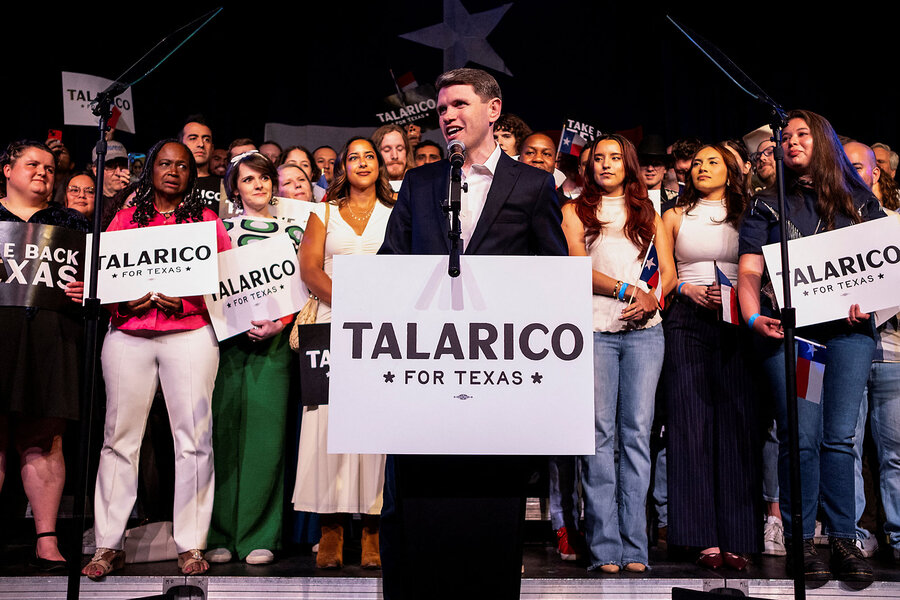
State Rep. James Talarico, a Presbyterian seminary student who is the democratic nominee for U.S. Senate seat in Texas, earned national attention for his unabashed quoting of the Bible – highlighted in a viral interview with podcaster Joe Rogan. Texas Rep. Jasmine Crockett, who lost to Mr. Talarico in the primary on March 3, talks about her Baptist faith. And a cadre of faith-based political consultants stands ready to guide Democrats again this election cycle, hoping for a new boldness.
Why We Wrote This
For decades, Republicans have embraced Christianity and faith-based leadership. A new crop of Democrats is now doing the same.
“As we go into the midterms … I would love to see us flip [the narrative],” says April Delaney, a first-term congresswoman from the rural western panhandle of Maryland, who is Catholic. “The dialogue has to change.”
It’s the Democratic platform, she insists, that best reflects the values of charity, humility, and care that Jesus taught. And she wants more of her colleagues to say this.
“Who are we as Christians? And what does that mean? It’s not only a faith in Jesus, but it’s the tenets of what he really lifted up,” she says.
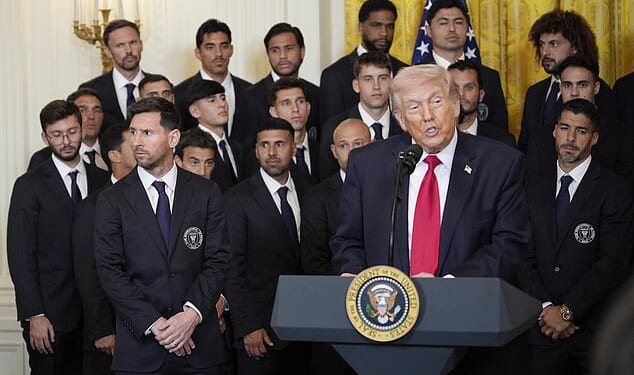
At the National Prayer Breakfast earlier this year, President Donald Trump said he didn’t know “how a person of faith can vote for a Democrat.”

Democratic officials – and certainly some Republicans – disagree with that statement. A survey last fall from the Pew Research Center, for instance, found that only 7% of American Christians said that supporting Mr. Trump is “essential to being a good Christian.”
Still, Democrats have steadily lost Christian voters to the Republican Party. White Evangelicals propelled President Ronald Reagan to the White House in 1980. In 2000, President George W. Bush won 68% of white evangelical Protestants and 53% of white mainline Protestants. By 2024, Mr. Trump won 85% of white Evangelicals and 57% of white mainline Protestants.
“To distance themselves in the political world from what the Republicans were doing, I think [Democrats] shied away from religion, which I think they have recognized was a mistake because it sort of ceded the ground,” says the Rev. Jonathan Wilson-Hartgrove, assistant director of the Center for Public Theology and Public Policy at Yale University.
Some Democrats argue that they haven’t moved away from religion. Instead, they have tried to bolster a more inclusive version of it, focusing on interfaith work and recognizing that some people have had negative experiences with church or religion overall. Many Democrats have been alarmed by the explicitly Christian statements and policies from the second Trump administration, which to them raise concerns about the separation of church and state.
Political leaders “want the Democratic Party to be a place for people that is safe and open for people who don’t have religious identity, or have changed their religious identity, or feel hurt by religion,” says the Rev. Doug Pagitt, executive director of Vote Common Good, a nonprofit that encourages Christian voters to prioritize “common good” over party loyalty, and trains candidates to speak to faith.
But these efforts to be inclusive may have ended up excluding Christians who respond to Republicans’ way of referencing their faith, he says. In the 2024 Democratic Party platform, nearly every major religion other than Christianity was mentioned by name.

Charlie Neibergall/AP/File
“People believe that Republicans want religion, especially Christianity, in America to succeed, and Democrats want it to recede,” he says. “You can’t be the major political party in America if you continue to say that you’re uninterested in the major religion in America.”
According to the Public Religion Research Institute’s 2024 “Census of American Religion,” some 62% of U.S. adults describe themselves as Christian. Eighty-four percent of Republicans are Christian, and while it’s a majority for Democrats, it’s a smaller one: 59% of the base in 2023.
President Barack Obama won the most evangelical Protestant votes of any Democrat since President Jimmy Carter. That share dropped when Hillary Clinton ran, and dropped again slightly with President Joe Biden before inching up again in 2024, when Vice President Kamala Harris ran.
“I’m personally obsessed with bringing people of faith back into the party, because this is where they belong,” says Billy Ray, a director and screenwriter of movies including the first “Hunger Games” and “Captain Phillips.” Mr. Ray, who is not Christian, works with about 50 Democratic candidates and 80 members of Congress on messaging.
He and a contingent of secular and religious voices are calling for Democrats to amplify a more moderate Christianity to answer the conservative Christianity expressed by leaders of Mr. Trump’s party.
“There has been this voice of faith informing and engaging and animating justice and equity for generations, so we should not pretend that it’s something new,” says the Rev. Dr. Derrick Harkins, who directed interfaith outreach for the Democratic National Committee and Mr. Obama’s 2012 campaign.
While Black Christians tend to vote for Democrats (83% voted for Ms. Harris), the party has sometimes been hesitant to allocate resources toward reaching white Christians, a group that generally votes Republican. But organizers think there are cracks in the support, particularly among mainline Christians.
Mr. Trump has a number of advisers who embrace the idea of the U.S. as an explicitly Christian country and some who have embraced the moniker of “Christian nationalism.”
“That change is, perhaps, leading more Democratic leaders to say, ‘We can’t just leave Christianity as something that could be defined fully by the GOP,’” says Melissa Deckman, a political scientist and CEO of the Public Religion Research Institute.
In February, the Pew Research Center released a report finding that, while white Evangelicals are some of the most reliable supporters of Mr. Trump, his approval rating among that group has dropped by 8 percentage points since early last year.
The Rev. Dr. Shannon Fleck, executive director of Faithful America, sees an openness to Democratic messaging from a broad range of Christians. Though her organization focuses on progressive Christians, she lives in Oklahoma, the heart of the Bible Belt.
“I am surrounded by folks that are more conservative than me, and I know that a large percentage of them are hugely bothered by the discrepancy and hypocrisy of what’s being said regarding faith, and what they’re seeing in the world,” she says.
“That is a growing edge that can easily be converted in an election.”