Booster ignition: that was a crucial stage on Wednesday evening before Nasa’s space rocket Artemis II lifted off the launch pad at Cape Canaveral, Florida.
With a flourish, the launch commentator added: ‘Humanity’s next great voyage begins.’ Mission commander Reid Wiseman said: ‘We go for all humanity.’
Indeed they do, in more senses than one. If the Americans’ ten-day expedition runs to plan they should bring back valuable data on the effects of solar radiation on the human body.
This will help scientists plan longer stays on the Moon, bringing closer the possibility of Hollywood-style Moon bases.
Who knows, perhaps we might even one day see something like the Lunar Hilton envisaged in the 1960s by hotelier Barron Hilton, complete with its Galaxy Lounge piano bar. But there is also a subtler significance to Artemis II.
This mission, despite or because of the risks involved, is an expression of remarkable optimism. Did you see the smiles of Commander Wiseman and his fellow astronauts as they walked to the rocket?
Inside they must have been nervous but outwardly they were bursting with happiness. This was ‘booster ignition’ time, all right: they were boosting our sense of can-do, of life, pride and hope. And there could not have been a better time for it.
Tomorrow is Easter Day. For the past week churchgoers have absorbed the upsetting story of one man’s self-sacrifice two millennia ago in Roman-occupied Judaea. A carpenter’s son from Nazareth was wrongly arrested, tried, nailed to a cross and left to die on a hill called Golgotha.
At Easter, more than the commercialised splurge of Christmas, our disbelieving kingdom has a chance to rediscover that it is a Christian country, writes Quentin Letts
You can’t get much more depressing than that; Golgotha meant ‘place of the skull’. From such utter bleakness would flow a story of Jesus’s resurrection and, again, that precious quality of hope.
Without it the Western world would not have become as rich and dominant as it was in the 20th century.
And without rediscovering hope, the West’s battle for pre-eminence – a war in which we are involved whether Sir Keir Starmer likes it or not – may not be winnable.
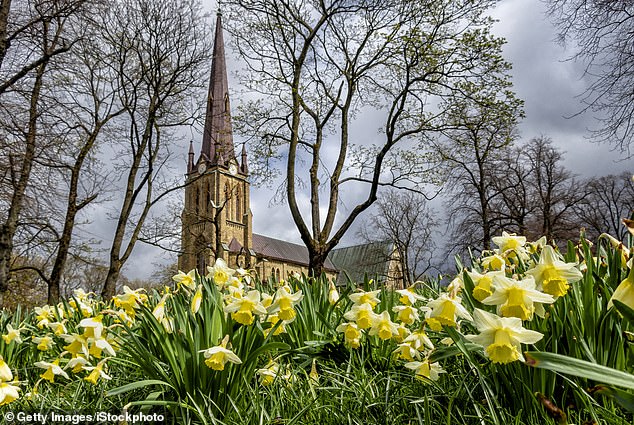
At Easter, more than the commercialised splurge of Christmas, our disbelieving kingdom has a chance to rediscover that it is a Christian country.
Not all of us go to church. Nor will everyone tomorrow receive a chocolate egg or a card decorated with daffodils or bunny rabbits. There will, however, be something unusual in the air: Easter joy. By gum we could do with some.
What a plague of misery has recently afflicted us. If it ain’t the Iran war and the hike in petrol prices it’s illegal immigration and rising unemployment, pub closures and doctors’ strikes. From potholes to Palestine, despair tries to mug us from every quarter.
The BBC is collapsing into another of its sex scandals. The Greens want to turn us into a northern-Atlantic version of communist Cuba. Labour has lost control of public spending and is plotting to plunge us back into the Brussels stink-pit.
Royal princes are letting the side down. Whitehall is useless and the Education Secretary, Bridget Phillipson, is whipping up class envy.
Reading the news, you might be forgiven for thinking the only people with anything to cheer are benefits recipients.
Not even lockdown was this depressing. It is as if a fog of glumness has shrouded our isles. Everywhere you go, people are dulled by pessimism.
They use expressions such as ‘in these uncertain times’. The national dial has been set to sadness.
Easter offers respite from this misery. Even if you don’t intend to sing some of those window-rattler Easter Day hymns you may have noticed that the days suddenly seem longer, the hedgerows are burgeoning, songbirds are twittering and the cricket season has started.
Easter is the busiest time of year for garden centres. The commodity they sell, more than compost or grit, is again that beautiful, essential thing called hope.
When you buy a packet of seeds you are raising your mind from the drudgery of the present. You are envisaging the day you can admire sunflowers in your balcony pots or pull plump carrots and parsnips from the soil.
That may sound prosaic, but it encapsulates our deep-rooted need for anticipation of better times. Maybe that is why gardeners often seem happier than people who never get their hands muddy. Maybe that is why country people smile more than their pouty town cousins.
Last year our plum tree produced a glut of fruit. This year, in part thanks to my bad pruning, it is unlikely to produce a single plum. Yet I can dream of bounties in future years, and anyway our gooseberries look promising and our asparagus bed is already pronged by slender spears of deliciousness. Such things do not happen by chance.

Sir Keir is drab hesitation made flesh. We have a Leftist establishment wedded to grievance and special-needs pleading, writes Quentin Letts
The asparagus patch was planted 15 years ago and it was three years before we could start harvesting. The gooseberries are in their fourth year and are only just coming into their own. They are prickly beggars. Good things can involve pain. What has this got to do with the price of eggs? Well, capitalism is not so different from gardening. Bankers or investors plant money in a company in the hope it will grow. Some investments fail to germinate. Such is life. You take a risk, win some, lose some.
Economies need a philosophical foundation that encourages risk and refuses to allow glumness to intimidate opportunity. It is no coincidence that capitalism is a Western/Judaeo-Christian strength.
Islam does not tolerate interest rates, considering them exploitative and ‘haram’, or forbidden. Christianity once took a similar view, which was why Jewish bankers largely had the field to themselves in medieval days.
Then came the Reformation which saw a new, strongly individualistic strand of Christian practice, Protestantism. It took a more lenient view of money-lending under which the ‘sin’ of usury was no longer applied to loans that had reasonable interest rates.
Banking prospered. In conjunction with a parliamentary and legal tradition that ensured rights for individuals, industrial and commercial growth ensued.
That shift in Christian attitudes to money-lending made sense, for it sat at ease with the faith’s core driver of hope. In the 1987 film Wall Street, Gordon Gekko drawls that ‘greed is good’. Christianity does not accept that. But it does accept that risk is moral, for risk can bring benefits both to the risk-taker and to others.
The very act of faith is, after all, a leap into the dark, a risk. It might not produce any return but it could make you a winner. The riskiness is what makes it noble.
And risk is almost always an individual thing. In the communist Soviet Union individualism was discouraged, as was Christianity. Entrepreneurship shrivelled and the economy failed.
Westminster politics at present is largely devoid of both risk and hope. In the three and a half decades I have reported on politics I have not known a parliament with less sense of bounce.
We have a Prime Minister unable to project optimism. On Wednesday – the very day Nasa was lighting those enormous engines that sent Artemis II hurtling into the heavens – Sir Keir held a Downing Street press conference at which he maundered on about the woes of the world.
Asked how he would reopen the Strait of Hormuz, our dismal haddock of a PM opened and closed his mouth and stammered: ‘We’re prepared to take a sort-of leadership role’. That ‘sort-of’ said it all.
Sir Keir is drab hesitation made flesh. We have a Leftist establishment wedded to grievance and special-needs pleading. The Lib Dems wring their hands. The Scots Nats are in a perpetual bate. The Greens do jazz-hands and bright colours but they are becoming bogged down by anti-Semitism.
Nigel Farage is a gregarious character but his Reform party overdoes the angry Tabasco. The Conservatives have started to make a few hopeful noises but the shadow justice secretary’s criticisms of a Muslim prayer rally in Trafalgar Square were hardly the stuff of buoyancy and civic encouragement.
Where are our buccaneers? Our upbeat tycoons? In the 1980s we were electrified and enthralled – sometimes scandalised – by life forces such as John King at British Airways, Anita Roddick at The Body Shop and Ralph ‘five times a night’ Halpern at Topshop. Sir Ralph certainly had some bounce!
Such entrepreneurs injected a sense of possibility into the country. Aspiration soared. People did not feel cowed. Our culture went gangbusters.
Where, today, are the feel-good fashion designers? At the Paris fashion show last autumn the prevailing trend was for ‘ugly chic’.
Where was the sense of beauty and fun? The dominant trend in fiction, you will be happy to learn, is for female rage. Violent ‘eat the men’ narratives are all the thing.
Until a couple of years ago I spent three nights a week in theatres as a drama critic. New comedies were rare. Most productions were hectoring, politicised affairs obsessed by ‘isms’: racism, feminism, Leftism, nihilism. Britain’s creative class has become irredeemably cheerless. Where is the hope?
It may seem ripe for a newspaper journalist, not least a scurvy sketch writer, to wail about the lack of positive vibes. Do we not add to the problem?
Furthermore, Noel Coward’s early 1950s song ‘There Are Bad Times Just Around The Corner’ satirised the wartime propagandists who had peddled a happiness-is-compulsory line. ‘They’re out of sorts in Sunderland and terribly cross in Kent,’ wrote Coward. ‘They’re dull in Hull and the Isle of Mull is seething with discontent.’
Although he was defending the right to be miserable, his brilliant wit made people laugh.
In the post yesterday I received an advertisement for underwear liners, a woman grinning manically as she discussed her bladder leakage. I do not endorse frenzied gaiety along such lines. But I would like our country to rediscover a sense of promise and potential.
Pessimists have talked us into a national slump, economic and psychological. Let’s start giving things a go again. Let’s stop being such glumbuckets.
Utilitarians will argue that hope doesn’t feed a family. Sir Stephen Fry, in his 1994 novel The Hippopotamus, writes that bleeding hearts who say ‘what the people of this town need is Hope’ really mean ‘what the people of this town need is money’. I have a soft spot for Sir Stephen but he is wrong on this. Hope may sometimes be sloganised by politicians (not least Barack Obama) but it involves much, much more than money.
Two years ago the National Health Service found that 20 per cent of our youngsters under the age of 25 had a mental disorder.
Even if that figure was exaggerated, we must ask why there is so much anxiety in our society. Mobile telephones and cyber-bullying probably contribute to it, which is why Kemi Badenoch’s proposed ban on social media for children deserves proper consideration.
Lack of exercise, grotty diets, ill-discipline in schools, bad housing, unhappy love affairs and family break-down also create unhappiness. Only some of those things can be attributed to lack of money. Hope is about morality, not mere money.
So let’s create some. Let’s start believing in our prospects and allowing capitalism to create jobs and fortunes. Let’s become excited about Brexit, not resent it.
Let’s have a Labour party leader who can put a swing into the country’s step rather than one who clasps his teddy and hides under the bed-sheets amid yet more of that bladder leakage.
Our future must lie in the message of hope from Christ’s resurrection, Western capitalism and Artemis II. Booster ignition time is here.
As that unlikely prophet of Easter Mr Buzz Lightyear put it: ‘To infinity and beyond!’