Quality Street fans across Britain have hit out at shrinkflation after the weight of a small plastic tub was cut this year to a record low of 550g, containing just 60 chocolates.
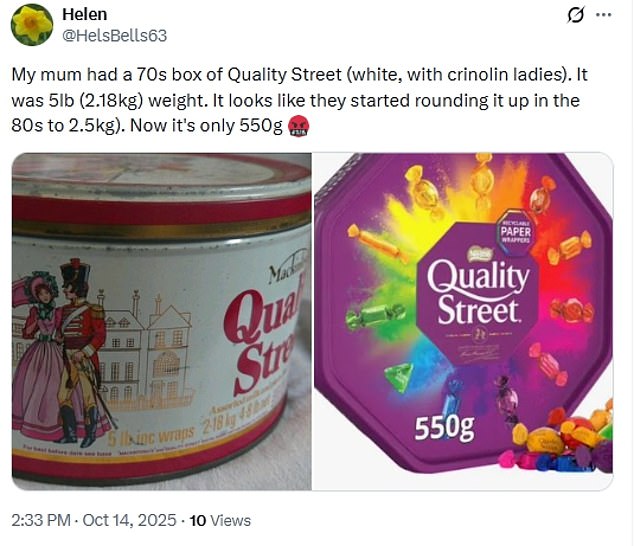
Back in the 1980s the colourful and deep 2.5kg metal tins were packed to the brim with more than 100 sweets that would last for weeks after the festivities were over.
But in keeping with the general feeling of malaise brought about by the cost of living crisis, the Scrooge-like portion of sweets in a sad plastic container has made people yearn for the bursting tins they remember from decades gone by.
The modern-day box is only about a fifth the size of the 2.5kg tin in the 1980s, when they cost about £5, or about £30 in today’s money when accounting for inflation.
Over the decades the size and weight of the box has steadily declined to 1.5kg in the 1990s, 1.35kg in the early 2000s, 1kg by 2010, 780g in 2013 and 650g by 2019.
Old favourites have also disappeared over time, such as the chocolate toffee cup, hazelnut éclair, fig fancy, almond octagon, gooseberry cream and coffee cream.
It comes as manufacturer Nestlé continues to see chocolate prices soar due to a record-high surge in the cost of cocoa beans after poor harvests in West Africa.
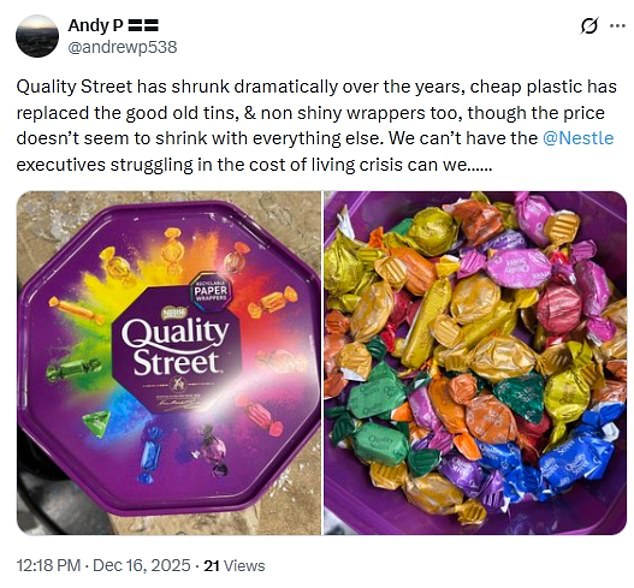
One shopper from Cornwall tweeted: ‘Quality Street has shrunk dramatically over the years, cheap plastic has replaced the good old tins and non-shiny wrappers too.
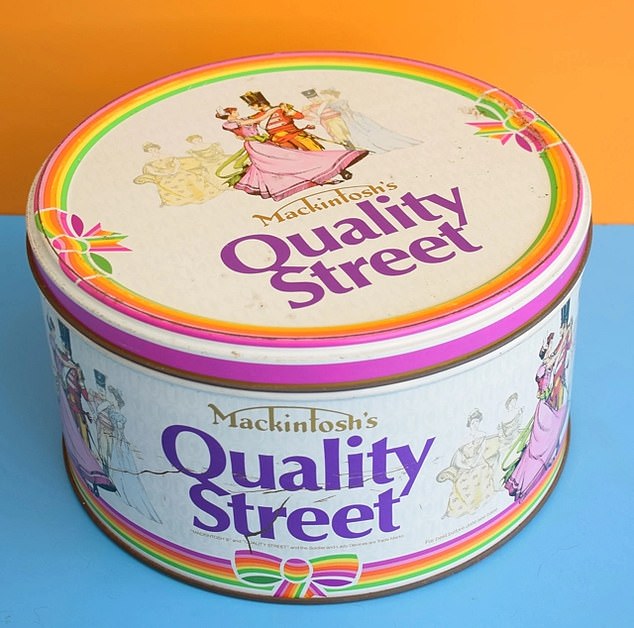
A 2.5kg Quality Street tin cost about £5 in the 1980s, equivalent to about £30 in today’s money
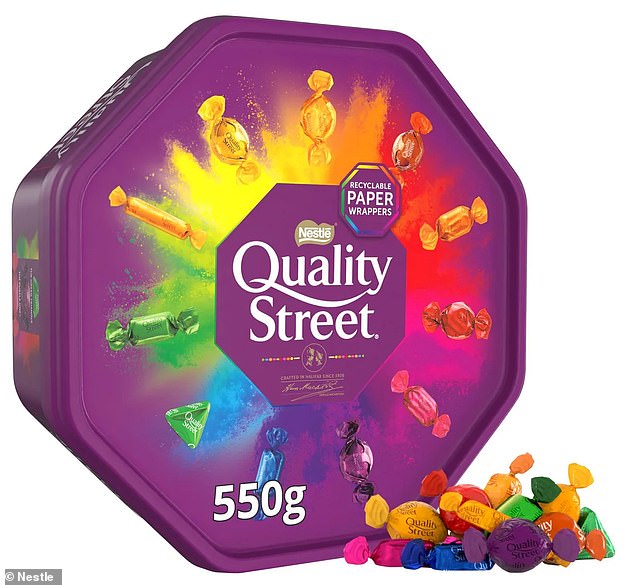
The weight of a Quality Street tub was cut by manufacturer Nestlé to a record low of just 550g this year
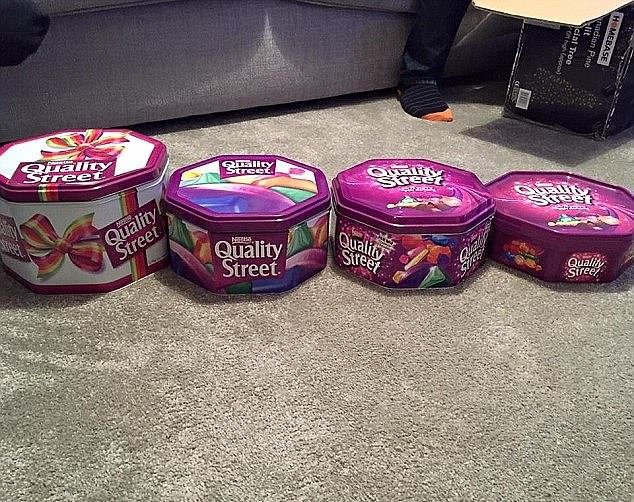
Back in 2015 a consumer posted this photo on Facebook, showing the declining size of Quality Street tins from the 1990s (left), the 2000s (centre left and right) and 2014 (right)
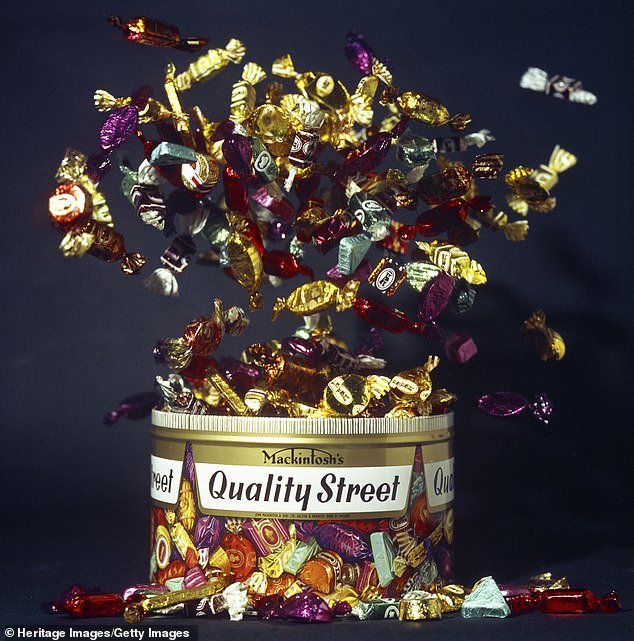
An advert for Mackintosh’s Quality Street in 1972. To create the effect of the chocolates exploding from the tin, a hole was cut in the bottom of the tin and compressed air blown through

Workers at Mackintosh’s factory in Halifax in 1958 sort and wrap Quality Street chocolates

Sainsbury’s prices in 1967 including 0.5lb (225g) of Quality Street for two shillings & sixpence
‘Though the price doesn’t seem to shrink with everything else. We can’t have the Nestle executives struggling in the cost-of-living crisis, can we?’
A second said: ‘Quality Street tubs get smaller every year and the selection is smaller. Lots of favourites have disappeared. And don’t get me started on the dull wrapping.’
And a third replied: ‘Agreed. There’s more tub than sweets these days – and they should drop the word “quality”. The wrappers may be environmentally friendly but selling a few ounces of sweets in a large plastic tub every year most certainly isn’t.’
Another wrote: ‘My mum had a 70s box of Quality Street (white, with crinoline ladies). It was 5lb (2.18kg) weight. It looks like they started rounding it up in the 80s to 2.5kg. Now it’s only 550g.’
Quality Street has long been a stark illustration of shrinkflation, where a company reduces the size or quantity of an item while the price is kept the same or increased.
Reena Sewraz, Which? retail editor, told the Daily Mail: ‘Each year there are three things we can count on at Christmas: the decorations go up earlier, food prices go up, and chocolate tubs get smaller and smaller.
‘The problem with shrinkflation is that when supermarkets and manufacturers quietly give shoppers less for the same price or more, they feel cheated.
‘You can make sure you are getting the best value by checking the price per 100g and comparing with different pack sizes and even different brands.’
The price of a 550g tub currently varies by more than £3 across the big supermarkets – with Morrisons the most expensive at £7.00, and Iceland the cheapest at £3.95.

The tub had weighed 600g between 2024 and 2022, down from 650g between 2021 and 2019.
The 2018 weight was 720g, while it was 750g in 2017 and 2016.
This was a fall from 780g in 2015 to 2013, when plastic tubs replaced metal tins, 820g in 2012 and 1kg in 2011 to 2010 – having dropped from 1.1kg in 2009 to 2008.
Going back further, the weight was 1.2kg in 2006 to 2007 and 1.35kg in the early 2000s, falling from 1.5kg in the 1990s and as much as 2.5kg in the 1980s.
Today the tub costs £7 at Morrisons (or £6 with a More Card), £6 at Sainsbury’s, £4.50 at Tesco, £4.42 at Asda, £4.39 at Lidl, £3.99 at Aldi and £3.95 at Iceland.
While the number of chocolates varies in each box, one family has monitored the total every Christmas since 2006 – and said it has more than halved from 137 to 60.
Popular TikToker Penny Melson said the total was also down from last year’s 67.
She cited a similar total of 68 from their annual count in 2018, after falling from 78 in 2017 and 84 in 2016.
Going back to 2009, their total was 119. In 2008 it was 122; while in 2007 it was 134.
Other TikTok users often post nostalgic videos of old Quality Street tins around this time of year, with one particularly popular clip by @welshvalleyslass last year showing how she could fit four present-day tubs in one from the 1980s.
Separate analysis published in October by The Mail on Sunday found this year’s tub now contains an average of 59 sweets, down from 64 in 2022.
The test showed that, on average, this year’s tubs contained two fewer pink fudge sweets, and one fewer toffee penny, toffee finger and strawberry delight.
The MoS looked at the contents of three tubs of Quality Street to find the average number of each type of sweet – and compared this with figures from 2022.
The spot test revealed the number of pink fudges in a box had dropped from eight to six, toffee fingers and strawberry delights from seven to six, and toffee pennies from six to five.
The first tin of Quality Street was sold in 1936 for two shillings and contained a mix of 18 individually wrapped sweets, including 11 chocolates and seven toffees.
Manufactured in 1936 by Mackintosh’s in Halifax, West Yorkshire, the box was named after a play of the same name by Peter Pan creator JM Barrie.
The first TV advert in 1958 came with the tagline: ‘No one ever says no to Mackintosh’s Quality Street’, with an image of two women kissing a man as he held a box. The advert also shows there were still 18 chocolates in the box at that stage.
A Nestle spokesman told the Daily Mail: ‘Each year we introduce a new Quality Street range with formats, sizes, weights and RRPs based on a range of factors including the cost of manufacturing, ingredients and transport and customer preferences.
‘We think our 2025 range and pricing is competitive.’
Last week, data from Worldpanel by Numerator found average chocolate prices at supermarkets are now up 18.4 per cent on the same time last year.
Researchers added that overall annual grocery price inflation across 75,000 products at all stores stood at 4.7 per cent for the four weeks to November 30.