Writing on the build up of French naval forces under Napoleon III, the historian William Echard wrote that it betrayed the Emperor of the French’s preference for “grandeur without cost and predominance without effort”. The same could be said of our current defence strategy, were it not for the lack of grandeur or predominance.
In these most august pages, many of our writers have wrestled with what Britain should do now Trump has exposed Europe’s reliance on American defence to be the monumentally absent-minded, complacent and dangerous choice it always was. Beyond Zack Polanski’s Alexander Dugin-esue desire for a Global South NATO, there has been little similarly serious contention of what British foreign policy should be from our political elites — or how we are to conjure the materiel necessary to make our leader’s pronouncements on geopolitics anything more than the air that carries them.
We shouldn’t have expected any more. The anguished mewling of our leaders owes more to their helplessness, their inability to do anything about it, than any reckoning with the responsibilities of power or statecraft. There is a reason the European nations who are so dedicated to Ukraine are called the Coalition of the Willing, not the Coalition of the Able.
But we are where we are, and the first step to any destination is a honest reckoning with your starting point; Britain can no longer afford to be a tri-service power. This is not going to change anytime soon, because we are unprepared for the massive economic changes required to make Britain a state capable of sustaining serious war-fighting capacity. Successive defence reviews have spread too meagre defence spending too thinly trying to counter every possible threat, and as a result almost all our defence capabilities are hollowed out.
None of our European allies are willing to bear the cost of being a tri-service power either, and not are they prepared for the massive economic changes required to make their state capable of sustaining serious war-fighting capacity. They, as we, need to work towards defensive self-reliance whilst balancing competing demands for spending. The logical destination for European defence, therefore, is deeper specialisation (if not integration) among European states.
Since we lack the resources to modernise all three services at once, prioritisation is unavoidable. Strategy must follow means. Britain should align its defence spending with its core national interests and concentrate it where it yields maximum strategic advantage.
Our eyes must then turn to the sea.
This is not a chance for some le epic WAR WITH FRANCE tweets, ludicrous longing for the Two-Power standard nor weepy-eyed nostalgia for the days of Nelson and Cochrane when boats were made of wood and men were made of steel. The age of heroes is long gone.
Rather it’s a recognition that British and European national interests lie in secure trade routes, dominance of the immediate maritime sphere and the ability to control the chokepoints and sea lanes on which our prosperity and security depend. The stability and prosperity of modern European trading nations rests on seaborne trade. Maritime power is therefore a requirement, not a luxury.
But rather than purely naval, British strategy should be maritime — which would represent a reversion to the historical norm. Throughout the Pax Britannica, British soldiers were few but indispensable: they secured key dockyards and ports at home and across the empire. Their ability to be “a projectile fired by the Royal Navy” allowed for control of vital points like Gibraltar, the Baltic Narrows and the Scheldt.
As Ben Barry has outlined in great depth, the Army is vastly diminished, but would be more than capable of this more limited, defined role. Indeed, there is a strategic virtue in keeping it small: a larger land force Large standing armies generate their own political gravity, creating pressure for deployment and the threat it might, in David Jones’s phrase, “net us into expeditionary war.”There is another argument against prioritising the Army for defence spending; whilstoever human rights laws are used to pursue British soldiers for doing their duty, we have a literal duty of care not to put them in lawyer’s sights. Meanwhile the RAF, probably the most powerful air forces in Europe (damning with faint praise), is more than capable of establishing air dominance in most theatres Europeans would need to protect power into.
If Britain is to focus its limited resources wisely, both must be oriented around the Royal Navy; projecting power through the seas, using soldiers and aircraft to secure key points and enable naval operations, rather than trying to be everything to everyone. In short, the Navy is our lever; everything else should be built to amplify it.
The Royal Navy is arguably in as dire a state as the Army. It is now struggling to carry out many of the routine tasks it handled with ease until recently. This decline is not the product of battlefield losses or operational overreach, but of years of chronic mismanagement. Things are likely to get worse before they get better; Russia is in the midst of a naval modernisation drive that will make the submarine threat in the Euro-Atlantic the most serious since the end of the Cold War. The People’s Republic of China is rapidly expanding its fleet and its ability to project power far beyond the Indo-Pacific. Meanwhile, disruption by non-state actors — as Houthi attacks in the Red Sea have shown — is proliferating, putting global shipping and energy flows at risk
First we must state clearly what the new Maritime strategy is aimed towards; to lead sea control efforts in the Euro-Atlantic, protecting European maritime lifelines and securing NATO’s northern flank — aded to this should be potential for a role in securing the Arctic. At the same time, it should contribute to sea denial in the Indo-Pacific, helping to deter China from using force to establish regional dominance.
Both missions are realistic for a serious maritime power. What is not realistic is pretending they can be achieved with today’s force levels and readiness.
The nuclear deterrent is being sustained, but only by pushing ageing Vanguard-class submarines and their crews to extremes. Patrols are now regularly stretching to six months or more because replacements were delayed. The attack submarine force is nominally five boats strong, yet at times only one is operational, with the rest in maintenance or lay-up thanks to lost industrial skills, spares shortages and weak support infrastructure.
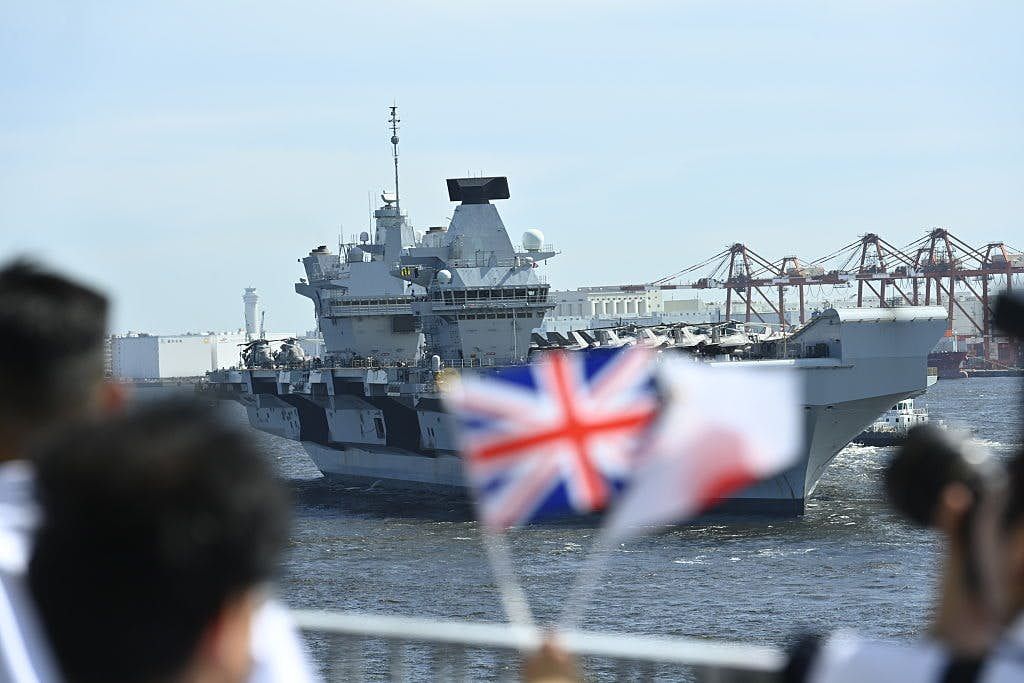
The carriers are a similar story. Although in materially decent shape jet availability is sporadic, key weapons are still being integrated, and the Crowsnest airborne early warning solution has been troubled. Besides, carriers without groups are sitting targets, and the escort force is a particular weak point. Only seven ageing Type 23 frigates remain, typically with just a handful at high readiness. Their Type 26 and Type 31 successors are coming, but years late. Of six Type 45 destroyers, only a couple are available at any one time due to well-known propulsion flaws and lengthy refits. Upgrades will help, yet replacement plans in the 2030s already look optimistic given industrial limits.
Amphibious capability does not exist.
Amphibious capability does not exist. This is due to crew shortages in both the Royal Navy and Royal Fleet Auxiliary. Seabed warfare — vital in an era of vulnerable cables and pipelines — currently rests on a single adapted vessel. Support shipping, the unglamorous backbone of seapower, is under acute strain. Tankers and solid support ships are laid up for lack of crews, not lack of hulls. Years of uncompetitive pay and conditions have drained both the Royal Navy and RFA of skilled mariners.
Thankfully there is a healthy build programme, but this is only addressing the chronic shortage of hulls. The Royal Navy needs a sweeping reform of procurement and well as recruitment and retention, as well as a vast improvement in on-shore facilities. Putting more hulls in the water would be little more than juicing the numbers with a few soon-to-be-rusting hulks.
William Freer and Emma Salisbury have provided a handy list of improvements. More F-35Bs, serious drone integration, and stronger defences would improve carrier capability. to address the escort problem, existing ships should be upgunned, the practice of building vessels “for but not with” weapons ended, the programme to build a larger and more capable Type 45 replacement accelerated. The submarine force should be de-risked by accelerating Dreadnought build times. A new batch of Offshore Patrol Vessels should take on constabulary roles, freeing high-end ships. Amphibious capability must be restored with a replacement for the retired Albion and Bulwark, as well as the ageing Mounts Bay. Autonomous systems should be developed to automate mine warfare, and seabed warfare should be expanded with additional surveillance vessels building on the Proteus model.
There are, of course, problems. Britain still can still rule the waves, but only where China and America aren’t sailing. Greater European defence integration is a great idea, but so far fellow European allies have shown themselves deeply unserious about greater British involvement in security, using our determination to lead on defence as a bargaining chip in wider negotiations. Allowing fish to get in the way of collective self-defence is not the action of a serious partner. Given there size, there is little we can do about the former. As for the latter, developing the Royal Navy does not necessitate a reliance on partners.
“The truth”, as Jérémie Gallon notes in his recent portrait of Kissinger, “is that our foreign policy has become amoral through its own tragic impotence.” As their marginalisation during the Ukrainian peace negotiations has shown, Europeans are no longer even participants in resolving crises on their own doorstep — crises that directly threaten the stability of their nations. Thankfully, as during the Pax Britannica, Britain can secure stability without overextending itself with maritime power, selective commitments, and disciplined spending.
Unfortunately, like Napoleon III, we cannot have predominance without effort, nor grandeur without cost; but with clear priorities and a maritime focus, we can still exercise decisive influence where it matters most.