The nationalists in charge of Belfast don’t feel constrained by the qualms of unionists or Jews
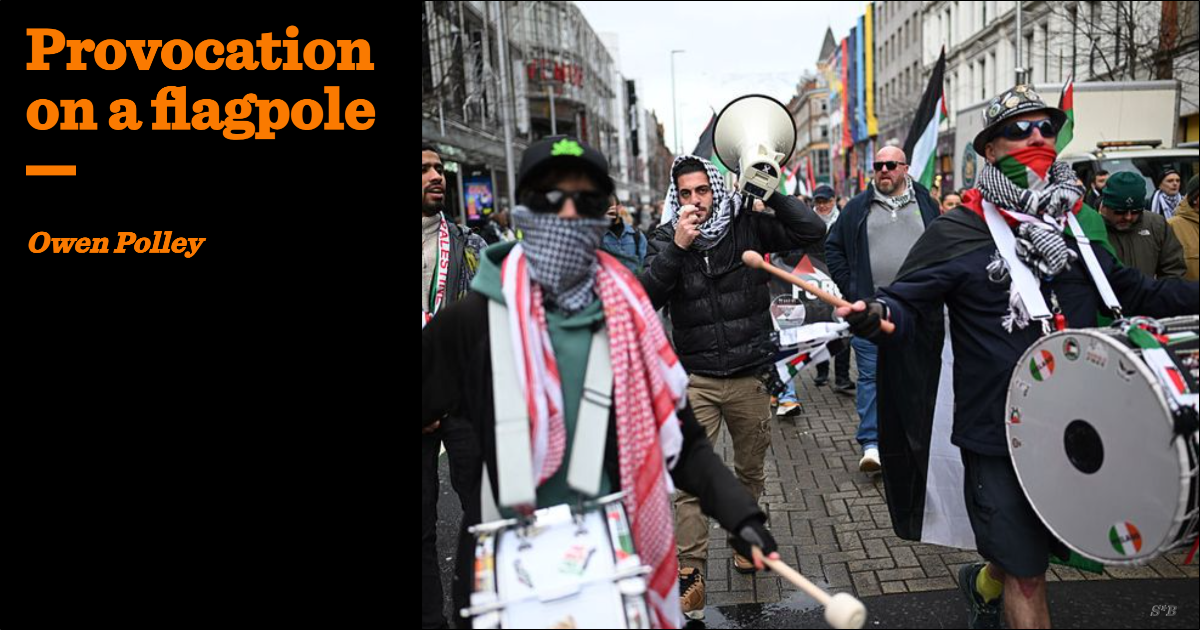
Last Tuesday, in Belfast, there were skirmishes in front of the City Hall and a heavy police presence, as republican youths goaded unionists and pro-Israel protesters. Shoppers and revellers at the Christmas market, which takes place on the city hall’s grounds, looked on, as PSNI officers struggled to keep the two sides apart. This festive chaos was brought to Belfast by Sinn Fein, which, alongside other nationalists and left-wingers, voted on Monday evening to fly a Palestinian flag from the building, and decided that it must be erected in the dead of night.
During the Troubles in Northern Ireland, flags and emblems were often blamed for inflaming passions or even sparking violence. In more recent times, British symbols have been increasingly banished from public view, to satisfy Irish republican demands for “neutrality” or “parity of esteem”. When loyalists reacted to the removal of UK flags with anger, nationalists enjoyed mocking their supposed obsession with “flegs”, exaggerating a thick Belfast accent, and implying that they were above such crass preoccupations.
Given this background, the City Council’s decision to fly the Palestinian banner was as ironic as it was incendiary. To add a further layer of irony, it was the ever-sanctimonious Alliance Party whose prevarication played a key role in ensuring that the emblem was displayed on one of Northern Ireland’s most prominent buildings. This is a party that, previously at least, claimed to be committed to bringing people together and opposing violence. Now, it has enabled nationalists to flaunt a symbol linked inextricably to anti-semitism and terror, as a way of antagonising their neighbours.
And make no mistake, the flying of the flag, at the behest of Sinn Fein, was a deliberately provocative act. It was intended to show that nationalists are now firmly in charge of Belfast and will not be constrained by the qualms of unionists or Jews.
The City Hall has a long history of disputes about symbols. In 2012, the Union Flag, which previously flew all year round, was removed, to be displayed subsequently only on a small number of designated days. This policy, instigated by Alliance, caused some of the most heated street protests since the Troubles. The decision was regarded by loyalists as another attempt to strip Northern Ireland of its British identity. Alliance, whose representatives viewed national emblems as divisive, claimed the flag’s removal created a more neutral, welcoming space.
That veneer of inclusivity had already frayed, thanks to the council’s policy of imposing Irish language signs in streets across Belfast, including areas where they are opposed by most residents. This week it was ripped away entirely. The council initially voted to display the flag to mark the “International Day of Solidarity with the Palestinian People”, on 29 November. The motion was proposed by Sinn Fein and the symbol’s erection was supported by nationalists, the Greens and the Alliance Party. However, a unionist legal challenge, based on equality safeguards and the council’s own standing orders, prevented the flag from flying.
On Monday evening, nationalist councillors convened an “emergency” meeting, at which they again voted to fly the flag, albeit by a tighter margin. To provide a rationale, the council’s solicitor claimed that the symbol’s display no longer risked stirring community sensitivities. Although the flag’s erection was opposed by Belfast’s small Jewish community, an expression of support had been secured from the group “Jews for Palestine”. This flimsy pretence was enough for councillors to bludgeon through the motion and ignore any legal objections.
Irish nationalists have repeatedly drawn parallels between their own aspirations to destroy Northern Ireland and Palestinians’ goal of wiping Israel from the map
The flag was duly erected at midnight, in front of a small crowd of cheering republicans. The unseemly haste was to avoid the outcome of a new legal challenge, which contended that the new vote had relied upon a blatant abuse of process. The result of that case is likely to be pronounced next year.
On this occasion, Alliance at least voted against the proposal, suggesting that, as an alternative, the City Hall should be lit up in Palestinian colours on a date in January. The party has refused, so far, to explain properly why it changed its position. The damage, however, was already done. Nationalists could argue that there was cross-community consent for their motion, or, at least, that it had had the backing of non-aligned “progressives”, thanks to Alliance’s previous support. The erection of the flag could be portrayed as a humanitarian gesture, rather than a crass sectarian provocation.
This, like councillors’ hysterical references to “genocide”, was a transparent ruse. Irish nationalists have repeatedly drawn parallels between their own aspirations to destroy Northern Ireland and Palestinians’ goal of wiping Israel from the map. They have not bothered to disguise the fact that they feel more empathy with Arab terrorists than the Israeli citizens targeted by their attacks.
When Hamas thugs swarmed into Israel on 7 October 2023, the reaction from Irish republicans was immediate and visceral. As the extent of the savagery was emerging, the People Before Profit MLA, Gerry Carroll, tweeted “Victory to the Palestinian resistance”. Just hours after the slaughter, an Irish language school in west Belfast issued a social media post showing its pupils posing with Palestine flags. In Dublin, the Republic’s then Taoiseach, Leo Varadkar, issued a cursory condemnation of the attacks, before lecturing Israel about the need to show “restraint”.
Indeed, as Belfast City council voted to display the Palestinian flag, officials in Dublin were forced to perform a technical manoeuvre, to avoid councillors stripping the name of the former Israeli president, Chaim Herzog, from a local park. The likelihood of a fresh international outcry about Irish anti-semitism had persuaded government ministers that they should speak out against the measure.
These incidents remind us that nationalists certainly did not turn against Israel because of its disproportionate actions in Gaza, as they now like to claim. That was always just another lie. Even moderate, mainstream politicians in Dublin could offer only qualified, guarded messages of sympathy for Jewish victims. Many of Irish nationalism’s most vocal representatives reacted to the 7 October atrocities by expressing open solidarity with the perpetrators or slyly celebrating their butchery. Their current protests against Israeli “brutality” are transparently just further excuses to spew this hatred.