Autocrats vs. Democrats: China, Russia, America, and the New Global Disorder
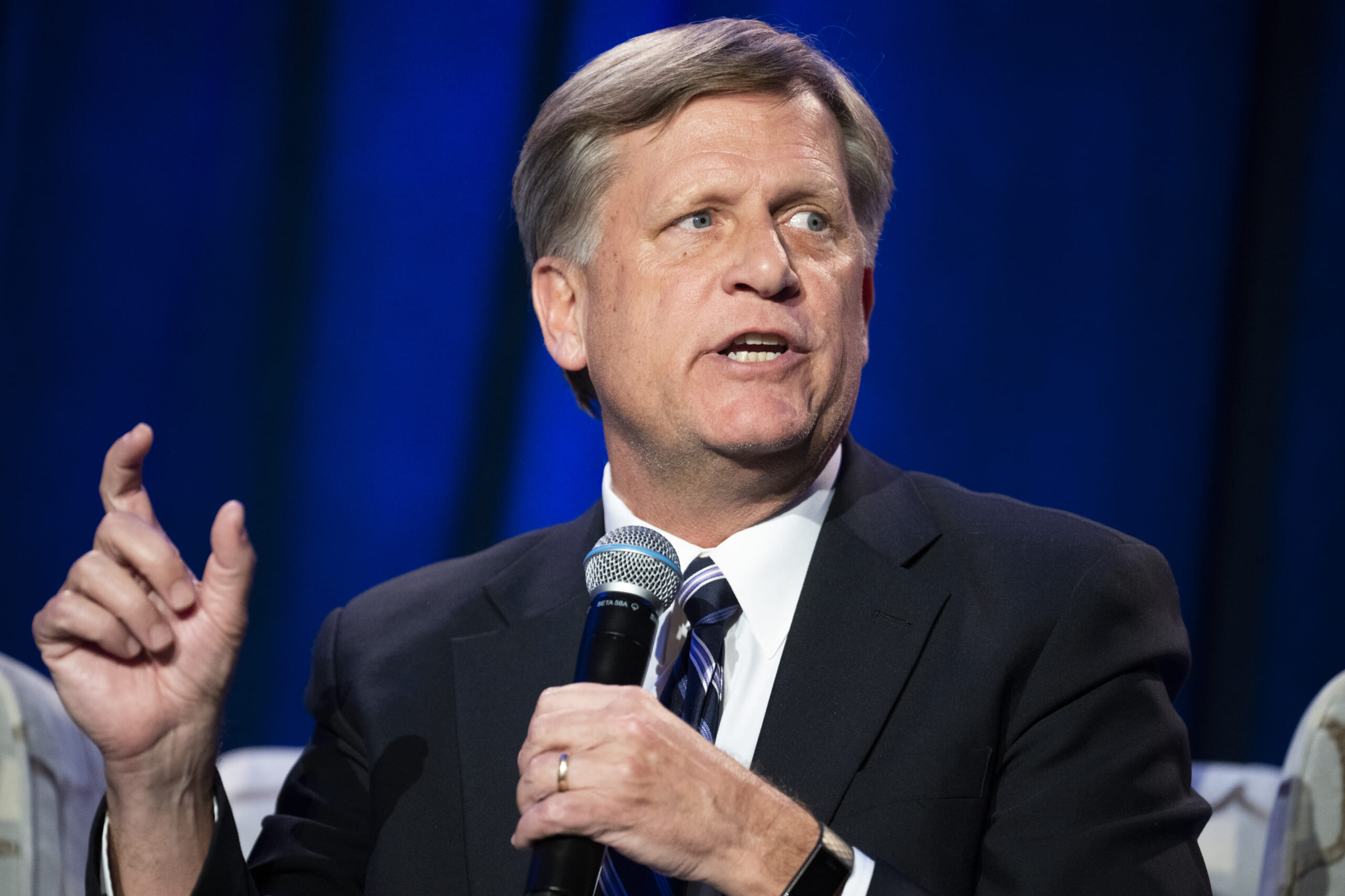
by Michael McFaul
Mariner Books, 544 pp.
Speaking at the 45th Munich Conference on Security Policy on February 7, 2009, Vice President Joe Biden said:
The last few years have seen a dangerous drift in relations between Russia and the members of our Alliance. It is time—to paraphrase President Obama—it’s time to press the reset button and to revisit the many areas where we can and should be working together with Russia.
The following month, on March 29, in Geneva, Switzerland, Secretary of State Hillary Clinton met with Russian foreign minister Sergey Lavrov. To symbolically promote the “press the reset button” approach touted by Biden, she presented Lavrov with an actual red button that had the word “reset” written on it in both English and Russian. Unfortunately, someone failed to translate “reset” into the accurate Russian “perezagruzka,” instead mistranslating it as “peregruzka,” a word that carries the meanings of “overcharge” and “overload.”
That someone was Michael McFaul. To be charitable to McFaul, who served as U.S. National Security Council (NSC) director for Russian and Eurasian Affairs and later U.S. Ambassador to Russia under Obama, he was not a translator. The Clinton team should have refrained from such a silly PR stunt in the first place; the red button evoked the apocryphal “nuclear strike button” in Lavrov’s mind. But they should have at least processed the translation through official State Department translators instead of having a staffer run it by McFaul on the fly. The historian Mark Ajita analyzed McFaul’s “bad Russian” and concluded that anyone not familiar with the Russian information technology space (where “reset” entered the language as slang) could have made the same mistake. If anything, McFaul did the best he could despite institutional failure.
McFaul’s latest book, Autocrats vs. Democrats: China, Russia, America, and the New Global Disorder, can be thought of as another failed effort to reset things. This time, he’s out to reset Washington DC’s imperial propaganda so that his unwitting audience can, in the words of Retired U.S. Army Col. Douglas Macgregor, “live permanently in the afterglow of World War 2.” After more than 30 years of post–Cold War geopolitical disaster, McFaul has valiantly attempted to relegitimize what he calls “the liberal international economic order.”
As with the reset button, or the actual reset policy he helped craft, McFaul is doing the best he can despite inimical circumstances. His new book fails to reset the propaganda. It merely overloads readers with the glittering generalities of a dying mythology. And at $35 in this late imperial economy, one might feel it overcharges as well.
The narrative of democracies versus autocracies was popularized by President Joe Biden. In February 2021, when Biden addressed the Virtual Munich Security Conference, he said:
We’re at an inflection point between those who argue that, given all the challenges we face—from the fourth industrial revolution to a global pandemic—that autocracy is the best way forward, they argue, and those who understand that democracy is essential—essential to meeting those challenges.
Biden vowed to make the United States the “arsenal of democracy” and consistently portrayed U.S. arming of Ukraine, Israel, and Taiwan as crucial to the survival of democracy on the world stage.
McFaul has taken up this narrative with alacrity. The Cold War might be over and the Global War on Terror (GWOT) might have jumped the shark, but we have a new metanarrative to justify DC’s global empire: autocrats vs. democrats.
Despite the book’s title, McFaul never bothers to offer definitions of democracy or autocracy. A charitable reading would attribute these omissions to a noble desire to connect with a popular audience; an audience that would be driven away by a journey through the vast academic discourse on competing visions and incarnations of democracy. And besides, McFaul’s understanding of democracy is implicitly present, and its definition can be reverse-engineered by anyone who wants a deeper engagement with the book.
For example, McFaul classifies America as a democracy and Russia and China as autocracies. So, he can’t be using a minimalist electoral democracy model. Russia’s President Vladimir Putin was elected and enjoys popular support. If he aspires to hold that office for life, well then, who does he think he is, Franklin Delano Roosevelt? China’s President Xi Jinping was also elected. Only the almost 3,000 members of China’s National People’s Congress got to vote, but still.
McFaul praises “liberalism” throughout the book and juxtaposes it with Russian “conservatism” and Chinese “Communist Party Dictatorship,” so it is fair to say he’s talking about liberal democracy, perhaps in one of the styles of “polyarchy” elaborated by Robert A. Dahl.
And while McFaul identifies as a “small-d democrat” and dedicates his book to “all the small-d democrats around the world fighting for democracy where it does not exist, or defending democracy where it is under assault, especially in Ukraine,” he is also a big-d Democrat, i.e, a partisan of America’s Democratic Party. If 99 percent of the American electorate voted to ban abortion, gay marriage, and same-sex parent adoption, McFaul would claim democracy was under attack. Therefore, he must support a benevolently guided democracy.
The charitable reading, however, is unadvisable here. McFaul ran Stanford University’s censorship regime out of its Cyber Policy Center, an integral part of DC’s global “censorship industrial complex.” And while he acknowledges that “some fault the United States for starting this second Cold War” with Russia, he never references Libertarian Institute director Scott Horton’s Provoked: How Washington Started The New Cold War with Russia and the Catastrophe in Ukraine. Currently the number two bestselling “War & Peace” book on Amazon, Provoked has become the standard anti-establishment account of DC’s relationship with Russia. To be fair, one cannot read everything. Perhaps someone can get McFaul a copy so that he can engage with Horton’s work in the second edition of Autocrats vs. Democrats. He can read all about himself, working to overthrow democracies in the name of saving democracy.
McFaul is a professor of International Studies at Stanford, but his failure to define contested terms like “democracy” should not surprise us. Within our postmodern philosophical epoch, and especially within our state-adjacent establishment academy, defining key terms risks trapping oneself within the strictures of honest rationality and candid presentation. As the post-realist philosopher Hilary Lawson put it in his 2001 book Closure:
The avoidance of the presentation of a theory, be it in the form of contradictory assertions, in the manner of [Friedrich] Nietzsche, the successive employment of alternative descriptions each of which undermines itself, as with [Jacques] Derrida, or the simple absence of any general philosophical claims at all, as with [Ludwig] Wittgenstein, would appear therefore either to be in bad faith – a smokescreen for an underlying theory which is implicit but unsaid – or we have no apparent means of determining what to do with the text and what meaning to assign it. (Emphasis Added)
McFaul’s book operates with an underlying theory which is implicit but unsaid: Democracy means the people either 1) vote for the appropriate state policy directly or 2) vote for the people who will pursue the appropriate state policy. The appropriate state policy is global domination with left-liberal characteristics. The people are sovereign, as long as they never vote to ban gay marriage or to elect representatives who will ban gay marriage. Democracy is a comforting abstraction, a goddess that legitimizes state power in the hands of the right people, which means people like McFaul.
If McFaul presented a definition of democracy, we could apply that definition to the United States and possibly discover inherent paradoxes within our polity. Cynical commentators might even conclude that Russia is merely an illiberal democracy and the United States is a liberal autocracy. Drag queens freely roam the halls of state-run elementary schools while Edward Snowden lives as a political enemy of the state and Julian Assange spent years in solitary confinement.
To avoid such a potentially fatal encounter with reason, McFaul simply never defines democracy. It’s a move that Derrida, who never defined the term “phallogocentrism” (a word he invented), would appreciate. And because “democracy” is a word in wide usage, it carries what Dahl called “a large freight of ambiguity and surplus meaning.” Most readers probably fill the term with fragments of meaning and never realize the sleight of hand at work.
Putting that aside, McFaul’s entire framing of autocracies vs. democracies is strange because the United States is allied with states that McFaul himself regards as autocracies. Qatar is a representative example. Freedom House, which McFaul characterizes as part of the “democracy promotion” ecosystem and Horton identifies as a locus of “professional regime changers” classifies Qatar as “not free” and reports:
Qatar’s hereditary emir holds all executive and legislative authority, and ultimately controls the judiciary as well. Political parties are not permitted, and the only elections are for an advisory municipal council.
While both Qatar and Russia ban gay marriage, in Qatar, same-sex sexual activity is criminalized, punishable by torture, imprisonment, and death. But Qatar is also nice enough to host the massive Al Udeid Air Base in the desert south of Doha. This base serves as the forward headquarters of the U.S. Air Force Central Command.
In early February 2022, weeks before Russia’s “full-scale invasion” of Ukraine, the Biden administration classified Qatar as a Major Non-NATO Ally (MNNA). According to foreign policy analyst Daniel Larison:
The new status involves no U.S. defense obligations to Qatar, but it facilitates closer security cooperation and gives them greater access to U.S. weapons, research, and technology than other clients.
The second Trump administration upgraded Saudi Arabia to MNNA status in November 2025. The George W. Bush administration granted MNNA status to Bahrain and Kuwait during the early years of the GWOT. By McFaul’s account, these are all autocracies.
Jeanne Kirkpatrick was known for the “Kirkpatrick Doctrine,” which held
that the US government should embrace any autocrat who aligned with Washington’s anti-communist agenda while working to undermine, sanction, or topple any left-wing leader who refused to “play ball,” even if they were democratically elected (and popular).
Subscribe Today
Get daily emails in your inbox
The “McFaul Doctrine” has the U.S. align with autocracies to fight the autocracies and stop the spread of autocracy. That sounds slightly insane until we qualify things by distinguishing between autocracies that are willing to “play ball” with the U.S. and those that are not. McFaul gives the game away when he writes, “For me, in the 1990s and early 2000s, the more important question was whether Russia would consolidate democracy and remain inside our tent.”
Consolidating democracy (whatever that means) is not of primary concern. Being inside the U.S.-dominated global tent is of paramount importance. Russia and China refuse to bend the knee. That is their crime against democracy.
If the state can be understood as meta-parental authority, then Autocrats vs. Democrats is a 500+ page bedtime story for the children. It could have been called Bad Guys vs. Good Guys. On the bright side, while McFaul is not a realist, at least he isn’t a neoconservative. He does a good job of conjuring up the imperial apparatus (from his perspective) without the unhinged rhetoric of the Israel First empire builders. The book won’t convince anyone to join the military, but it might soothe the moral injury of those in power who are scheming to send the nation’s children off to the next catastrophic war.