- Blood, Sweat and Asparagus Spears by Andrew Turvil (Elliott & Thompson £20, 272pp) is available now from the Mail Bookshop
If you thought that the last battle between Britain and France took place at Waterloo in 1815, Andrew Turvil’s mouthwatering new book would beg to differ. It seems an even more fiery frontier opened up in the 1990s across the stoves, fridges and plates of Britain’s best restaurants.
Formerly editor of the Good Food Guide, there are few better placed than Andrew Turvil to adjudicate this struggle. Each chapter focuses on an era-defining restaurant, so it is a whistlestop tour through the eateries that changed Britain, and how we evolved from a nation whose best dishes were French to one that began to find its feet with traditional British food.
Laying the foundation for what Turvil sees as a revolution are the likes of Raymond Blanc at Le Manoir aux Quat’Saisons, in which both Marco Pierre White and Heston Blumenthal, right, trained, and Le Gavroche, opened by Michel and Albert Roux, which also housed Marco.
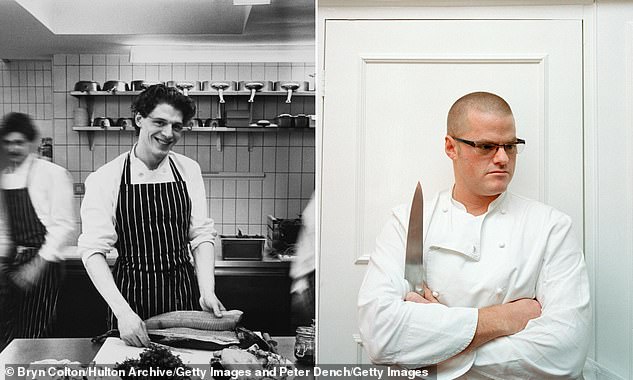
Battle of the best: Marco Pierre White and Heston Blumenthal both strove for perfection in their cooking
Understandably, with his quick temper, skilled hands and eye for detail, Pierre White became a god among chefs in the Nineties. His restaurant Harveys, which became a battleground in its own right when the great and the good of London were trying to get a table, earned a Michelin star within a year of opening. By the age of 33, Pierre White was the youngest chef to be awarded three stars, and the first British chef to ever do it. Happily, he would not also be the last.
However, while the French may have made dining fashionable again, it’s Brits such as Blumenthal and Fergus Henderson who made it cool.
With Henderson’s whitewash-walled, industrial St John came ‘nose-to-tail’ eating. The menu littered with ‘warm pig’s head, jellied tripe, deep-fried lamb’s brains and blood cakes’. It is not food for the faint-hearted.
Charles Fontaine, previously head chef of Farringdon’s Quality Chop House, also reinvented the meat-and-two-veg way of eating to which our country had become accustomed.
But it was Blumenthal who really rejected the traditionalism of France. We know about his triple-cooked chips and his hidden orange Christmas pudding (a staple of my mother’s festive larder) but the way he pushed food to its limit was truly impressive.
Having only spent one week at Le Manoir and a few more at Pierre White’s Canteen, he stayed away from kitchens and honed his skills to a scientific precision. His goal? To create that which was truly optimal. Although for some, his food was a little too experimental.
Turvil is adept at joining the dots between the training Pierre White received from Blanc and the Roux brothers, how that influenced his mentorship of Gordon Ramsay, and in turn how that moulded the public’s understanding of professional kitchens as places of anger, masculinity and noise… lots of noise.
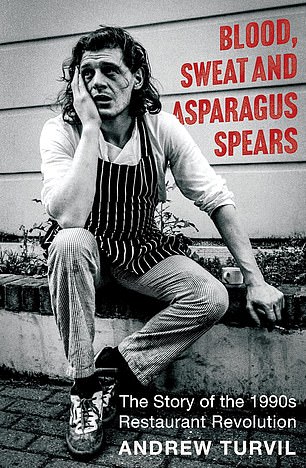
Blood, Sweat and Asparagus Spears is available now from the Mail Bookshop
Turvil is good not to focus on just ‘franglais’ food. He charts the rise of Wagamama, Madhur Jaffrey and the curry house, as well as Spaghetti House. He examines how McDonald’s stormed the capital and cemented its golden arches in our hearts.
He also impresses upon us the importance of two women in Hammersmith who turned a workman’s canteen into one of London’s best loved Italian restaurants. If you happen to find yourself in the area, you will never regret a piece of The River Cafe’s nemesis cake: rich, chocolatey, perfection.
Turvil has compiled a fascinating foray into our country’s restaurants and shown that while we might be a small nation, we have always had a huge appetite.